

The Citation Lottery: We Pulled the Same 20 AI Overviews Three Times in One Hour. Three Rewrote Their Sources.
On the afternoon of July 24, 2026 I pulled the same 20 Google AI Overviews three times inside one hour, from the same browser, and recorded every cited source on every pull. 17 of the 20 kept an identical citation list all three times. The other three quietly rewrote themselves: across the three pulls they cited 41 different URLs between them, and only 14 of those appeared every time. If your page is cited on one of the stable queries, that citation is solid. If it is cited on one of the re-rollers, whether a given searcher ever sees your name is a lottery. This post publishes the full pull-by-pull data.
What I did
The test is deliberately boring: run the identical search three times and see what changes. The 20 queries are core blogging searches, a mix of how-to, question, and commercial best-of intent, all of which reliably trigger an AI Overview. Each pull loaded the live search page, expanded the AI Overview, and recorded every cited source URL. Pull one started at 12:45 UTC, pull two about 20 minutes later, pull three about 30 minutes after that. Same signed-in Chrome profile, same US location settings, no clearing of cookies between pulls, because the point is to see what one ordinary searcher would see on a repeat search.
An AI Overview appeared on all 60 pulls, so this dataset says nothing about AIOs vanishing. It measures one thing: with the answer box present every time, how stable is the list of sources behind it?
Finding 1: most AI Overviews are frozen solid
17 of 20 queries returned exactly the same set of cited sources on every pull. Not roughly the same. The same, down to the URL, including big citation lists like the 19 sources behind “best ai writing tools” and the 16 behind “how to monetize a blog.” All six commercial best-of queries in the sample were in this frozen group.
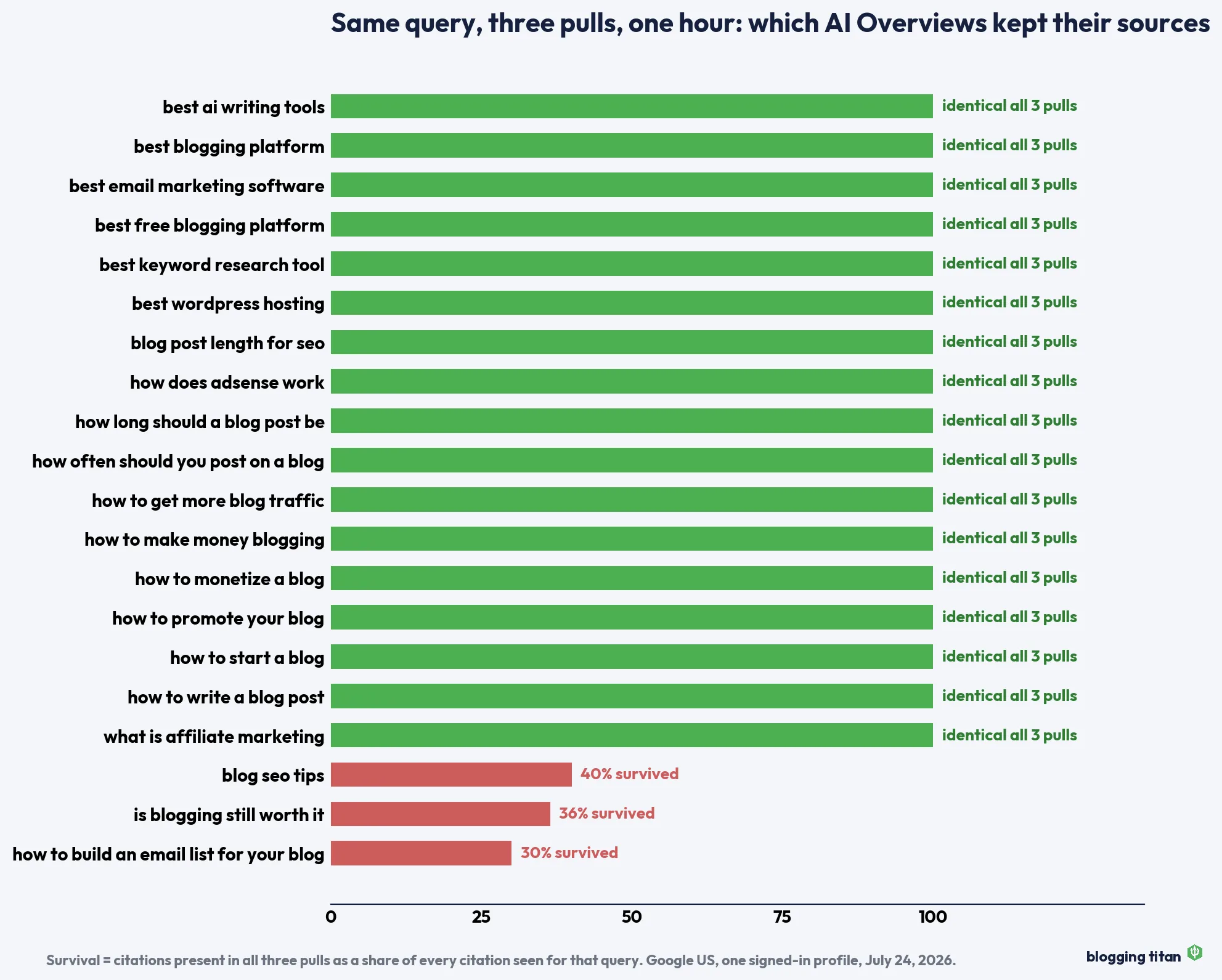
That stability is consistent with heavy caching: Google appears to generate an AI Overview for a query, then serve the same generation to repeat searches for some period. For anyone doing generative engine optimization, this cuts both ways. A citation you hold is stickier than most people assume. A citation you lack is equally sticky, and no amount of refreshing will show you a different answer today.
Finding 2: when an AI Overview re-rolls, it re-rolls hard
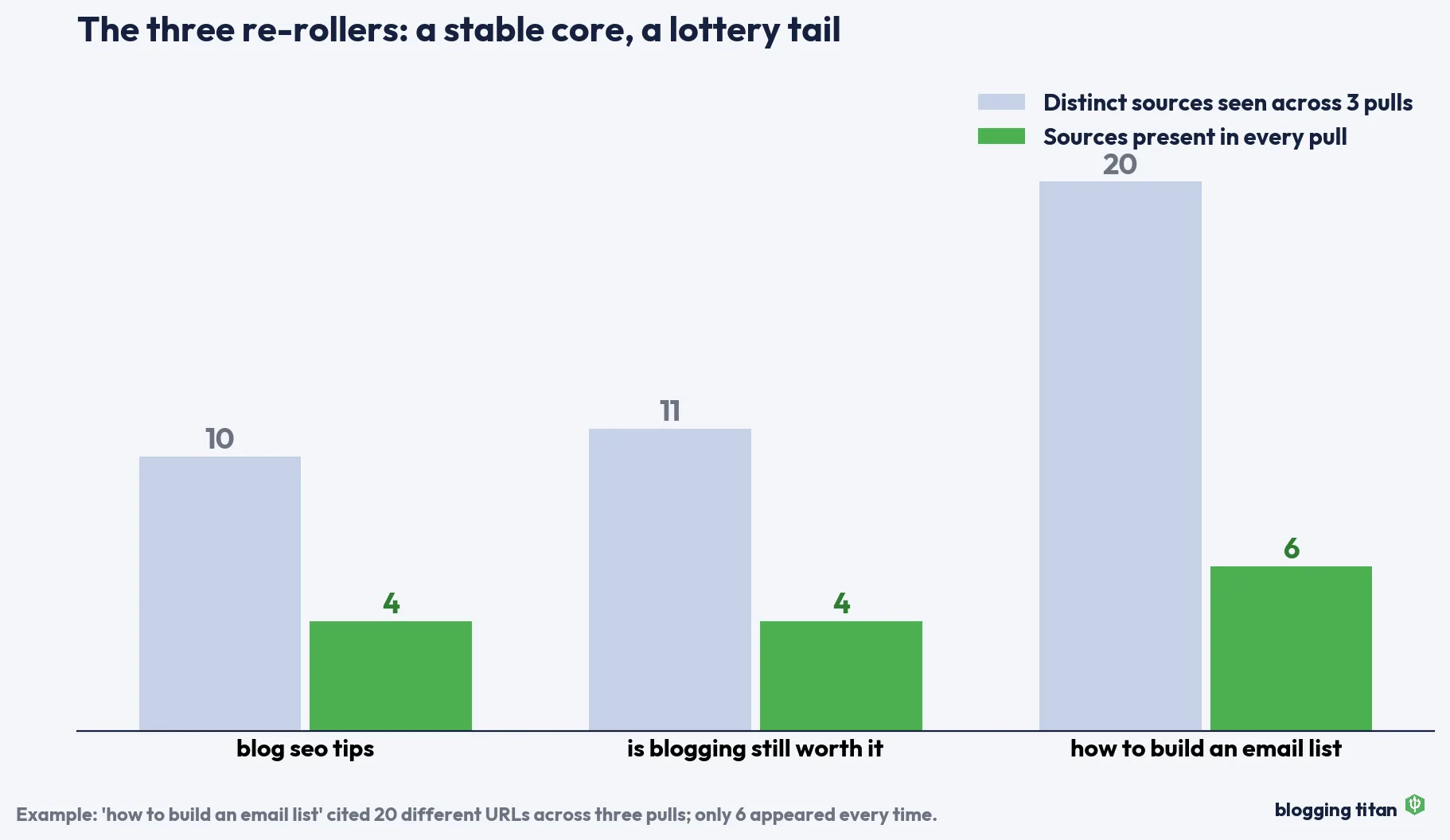
The other three queries behaved like a different product. “How to build an email list for your blog” cited 10 sources on pull one, 15 on pull two, and 12 on pull three, using 20 distinct URLs across the hour, of which only 6 appeared every time. “Is blogging still worth it” used 11 distinct URLs with 4 ever-present. “Blog seo tips” went from 7 sources to 10 to 5, keeping 4 throughout. Survival rates of 30 to 40 percent, on searches repeated within the hour.
The flicker is the striking part. Wix’s article on whether blogging is worth it was cited on pulls one and three but missing on pull two. Reddit was a citation for the email list query on pull two only. Backlinko and Quora backed “blog seo tips” on the first two pulls and were gone on the third. None of these pages changed in the intervening minutes; the answer engine simply assembled a different supporting cast for the same script.
Finding 3: even the re-rollers have a protected core
No query ever re-rolled completely. Each of the three volatile Overviews kept an anchor set that survived every pull: Semrush, Yoast, Reddit, and a Medium post for “blog seo tips”; Venture Harbour, a Twilio guide, two YouTube videos, Copyposse, and MemberPress for the email list query; Reddit, a Medium essay, and two independent blogs for “is blogging still worth it.” The lottery applies to the tail of the citation list, not the head. Sources the engine treats as central to the answer stay; the supporting examples get shuffled.
What this means if you want AI citations
Follow-up study, 31 August 2026: we ran the mirror image of this experiment, holding the time fixed and varying the wording instead. Asking the same question in three different phrasings dropped citation survival from the 87.5 percent below to just 14 percent. The AI Overview is stable against the clock and very unstable against the question.
Never conclude anything from one check. If you had checked whether Wix was cited for “is blogging still worth it” during my second pull, you would have recorded a miss for a page that holds the citation two pulls out of three. Any citation audit, including ours with the AI Citation Grader, should sample a query at least three times before recording a verdict on a volatile Overview.
Read single-snapshot studies, including ours, with that error bar. Our schema study and freshness study each harvested AIO citations once per query. With 17 of 20 Overviews frozen, single snapshots are mostly sound, and aggregate rates across many queries will wash out per-query noise. Per-query claims about who is cited are the fragile kind, which is the same lesson the organic SERP taught us in the Reddit Tax census, where two #1 slots changed hands in four days.
Aim for the anchor set, not the tail. Being one of 15 shuffled supporting links is worth little if you are only present on some rolls. The pages that survived every re-roll are the ones the Overview is structurally built on. That argues for being the primary source on a narrow claim, the page the answer cannot be written without, rather than one more general take. Original data is the most reliable way in; that is the entire argument of our commodity content study.
Method and limits
Three pulls per query is enough to catch instability, not to measure it precisely: a query that looks frozen across three pulls could still re-roll on the fourth, so 17 of 20 is a floor for same-hour stability, not a law. All pulls came from one signed-in profile in one location within one hour; different users, locations, or days could see different generations, and this design cannot separate per-user caching from global caching. Comparison is set-level on cleaned source URLs, so a change in citation order or in which snippet a source backs would not register as churn here. The three volatile queries all happened to be informational, but with three cases that pattern is suggestive, not proven. Full pull-by-pull lists ship in the dataset below.
Frequently asked questions
Do Google AI Overview citations change between searches?
Mostly no, sometimes drastically. In this test, 17 of 20 AI Overviews returned identical citation sets on three pulls within one hour, while the other three swapped out 60 to 70 percent of their cited URLs between pulls of the same query.
How many times should I check whether AI Overviews cite my site?
At least three times per query, spaced out, before recording a hit or a miss. In this dataset a source could be present on two pulls and absent on the third within a single hour, so one check can misreport a citation you actually hold most of the time.
What is the citation lottery?
The citation lottery is the volatility in AI Overview source lists on a minority of queries: the same search, repeated by the same user within an hour, returns a partly different set of cited sources each time. In this study it affected 3 of 20 queries, with only 30 to 40 percent of citations surviving all three pulls, while a small anchor set of sources survived every roll.
- The AI Crawler Log, which AI bots actually visit a small blog over 37 days, and why blocking GPTBot misses the one that matters.
This is original first-party research by Blogging Titan. The dataset below is free to cite or republish with attribution under a CC BY 4.0 license.
| Queries tested, pulls per query | 20 x 3 (one hour) |
| AI Overview appeared | 60 / 60 pulls |
| Queries with identical citation sets all 3 pulls | 17 / 20 |
| Citations surviving all 3 pulls (all queries) | 189 / 216 (87.5%) |
| Survival on the 3 re-rolling queries | 30% / 36% / 40% |
Blogging Titan. (2026). The citation lottery: stability of Google AI Overview citations across repeated searches. Retrieved from https://bloggingtitan.com/blog-seo/ai-overview-citation-lottery/
@misc{bloggingtitan2026citationlottery,
  title  = {The Citation Lottery: Stability of Google AI Overview Citations Across Repeated Searches},
  author = {{Blogging Titan}},
  year   = {2026},
  url    = {https://bloggingtitan.com/blog-seo/ai-overview-citation-lottery/},
  note   = {Original first-party dataset, CC BY 4.0}
}
These 20 queries were pulled again on 20 September 2026 for our study of Reddit citations in AI Overviews. Of the ten Reddit threads Google cited here in July, six were still cited 58 days later, which is every one that still had a slot to occupy.

Written by
Blogging Titan Team
Blogging Titan is an independent team of bloggers documenting what actually grows a blog in the AI search era. We have been building, ranking, and monetizing WordPress sites since 2017, and every guide on this site is based on strategies and tools we have tested ourselves. Want a second pair of eyes on your blog? Request a free blog audit or start with the 2026 playbook.