

Commodity Content Is Now the Floor: How Solo Bloggers Write Posts AI Can’t Copy
In April 2026, at Google’s Search Central Live event in Toronto, Danny Sullivan put a name to the thing every blogger has felt in their traffic graphs for two years. He called it commodity content, and he told a room full of SEOs to stop building their strategy on it.
Here is the uncomfortable version for solo bloggers: most of what you have published is commodity content. The “10 best tools for X” post. The “how to start a blog in 2026” guide that reads like nineteen other guides. The trend roundup. None of it is bad. It is just replaceable, and now anyone with a chatbot can replace it in ninety seconds.
This post is about the other kind. The kind that is hard to copy on purpose. And because Blogging Titan is a one-person operation with no proprietary corporate dataset, I am going to show you how to build non-commodity content when your only real asset is that you have actually done the thing. I also ran a small study to see how much of the content ranking in our own niche is already commodity. The number is worse than I expected.
What Google actually said
Commodity content is anything a competent stranger could produce with zero input from you, using public information or an AI model. It gets recycled from the top-ranking pages, so it ends up indistinguishable from every article already on the topic. Sullivan’s framing was blunt: this is the content AI is best at, which means it is the content you are least protected on.
Non-commodity content, in Google’s words, offers “unique expert or experienced takes that go beyond common knowledge or the ordinary.” Sullivan gave it three traits:
- Unique. It carries a viewpoint or information others cannot easily replicate.
- Specific. It covers a particular instance, not a general rule.
- Authentic. It shows first-hand knowledge from someone who did the work.
His examples were small businesses, not SaaS giants. A running store writing “Why This Customer’s Shoes Collapsed After 400 Miles” instead of “Top 10 Things to Consider When Buying Running Shoes.” A real estate agent writing “Why We Waived the Inspection (And Saved $15k)” instead of “7 Tips for First-Time Homebuyers.” Same topic. One is a commodity. One is a story only that person could tell.
If this sounds familiar, it should. It is the 2022 Helpful Content Update wearing a new coat. Google has been asking the same question for years: would this post have value if no search engine ever saw it? The difference in 2026 is that generative AI flooded the commodity side of the line. Competent content is no longer the standard. It is the floor. Everyone is standing on it, so it no longer lifts you above anyone.
I checked our own niche. It is 89% commodity.
Talk is cheap, so I ran the numbers on the blogging niche itself. In July 2026 I took ten of the most common queries a new blogger types into Google, pulled the top results Google returned for each, and hand-classified every page. A page counted as non-commodity only if its title or format carried a clear signal of first-hand experience or original data: an “I did this and here is what happened,” a real result, a personal teardown. Everything else, the generic guides, the numbered listicles, the definitional roundups, counted as commodity.
Out of 79 pages, 70 were commodity content. That is 89%.
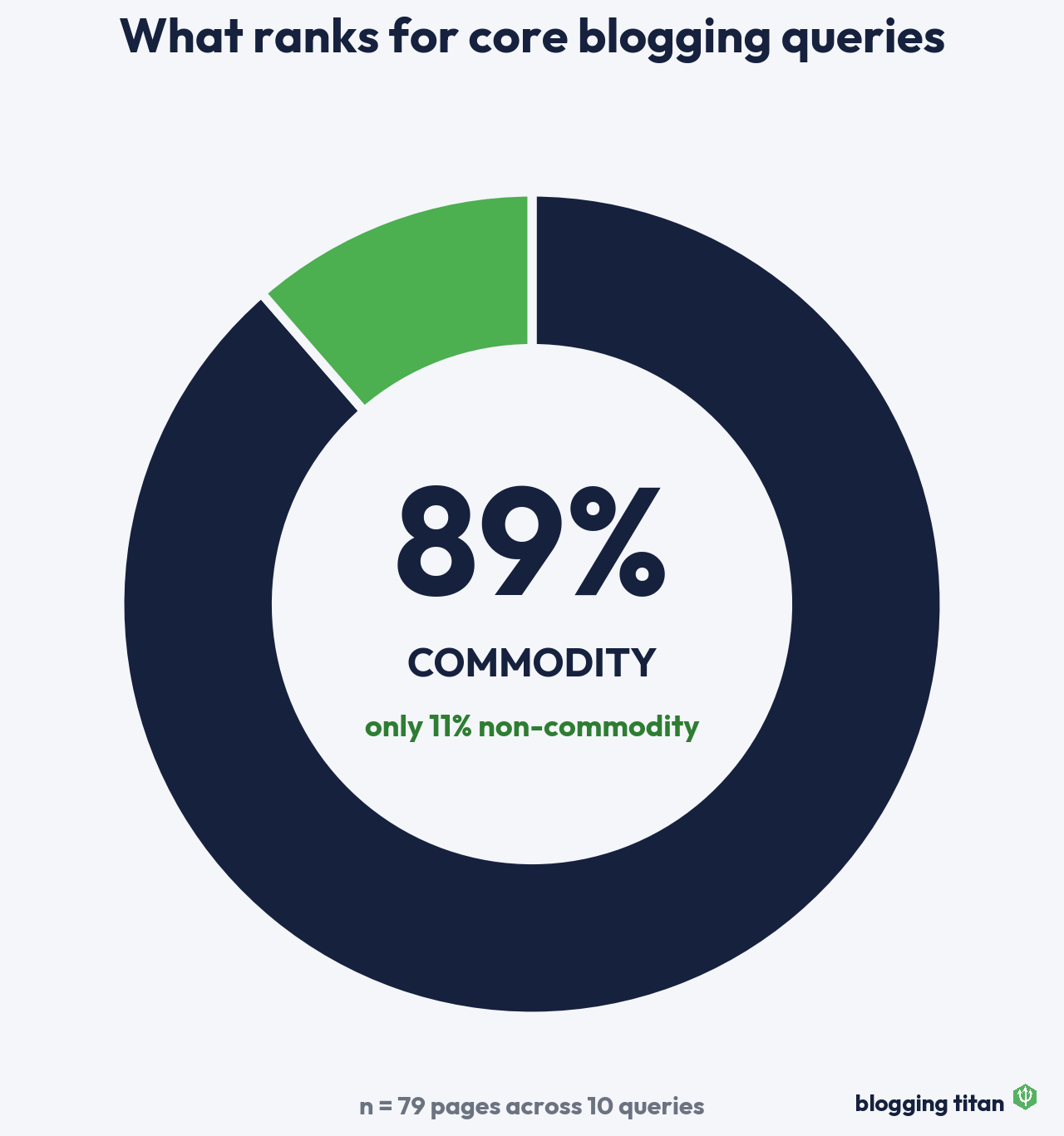
That alone is a big number, but the more useful finding is where the non-commodity content was, and where it was not. Every one of the nine non-commodity results showed up in queries that invite opinion and experience: how to increase traffic, how to make money, which platform to pick, is blogging still worth it, how to write a post. The moment the query got purely informational, the experience vanished entirely.
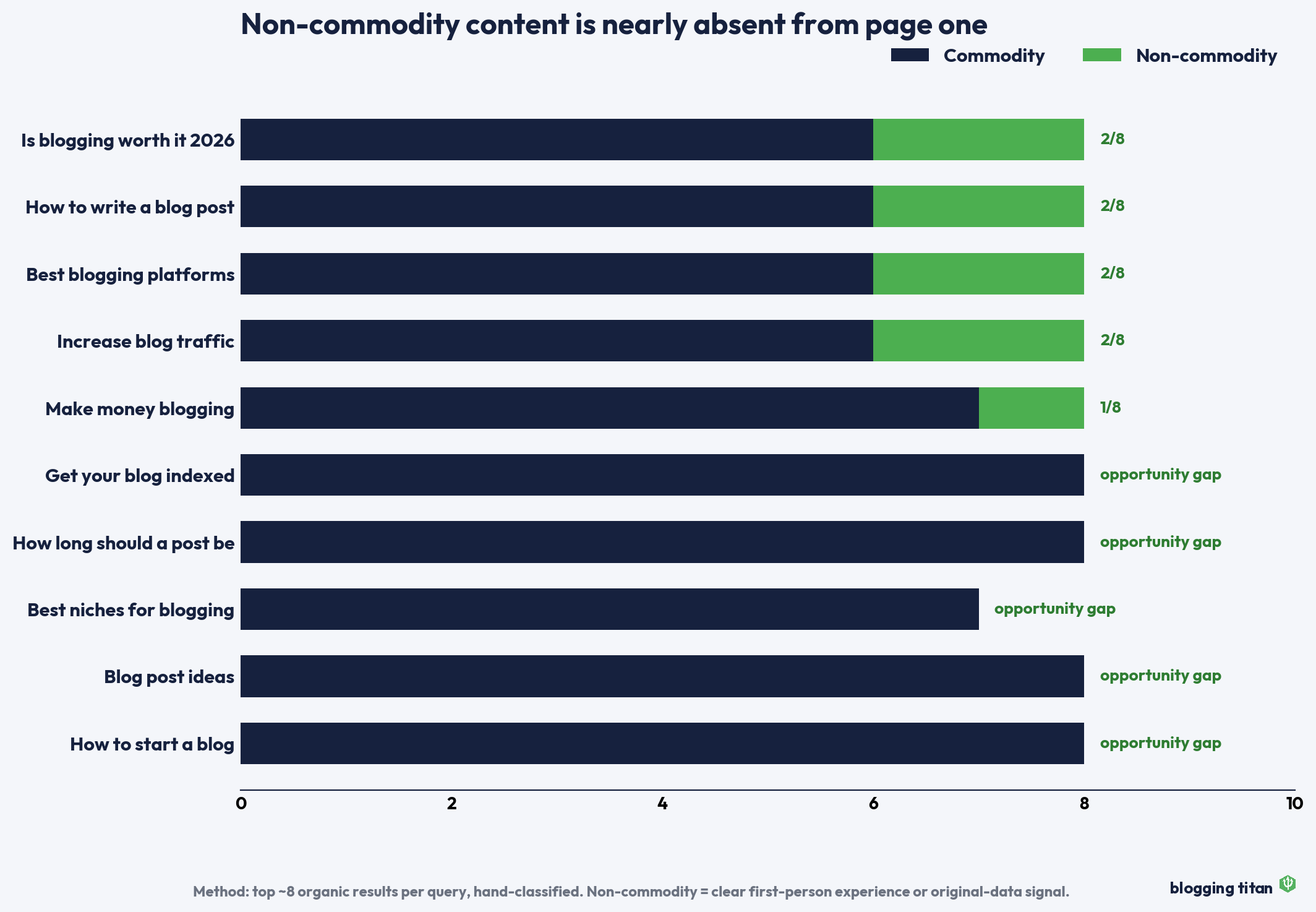
Five queries came back 100% commodity: how to start a blog, blog post ideas, best niches for blogging, how long should a post be, and how to get indexed. Not one page in the top results for those terms led with a real experiment, a real number, or a lived account. Those are not saturated. They are wide open. The entire first page is the generic version, which means the first person to show up with actual receipts has nothing experiential to compete against.
A few honest caveats, because a study you cannot poke holes in is not worth publishing. This is a small manual sample of 79 pages, classified by one person from titles and formats, without a full read of every article, captured on a single day in one country. It measures how content presents itself, not a perfect audit of every word. Run it yourself next week and you will get slightly different counts. But the direction is not subtle: the shelf is stacked with the copyable version, and the experiential version is nearly absent.
The problem with the standard advice
Every article explaining non-commodity content right now uses the same three examples: a company with proprietary buyer-intent data, a startup with a founder’s origin story, a platform sitting on billions of internal data points. Great for a venture-backed brand. Useless if you are one person writing about blogging, gardening, personal finance, or model trains from a spare room.
There is a second layer underneath this. We later followed every link on 40 page-one “best blogging tool” posts and found 32 of 40 had a financial stake in the answer they gave, with two thirds hiding their affiliate links behind their own domain. Commodity content is not only generic. It is usually paid.
And a third layer: we later checked 47 page-one tool reviews for proof the writer ever used the tool. 38% could not show any. Commodity content is not just unoriginal, it is frequently unearned.
Solo bloggers read that and conclude they are locked out. You have no proprietary funnel. No internal analytics on 600 companies. No annual industry report.
You have something the advice ignores. You have receipts, and you have reps. Here is how to turn those into content nobody can lift.
The five non-commodity assets a solo blogger already owns
None of these require a company behind you. Each one is a source of the “only you could write this” quality that Google now rewards and AI cannot fake.
1. First-person receipts. The actual numbers, screenshots, and outcomes from your own work. Your real traffic dip after a core update. The exact income breakdown from a month you would rather not show. The A/B test where the ugly button won. A model cannot generate your Search Console screenshot. It can only describe the concept of one.
2. Original tests. You did something for thirty days and reported what happened. You published daily for a month, or deleted 40 old posts to see if pruning helped, or moved your email opt-in and watched conversions. The test does not have to be scientific. It has to be yours, with a real before and after. This whole post is an example: the 89% number did not exist until I went and counted. (If you want a repeatable process for this, see how to run and publish original research as a blogger.)
3. Named specificity. Real names, real dollar amounts, real dates, real tools you paid for. “I switched hosts in March 2026 and my Largest Contentful Paint dropped from 3.1s to 0.9s” cannot be paraphrased into oblivion, because the specifics are load-bearing. Vague content compresses into an AI summary. Specific content resists it.
4. Earned contrarian opinion. A take you can defend because you lived the cost of getting it wrong. Not contrarian for clicks. Contrarian because your experience genuinely disagrees with the consensus, and you can show the scar. This is the hardest for AI to reproduce, because a model averages toward the consensus by design.
5. Synthesis across your own body of work. Patterns only you can see because you have written 200 posts and watched which ones aged well. “After four years, here is the one type of post that keeps earning links and the three types that quietly died.” An outsider does not have your archive. You do.
Notice what every one of these has in common: it requires you to have been there. That is the entire game. Commodity content asks what is true about the topic. Non-commodity content asks what is true about your experience of the topic.
The Commodity Line Test
Here is a diagnostic you can run on any draft in about sixty seconds. Score one point for each “yes.” I built this specifically for solo creators, so it measures the things you can actually control.
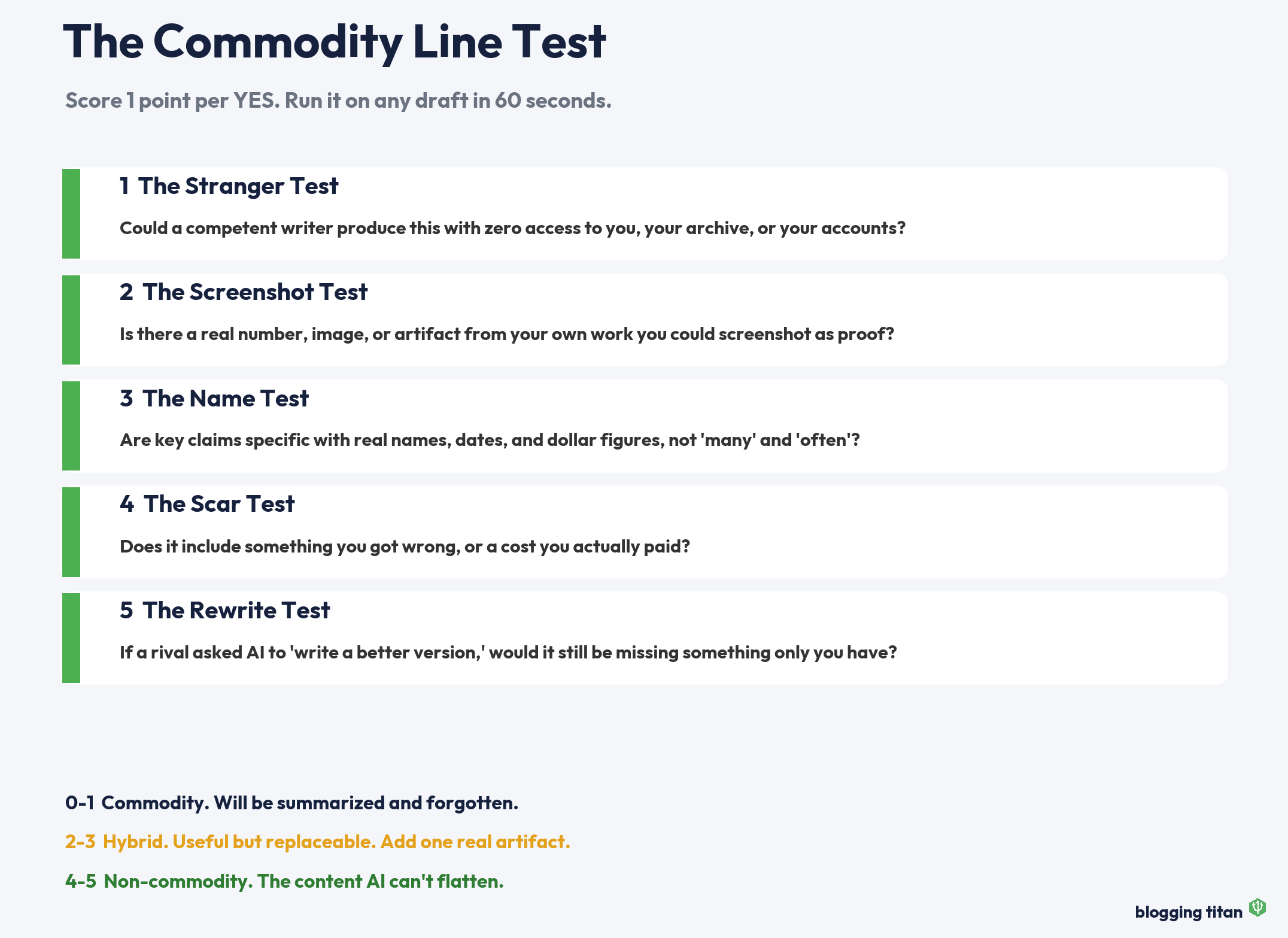
- The Stranger Test. Could a competent writer produce this post with no access to you, your archive, or your accounts? If no, score a point.
- The Screenshot Test. Does it contain at least one real number, image, or artifact from your own work that you could screenshot as proof? Point.
- The Name Test. Are the key claims specific, with real names, dates, or dollar figures, and free of “many” and “often”? Point.
- The Scar Test. Does it include something you got wrong, or a cost you actually paid? Point.
- The Rewrite Test. If a competitor fed your post to an AI and asked it to “write a better version,” would the result be missing something essential that only you have? Point.
Score it honestly:
- 0 to 1: Commodity. This will get summarized and forgotten. Rework it or do not bother publishing.
- 2 to 3: Hybrid. Useful, but replaceable. Add one real artifact or one lived detail and it climbs.
- 4 to 5: Non-commodity. This is the content Google’s guidance is pointing at and AI cannot flatten.
The test is deliberately harsh, because the whole point is that the bar moved. If your last five posts all score a 1, treat that as a map of exactly where the copyable content is, so you know what to defend.
What this does not mean
It does not mean commodity content is worthless. Google still surfaces it for quick facts, and in a brand-new niche where nobody has written the basics yet, being the clear commodity answer is a real opening. If you are the only decent “how to X” in a young space, publish it.
It does mean you should stop pretending a tenth “best blogging tools” post is a strategy. In a mature niche, more commodity content moves nothing, because an AI can now produce the generic version instantly and for free. Your leverage is the part of your knowledge that never made it into a training set: the specific, the tested, the lived. If you want the flip side of this, the signals that actually get a page quoted by AI, read the Answer-First Test.
The good news is that the raw material is already yours. You have run the experiments. You have the screenshots. You have the opinions you earned the hard way. The only thing standing between that and a post nobody can copy is the decision to put the receipts on the page instead of the recap.
Start with your next draft. Run the Commodity Line Test on it before you hit publish. If it scores a 1, you already know what to do.
- How to Run and Publish Original Research as a Blogger
- The Answer-First Test: 5 Signals That Get a Page Quoted by AI Search
- How to Audit Your Blog for AI Search Visibility (a GEO Audit)
- The First-Person Fallacy: Does “I Tested” Language Win AI Citations?
- The Volume Trap: Why Most Blogs Should Publish Less and Link More
About this study
In July 2026 we searched ten common blogging queries (how to start a blog, make money blogging, increase blog traffic, best blogging platforms, how to write a blog post, blog post ideas, is blogging worth it in 2026, best niches for blogging, how long should a blog post be, and how to get your blog indexed). We collected the top results Google returned for each, excluded off-topic and duplicate results, and hand-classified the remaining 79 pages. A page was counted as non-commodity only when its title or format showed a clear first-person experience or original-data signal; all others were counted as commodity. Result: 70 commodity (89%) and 9 non-commodity (11%). Limitations: small single-rater sample, title and format based classification, one snapshot in one country. Method is reproducible; your counts may vary slightly. Sources: Google Search Central Live, Toronto (April 2026), Danny Sullivan’s commodity versus non-commodity content guidance; Google Helpful Content Update (2022). Original data: Blogging Titan analysis, July 2026.
The scale of that squeeze is now measurable: our Reddit Tax census found user-generated platforms holding 30% of page-one slots across 30 blogging queries, and 20 of the 30 #1 positions.

Written by
Blogging Titan Team
Blogging Titan is an independent team of bloggers documenting what actually grows a blog in the AI search era. We have been building, ranking, and monetizing WordPress sites since 2017, and every guide on this site is based on strategies and tools we have tested ourselves. Want a second pair of eyes on your blog? Request a free blog audit or start with the 2026 playbook.