
On 24 July 2026 I recorded every source cited by the same 20 Google AI Overviews, three pulls each inside one hour, and published the result as the citation lottery: 17 of 20 answer boxes were frozen solid, and 87.5% of citations survived every pull. On 19 October 2026, 87 days later, I ran the identical harvest again. The freeze is still there, hour to hour. Across the quarter it means nothing: of the 212 citations July’s first two pulls recorded, only 74 were still present in October, a 35% survival rate at exact URL level. Not one of the 20 queries kept its July citation set. The lottery freezes by the hour and re-rolls by the quarter. This post publishes the full wave-by-wave data.
What I did
Same design as July, deliberately unchanged: the same 20 blogging queries, repeated pulls from the same signed-in Chrome profile with the same US location parameters, every cited source URL recorded per pull and cleaned to host plus path. October’s two pulls ran 19:36 to 19:42 and 19:44 to 19:50 UTC; July’s ran about 20 minutes apart. The July wave-one data has sat committed in our project folder since publication day, so the baseline cannot be reconstructed, backdated, or quietly tidied; the diff runs against the exact files.
One thing did change between waves, and it was Google, not the method. The AI Overview interface was redesigned at some point in the intervening 87 days: most citations now sit behind small source chips in the text and a collapsible source rail with a Show all control. The October harvest expanded the Overview, expanded the rail, and clicked through every chip, so the recorded set is everything the Overview cites anywhere in its interface. Google rate-limited the profile during the planned third October pull and began serving a CAPTCHA on every search, so the third pull was abandoned. To keep the waves comparable, every July-to-October number in this post uses the first two pulls of each wave, except the anchor-versus-tail split, which classifies July citations using all three July pulls; July’s third pull file still ships with the dataset. An AI Overview appeared on every completed pull in both waves.
Finding 1: the hourly freeze reproduced almost exactly
Within the October session, 17 of 20 queries returned identical citation sets on both October pulls, exactly the count July produced on the same two-pull basis. More striking, the re-rollers are largely the same searches. “Blog seo tips” and “how to build an email list for your blog” re-rolled in July and re-rolled again in October, while “is blogging still worth it” settled down and “how to write a blog post” took its place. Whatever makes an Overview volatile looks mostly like a property of the query, not of the day you happen to test it.
Finding 2: across 87 days, two thirds of citations are gone
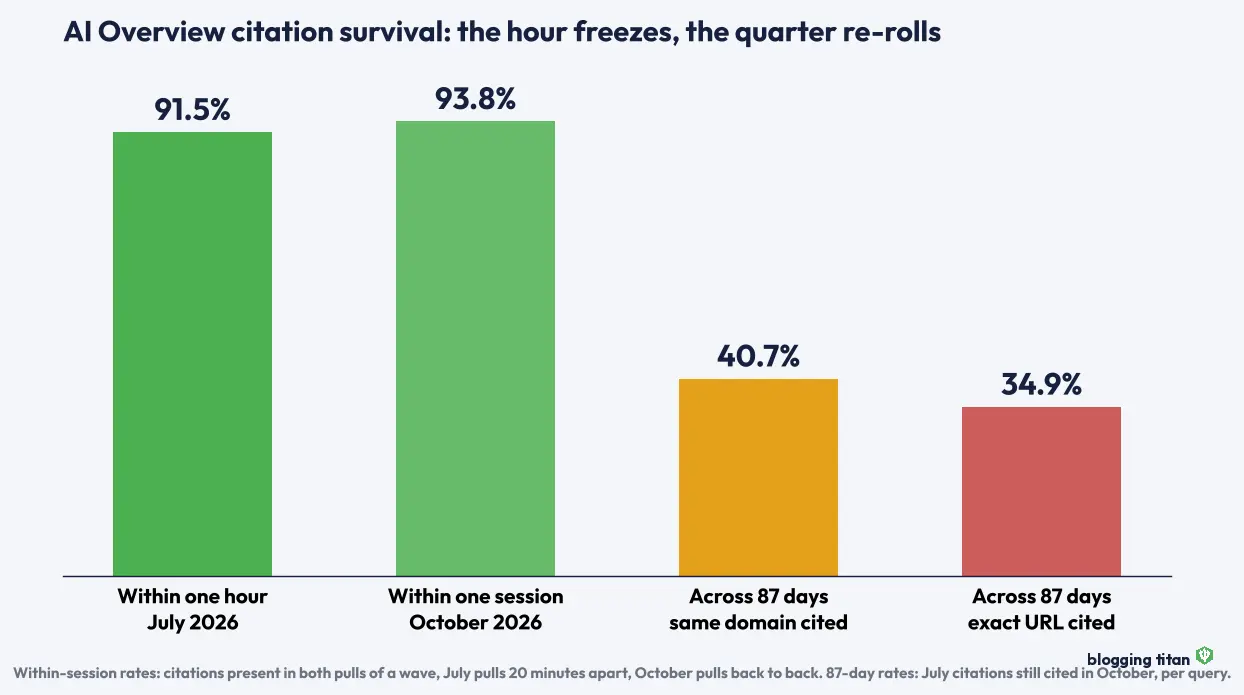
Pool every citation each query showed across its two compared pulls, July versus October, and the stability story collapses. 74 of 212 July citations were still present in October: 34.9% survival at URL level, 40.7% if you only require the same domain to still be cited on that query. Zero queries kept their exact July set. Measured the same two-pull way, within-session survival was 91.5% in July and 93.8% in October. A citation check and a citation guarantee are different things, and the gap between them is about 57 points per quarter.
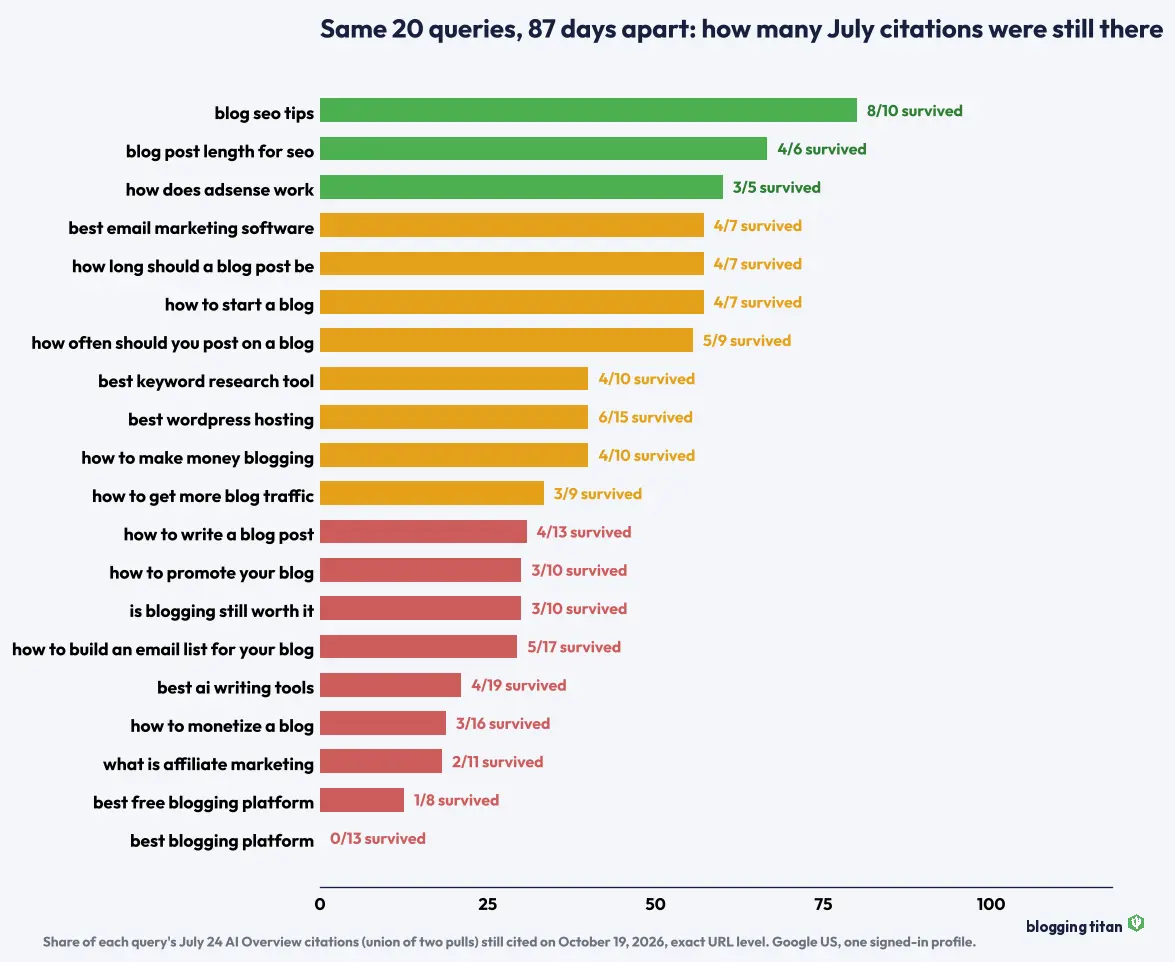
The extreme case is “best blogging platform”. In July its Overview cited 13 distinct URLs, identical on every pull. In October the Overview cites 3 sources, and none of the 13 July URLs is among them; of the 13 domains, one survived. A frozen Overview only looks safe. Its re-roll clock runs on a timescale longer than anyone’s spot check.
Finding 3: July’s anchor set bought almost no protection
The July study ended with advice: aim for the anchor set, the sources present on every pull, because the lottery only shuffles the tail. Eighty-seven days of data say that advice had a shelf life. July’s ever-present anchor citations, the ones present on all three July pulls, survived to October at 36.0%; the flickering tail survived at 29.6%. Six points. Being structurally load-bearing in July’s answer bought a source almost nothing by October, because the engine did not shuffle the supporting cast, it recast the whole production. We were wrong to project hour-scale structure onto quarter-scale behaviour, and this is the correction.
Finding 4: the citation lists themselves shrank
July’s 20 Overviews held 212 query-citation slots between them on the two compared pulls. October’s hold 160, a 25% smaller citation surface across the identical queries. Count each URL once across all queries and the pattern is the same: 191 distinct URLs cited in July, 137 in October. Part of that could be the interface redesign changing what Google surfaces at all, which is exactly why we harvested every chip and rail entry before counting. Fewer cited slots on the same queries means the pool everyone is optimising for got smaller while nobody was measuring it.
Who survived the quarter
The survivors skew heavily to platforms. YouTube was cited on 15 queries in July and kept 14 of those slots; Reddit kept 11 of 14, Wix 6 of 9, Quora 4 of 7. The casualties are mostly individual publishers and vendor blogs: Shopify kept 1 of its 5 July slots, Bluehost 1 of 4, and dozens of sites lost the only slot they held. The pattern matches our Reddit Tax census from the organic side: when answer surfaces consolidate, user-generated platforms hold tenure and everyone else reapplies for their job each quarter.
What this means if you want AI citations
A citation audit is a photograph, and the subject moves. July’s advice to sample a query three times before recording a verdict still stands, but this data adds an expiry date: a verdict recorded in one month says little about the next. If a tool or an agency is selling you “AI visibility tracking” from monthly snapshots, ask what their measured quarter-over-quarter churn is. Ours is now public: 65% of citations did not survive the quarter.
Losing a citation is usually not your fault, and winning one back is possible. The 138 July citations that vanished pointed at pages that mostly did not change. The engine re-selected. That cuts against both panic and complacency: a lost citation is not a penalty to diagnose, and a held citation is not an asset to bank. It is a position to re-win, which favours the only input you control fully, publishing the page the answer cannot be assembled without. That remains the argument of our commodity content study, now with a decay rate attached.
Watch the volatile queries, bank the frozen ones less. The same two queries re-rolled in both waves, 87 days apart. If your target query is a re-roller, you get fresh lottery draws constantly, and a miss today means little. If it is frozen, the current generation is the wall you live behind until the next quarterly recast, in or out.
Method and limits
Two waves is one interval: this measures the churn between July and October 2026, and cannot say whether the rate is steady, seasonal, or event-driven. The interface redesign between waves is a confound we cannot fully remove; we minimised it by harvesting every visible and chip-hidden citation in October, but if Google now simply cites fewer sources, some “lost” citations are compression losses, which is why the headline number is paired with the shrinkage figure and the domain-level rate. Comparison is set-level on host plus path with query strings stripped, which collapses all YouTube watch URLs into one entry, in both waves, so platform survival is slightly flattered. Two pulls per wave is the floor for catching instability, not a precise measure of it. One profile, one location, afternoon in July against evening in October, so time-of-day effects cannot be excluded. The abandoned third October pull is disclosed above because it is the kind of detail that silently becomes someone else’s methodology footnote. All three July pull files and both October pull files ship with this post.
Frequently asked questions
How long does a Google AI Overview citation last?
In this dataset, a citation held in July 2026 had a 35% chance of still being present 87 days later at exact URL level, and 41% at domain level. Within a single session, survival was above 90% in both waves. Stability on the day tells you almost nothing about stability across a quarter.
Do AI Overview citations change even when the cited pages do not?
Yes. Most of the 138 citations that disappeared between July and October pointed at pages that were still live and largely unchanged. The engine reassembled its source list; the sources themselves mostly did nothing to earn or lose their place.
Is it worth being an anchor source in an AI Overview?
Within the hour, yes: anchor sources survive every re-roll of a volatile Overview. Across 87 days, barely: July’s anchor citations survived to October at 36.0% against 29.6% for the flickering tail. Over a quarter the whole answer gets recast, anchors included.
- The citation lottery: the July 2026 study this one re-pulls
- The paraphrase re-roll: rewording a question drops citation survival from 87.5% to 14%
- The AI citation league: 100 blogging questions across ChatGPT and Perplexity
- The staleness penalty: AI Overviews and content age
- Free tool: the AI Citation Grader
This is original first-party research by Blogging Titan. The dataset below is free to cite or republish with attribution under a CC BY 4.0 license.
| Design | 20 queries x 2 pulls per wave, 87 days apart |
| Waves | 24 July and 19 October 2026 |
| July citations in the comparison set | 212 |
| Still cited in October, exact URL | 74 / 212 (34.9%) |
| Still cited in October, domain level | 81 / 199 (40.7%) |
| Queries keeping their exact July citation set | 0 / 20 |
| Queries frozen within their own session | 17 / 20 in both waves |
Blogging Titan. (2026). The citation lottery, 87 days later: survival of Google AI Overview citations across a quarter. Retrieved from https://bloggingtitan.com/blog-seo/ai-overview-citation-survival-87-days/
@misc{bloggingtitan2026citationsurvival87,
  title  = {The Citation Lottery, 87 Days Later: Survival of Google AI Overview Citations Across a Quarter},
  author = {{Blogging Titan}},
  year   = {2026},
  url    = {https://bloggingtitan.com/blog-seo/ai-overview-citation-survival-87-days/},
  note   = {Original first-party dataset, CC BY 4.0}
}

Written by
Blogging Titan Team
Blogging Titan is an independent team of bloggers documenting what actually grows a blog in the AI search era. We have been building, ranking, and monetizing WordPress sites since 2017, and every guide on this site is based on strategies and tools we have tested ourselves. Want a second pair of eyes on your blog? Request a free blog audit or start with the 2026 playbook.