

I Ran the Signs of AI Writing Checklist on All 176 of My Own Posts. Here Is the Tally.
Quick answer: I ran Wikipedia’s Signs of AI Writing checklist across all 176 published posts on this blog and logged every hit. The em dash, the tell everyone points to, appeared in 31 posts, or 17.6%. The phrasings AI detectors flag most, like “not just” and “rather than”, turned up 204 times across 81 posts, and nearly all of them were ordinary English. The signals that actually mattered for readers had nothing to do with word choice.
Updated July 2026. Everyone has an opinion about AI-written content, but almost nobody shows their own receipts. So I did the uncomfortable thing. I took Wikipedia’s Signs of AI Writing checklist and ran it across all 176 published posts on this blog, logging every hit. The tell everyone points to, the em dash, turned up in 31 posts, or 17.6%. The phrasings most AI detectors flag, like “not just” and “rather than,” appeared 204 times across 81 posts, and nearly all of them were ordinary English. The problems that actually mattered for readers had nothing to do with word choice. Here is the full tally, and what running this blog taught me about which signals are real.
How I ran the audit
I pulled every published post through the WordPress REST API, stripped out the style and script blocks so I was only reading prose, then ran a targeted pattern for each signal on the checklist. Anything the pattern flagged, I read by hand, because a raw count means nothing until you check whether the hit is real. That last step is where most “AI detection” falls apart, and it is where the interesting findings came from.
The results across 176 posts
| Signal | Posts affected | Total hits | My verdict |
|---|---|---|---|
| Em dashes | 31 (17.6%) | 36 | Real, but a weak signal |
| “not just” / “not only” / “rather than” | 81 (46%) | 204 | Mostly false positives |
| Mid-word keyword-stuffing corruption | 4 | 5 | The one that actually hurt readers |
| Call-to-action buttons with empty links | 2 | 2 | Automation residue, not AI prose |
Finding 1: the em dash is a weak signal, not a smoking gun
The em dash has become shorthand for “a robot wrote this.” My data says be careful with that assumption. Em dashes showed up in fewer than one in five posts, and every one of those posts was written and edited by people. The em dash is a punctuation habit, not a confession. I removed them here because clean, comma-based sentences match the house style I want, not because their presence told me anything about how the words were produced.
Finding 2: the phrasings detectors love are why detectors are wrong
The single noisiest signal was the group of “negative parallelism” phrasings: “not just,” “not only,” and “rather than.” They appeared 204 times across 81 posts, which is 46% of the library. When I read the hits, almost all of them were plain, correct English that any writer would produce. This is the exact mechanism that makes commercial AI detectors flag genuine human work. They score surface phrasings, and surface phrasings are shared by humans and machines alike. If a tool tells you a post is AI because it contains “rather than,” the tool is the problem.
Finding 3: the real damage was structural, not vocabulary
Here is the part word-level detectors would never catch. An older automated editing pass had jammed keywords into the middle of real words, leaving broken text in live posts. One sentence read “set up yo hobby blog,ur website” where it should have said “set up your website.” Two review posts had call-to-action buttons pointing at empty links, so the button did nothing when clicked. None of that trips an AI vocabulary filter, yet it does far more harm to a reader than any adjective. If you only audit for style, you will scrub harmless em dashes while broken sentences sit untouched.
What this means for AI citations and GEO
If your goal is to be cited by AI answer engines, none of the cosmetic tells move the needle. What moves it is structure: a direct answer in the first 40 to 150 words, question-style headings with FAQ schema, working internal links, and original data an engine can quote. During this same audit I found review posts missing FAQ schema entirely, which is a citability gap that matters, unlike the em dashes. Fix the structure that helps machines quote you, and stop performing style rituals that no reader or engine rewards.
Update: the July 24 re-audit
Three weeks after this audit went live I ran the same scan again, over what had grown from 176 to 190 published posts. The re-run is the part I would show a skeptic, because the two headline signals moved in opposite directions.
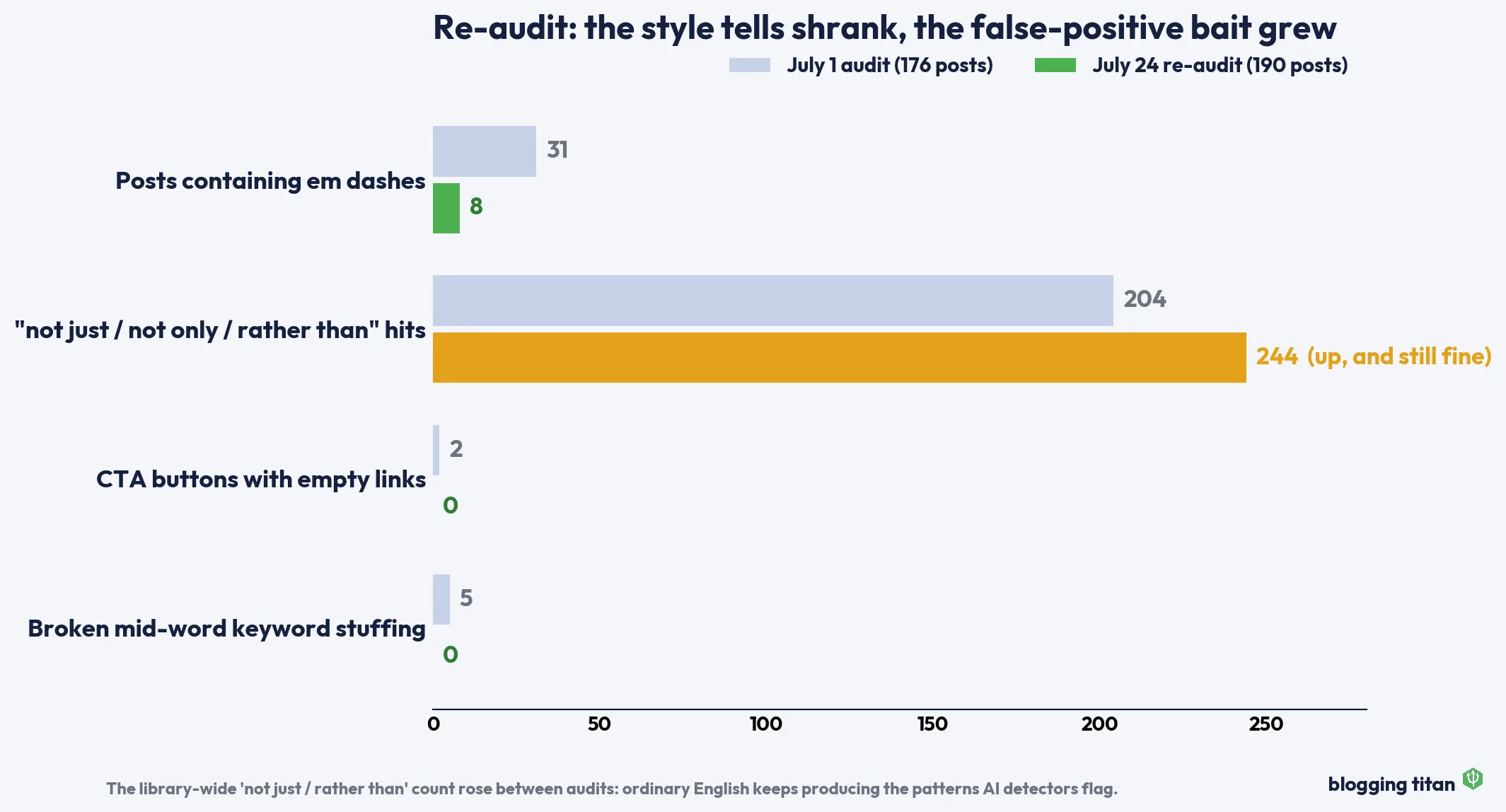
The em dash cleanup stuck. Posts containing em dashes fell from 31 to 8, and the survivors cluster in a handful of older data studies, with two stray ones removed the day of the re-audit. Since em dashes were never evidence of anything, this is a style win, no more.
The detector-bait phrasings went up, and that is the point. The “not just / not only / rather than” count rose from 204 hits in 81 posts to 244 hits in 93 posts. The 14 posts added between the audits were all written and edited with human review, several of them original data studies, and the library-wide count still rose by 40 hits. Ordinary English keeps producing the exact patterns commercial AI detectors score. If those phrasings were a reliable fingerprint, this library would be getting more machine-written every week, which is the reductio of the whole word-list approach.
The structural defects stayed dead. Zero CTA buttons with empty links, zero mid-word keyword corruption. Fixing broken things once tends to keep them fixed, which is another reason to spend your audit energy there.
The structural half of this cleanup got its own before-and-after too: the internal link graph audit re-ran the same day, and the redirect number tells a similar story. For the bigger argument about why receipts beat style rituals, see how solo bloggers write posts AI can’t copy.
How to audit your own library
- Export every post, or pull them through your CMS API, so you can scan the raw content.
- Strip out style and script blocks first, or your counts will be full of CSS false positives.
- Run one pattern per signal, then read every hit by hand before you change anything.
- Rank fixes by reader harm. Broken words and dead links first, cosmetic punctuation last.
- Check for missing structure, like absent FAQ schema, while you are in there. That is the work that earns citations.
The honest takeaway
Auditing my own library was humbling and useful. The scary-sounding “AI tells” were mostly noise, the punctuation everyone fears was harmless, and the genuine defects were quiet structural bugs that no detector would flag. If you write or edit at scale, spend your energy on the things a reader actually feels, and treat single-word “AI detectors” with the skepticism their false-positive rate has earned.
Frequently asked questions
Are em dashes a sign of AI writing?
They are a weak signal at best. In this audit em dashes appeared in 31 of 176 human-edited posts, and many skilled human writers use them constantly. Presence alone proves nothing.
Why do AI detectors flag human writing?
Because they score common phrasings. Terms like “not just” and “rather than” appeared 204 times in this library and were nearly always ordinary English, which is exactly why detectors return so many false positives.
What actually signals low-quality automated content?
Structural residue. In this audit the real defects were keyword stuffing that broke words mid-sentence and buttons with empty links, neither of which a vocabulary filter detects.
This is original first-party research by Blogging Titan. The dataset below is free to cite or republish with attribution under a CC BY 4.0 license.
| Posts scanned (July 1 / July 24) | 176 / 190 |
| Posts containing em dashes (before / after) | 31 / 8 |
| “not just / not only / rather than” hits (before / after) | 204 / 244 |
| CTA buttons with empty links (before / after) | 2 / 0 |
| Mid-word keyword corruption (before / after) | 5 / 0 |
Blogging Titan. (2026). Signs of AI writing: a two-wave self-audit of a blog library. Retrieved from https://bloggingtitan.com/blog-seo/ai-writing-signs-self-audit/
@misc{bloggingtitan2026aisigns,
  title  = {Signs of AI Writing: A Two-Wave Self-Audit of a Blog Library},
  author = {{Blogging Titan}},
  year   = {2026},
  url    = {https://bloggingtitan.com/blog-seo/ai-writing-signs-self-audit/},
  note   = {Original first-party dataset, CC BY 4.0}
}

Written by
Blogging Titan Team
Blogging Titan is an independent team of bloggers documenting what actually grows a blog in the AI search era. We have been building, ranking, and monetizing WordPress sites since 2017, and every guide on this site is based on strategies and tools we have tested ourselves. Want a second pair of eyes on your blog? Request a free blog audit or start with the 2026 playbook.