
AI Traffic Converts 1.3x Better Than Organic. Or 4.4x. Or 23x. We Traced Every Claim to Its Source.
Quick answer: We traced seven circulating claims that AI traffic converts better than organic search back to their original publishers. Every number is real. They range from 1.31x to 23x, a 17.6-fold spread, because they measure different conversions on wildly different samples. The pattern that matters: the biggest multipliers come from the smallest samples. The trillion-visit retail panel found 1.42x. The 23x figure is one website counting its own signups.
If you read anything about blogging or SEO this year, you have met at least one of these numbers. AI shoppers convert 42% better than Google traffic. AI referrals convert at 4.4 times the rate of organic. AI search visitors convert 23x higher. They are quoted in statistics roundups, agency pitches, and conference decks, usually in the same breath, as if they described the same fact.
They cannot all describe the same fact. A visitor cannot be both 1.3 times and 23 times more likely to convert. So we did what we did for tool-review pricing and anonymous expert advice: we followed every claim back through its citation chain to the original measurement, and recorded what was actually measured, on what sample, by whom.
Key data points
- 7 conversion-multiplier claims traced to their original publishers; stated multipliers span 1.31x to 23x.
- The three largest disclosed samples (Adobe at 1 trillion+ retail visits, Shopify enterprise merchants, a 94-brand ecommerce panel) cluster at 1.31x to 1.5x.
- The famous 23x is arithmetic on one website: AI search brought Ahrefs 0.5% of visitors and 12.1% of signups in a 30-day window.
- Semrush’s widely quoted 4.4x discloses no sample size, and a footnote says part of the impact was modelled.
- One 68% time-on-site statistic circulates credited to two different companies.
- Meanwhile AI referral traffic is roughly 1% of total visits (Conductor benchmarks: 1.08%), so every multiplier applies to a small base.
The spread nobody mentions
Here are the seven claims side by side, each traced to the party that first published it, with the multiplier exactly as stated at the source.
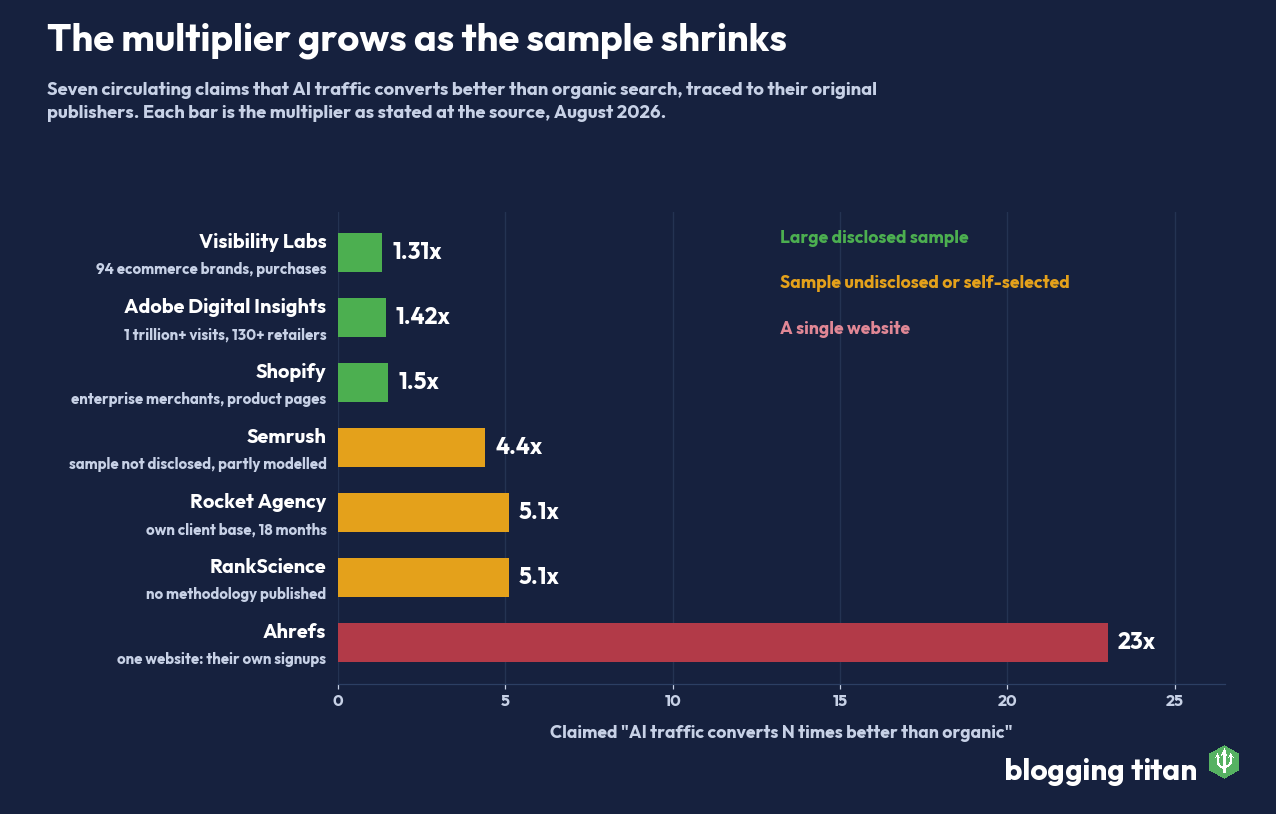
Sorted this way, the story tells itself. Every publisher with a large, disclosed, purchase-based sample lands between 1.31x and 1.5x. The multipliers that make headlines, 4.4x and 23x, come from an undisclosed sample and a single website respectively.
Where each number actually comes from
| Circulating claim | Original publisher | What was measured | Sample |
|---|---|---|---|
| “42% better than Google traffic” | Adobe Digital Insights, Q1 2026 | Purchase conversion rate, AI-referred vs non-AI retail traffic | 1 trillion+ visits, 130+ North American retailers |
| “Nearly 50% higher on product pages” | Shopify, May 2026 | Conversion on product detail pages, plus 14% higher order value | Enterprise merchants, 25 categories |
| “31% higher than non-branded organic” | Visibility Labs, 2025 | Purchase conversion: ChatGPT referrals 1.81% vs organic 1.39% | 94 ecommerce brands |
| “4.4x the rate of organic” | Semrush, July 2025 | Conversion rate, definition not detailed; footnote notes partial modelling | Not disclosed |
| “5.1x the rate of organic” | Rocket Agency | ChatGPT visit conversion across the agency’s own clients | Own client base, 18 months |
| “14.2% vs 2.8%” (5.1x) | RankScience | Stated conversion rates; no methodology published | Not disclosed |
| “23x higher” | Ahrefs, June 2025 | Share of signups vs share of visitors on ahrefs.com | One website, 30-day window |
Two things stand out once the claims sit in one table. First, the definitions of “conversion” never match: retail purchases, product-page checkouts, form fills, and software signups are all being compared to each other as if they were one metric. Second, the two most quoted numbers are the two with the least disclosed methodology.
The 23x number is real arithmetic on one website
The 23x figure deserves credit for being the most transparent of the lot, and that transparency is exactly what the citation chain strips away. Ahrefs published its own analytics: AI search brought 0.5% of visitors and 12.1% of signups over 30 days. Divide one share by the other and you get roughly 23.
Ahrefs was careful about the context. The authors called out that AI search users click links 75% less than search users, and said a wider multi-site study was coming. But the number that travelled is not “our SaaS signup share, one site, one month”. It is “AI search visitors convert 23x higher”, which is how it now appears in agency posts with titles like “Everyone’s Ignoring It”.
A SaaS tool whose audience is SEO professionals is close to a best case for AI referral quality: the people asking ChatGPT about backlink tools are unusually likely to sign up for one. Nothing about that generalises to a food blog’s display-ad revenue or a travel blog’s affiliate clicks.
The 4.4x number ships with a footnote most citations drop
Semrush’s 4.4x is the most cited multiplier of the family, and its original write-up states it plainly: the average AI search visitor is 4.4 times as valuable as the average organic visit, based on conversion rate. What the write-up does not state is the sample: how many sites, how many visits, which industries. And a footnote concedes that part of the impact was modelled rather than measured, to account for users who arrive without referrer data.
None of that makes the number wrong. It makes the number unverifiable, which is a different problem: you cannot check it, weight it, or compare it to the others, and yet it is routinely quoted alongside Adobe’s trillion-visit panel as if the two carried equal evidence.
What the big samples agree on
Strip out the undisclosed samples and the single-site arithmetic, and the remaining evidence is surprisingly consistent. Adobe (1.42x on retail purchases), Shopify (roughly 1.5x on product pages), and the 94-brand panel (1.31x) all point the same way: AI-referred visitors do convert better, by somewhere between a quarter and a half, not by multiples.
That is still a genuinely useful finding. An AI-referred visitor arrives pre-sold: they asked a question, an assistant summarised the answer, and they clicked through anyway. The intent filter does the qualifying before the visit. But a 30% to 50% edge on roughly 1% of your traffic is an optimisation, and the discourse is treating it like a revolution.
How a stat gets laundered
The mechanism that turns a one-site signup ratio into an industry fact deserves a name. Stat laundering is what happens when a number keeps its precision but loses its provenance: each citation strips a caveat until the multiplier travels alone. We reconstructed the chain for the two biggest numbers, hop by hop.
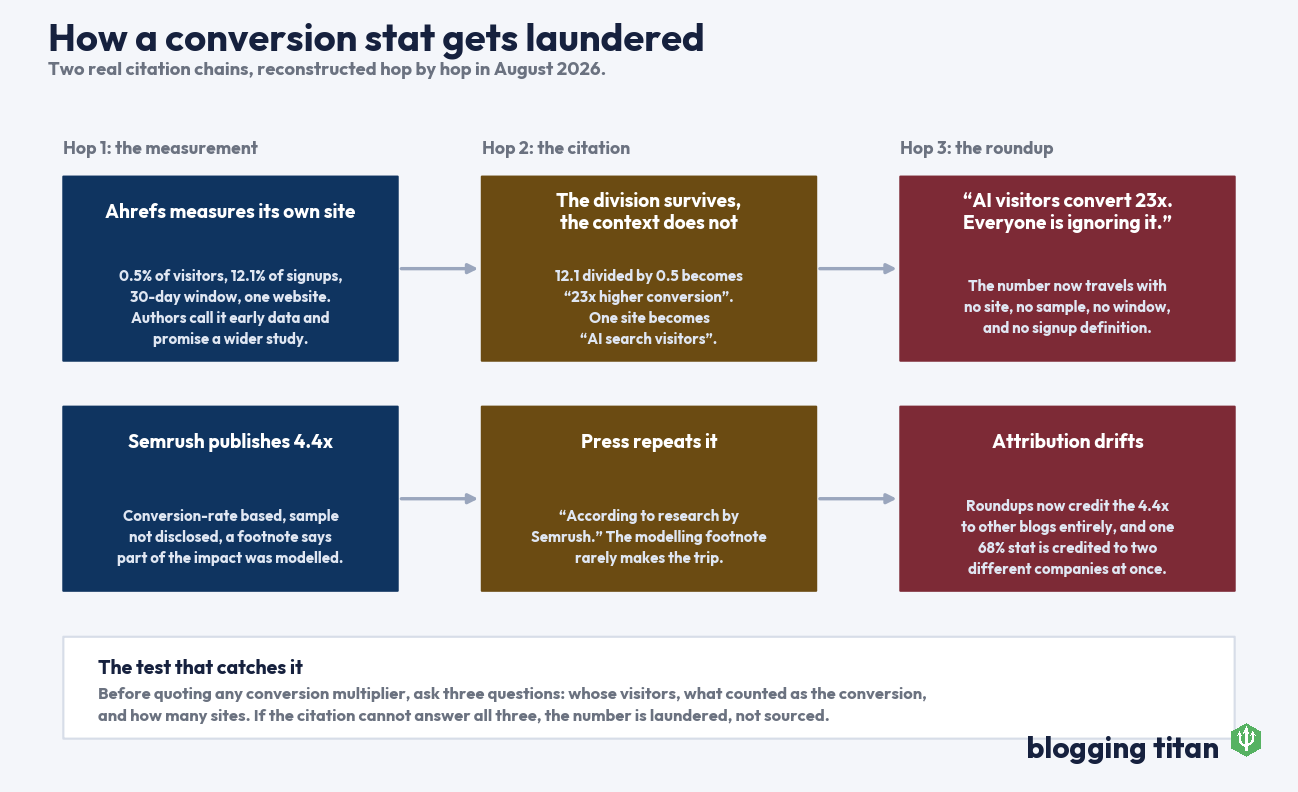
By the third hop the numbers have detached from their sources entirely. We found the 4.4x credited to a marketing blog that had itself borrowed it, and the same 68% time-on-site statistic attributed to two different companies in the same week. At that point the figure is not evidence. It is decoration.
What a small blogger should do with this
Three practical rules fall out of the trace.
Use the three-question test before quoting a multiplier. Whose visitors, what counted as the conversion, and how many sites. If a citation cannot answer all three, treat the number as marketing, not measurement.
Plan on the honest range. If you want a working assumption for AI referrals, use the big-sample range of 1.3x to 1.5x on a base of roughly 1% of visits. On a blog doing 10,000 visits a month, that is about 100 AI-referred visitors converting somewhat better than the average visitor. Worth having. Not worth rebuilding a strategy around.
Fight for the citation, not the click. The real strategic ground is whether AI assistants cite you at all, which is why we argued against opting out of AI Overviews and why our Citation Lottery study tracks how unstable those citations are. You can score any post’s citation readiness in a minute with our free AI Citation Grader.
One caveat on the base those multipliers sit on: it is shrinking. A review of 800 companies across 16 sectors found average organic traffic growth fell from 26.3% to 3.7% a year after AI search arrived. A better conversion rate on a smaller number of visits can still leave you worse off in absolute terms.
About this study
Method and limitations. In August 2026 we collected the AI-traffic conversion claims circulating in SEO and blogging coverage, then followed each citation chain to the earliest public source we could reach, recording publisher, metric, sample, and the multiplier as stated. Seven claims resolved to an identifiable original publisher and are reported here. We did not have access to any publisher’s underlying data, so we compare claims as published, not recomputed. Sample descriptions are the publishers’ own. This is a census of public claims, not a new measurement of conversion rates.
Frequently asked questions
Does AI traffic really convert better than organic search?
The large disclosed samples say yes, modestly: Adobe found 1.42x on retail purchases across 1 trillion+ visits, Shopify roughly 1.5x on product pages, and a 94-brand ecommerce panel 1.31x. The 4.4x and 23x figures come from an undisclosed sample and a single website’s signups, so they should not be used as planning numbers.
Where does the “AI visitors convert 23x higher” statistic come from?
From Ahrefs’ own analytics in June 2025: AI search sources sent ahrefs.com 0.5% of its visitors but produced 12.1% of its signups over 30 days. Dividing those shares gives roughly 23. It is honest arithmetic about one SaaS website, not a cross-industry conversion rate.
How much of a typical blog’s traffic comes from AI assistants?
Around 1%. Conductor’s 2026 benchmarks put AI referral traffic at 1.08% of all website visits, with ChatGPT supplying most of it. The share is growing quickly, but every conversion multiplier in this study applies to that small base.
Cite this data
Data is CC BY 4.0. Cite as: Blogging Titan (2026), “The Stat Laundering Census: 7 AI-Traffic Conversion Claims Traced to Source.” First published 10 August 2026.
| Claims traced to an original publisher | 7 |
| Range of stated multipliers | 1.31x to 23x |
| Large-sample range (disclosed, purchase-based) | 1.31x to 1.5x |
| AI referral share of all visits (Conductor) | 1.08% |

Written by
Blogging Titan Team
Blogging Titan is an independent team of bloggers documenting what actually grows a blog in the AI search era. We have been building, ranking, and monetizing WordPress sites since 2017, and every guide on this site is based on strategies and tools we have tested ourselves. Want a second pair of eyes on your blog? Request a free blog audit or start with the 2026 playbook.