

We Checked Who Wrote the 951 Pages ChatGPT and Perplexity Cited. On 195 of Them, Nobody.
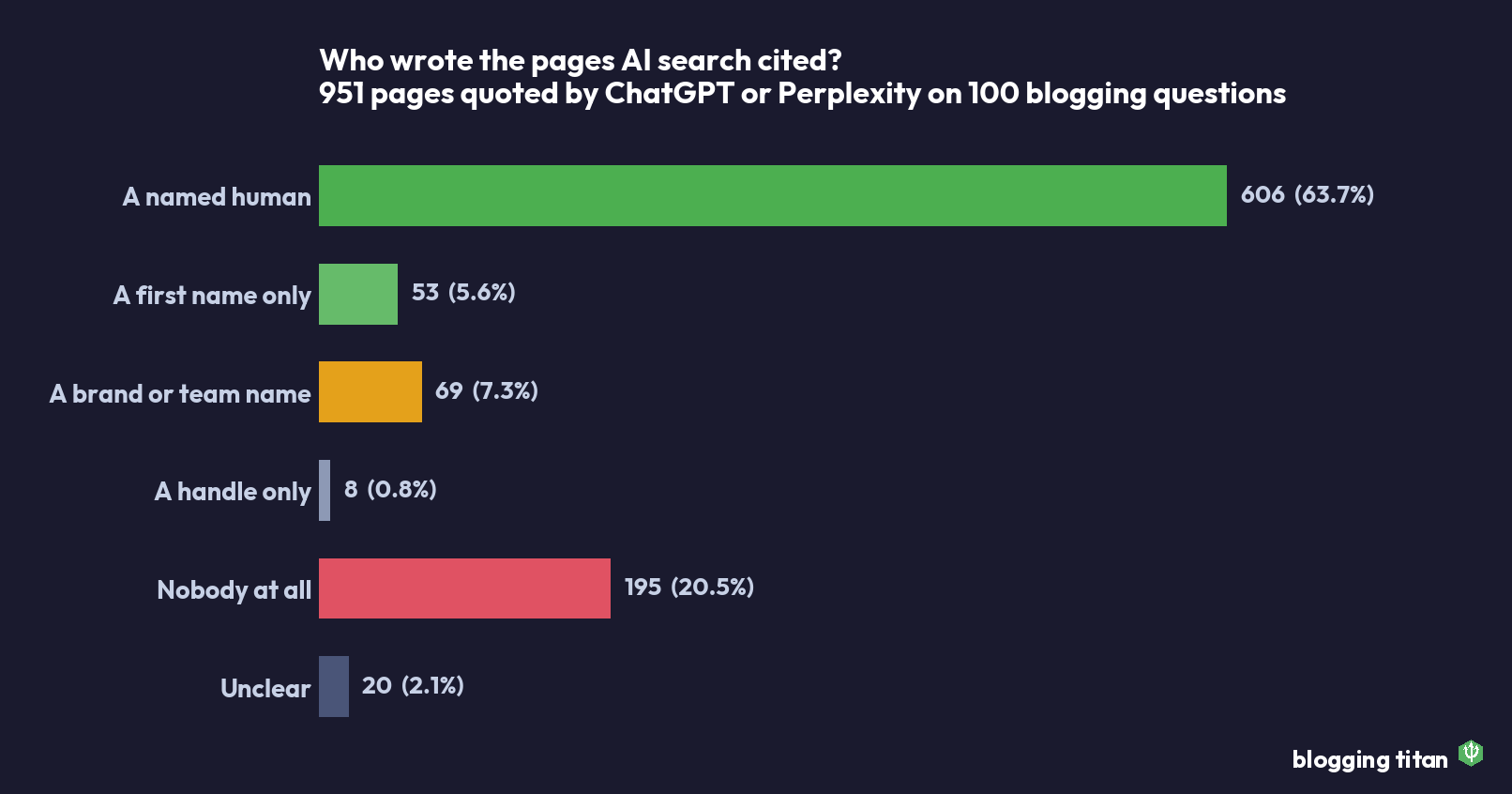
Quick answer: We took every page ChatGPT and Perplexity cited across 100 blogging questions, retrieved 961 of them, and checked who was credited with writing each of the 951 that were not platform pages. 606 name a human being. 195 name nobody at all. The two engines are not alike here. With vendor documentation set aside, 71.6 percent of Perplexity’s sources carry a human byline against 45.4 percent of ChatGPT’s, and ChatGPT is more than three times as likely to quote a page with no author anywhere on it. We call that quotation the nameless citation.
Original study. 951 pages, 2 engines, 100 questions. Citations captured 2 September 2026, pages read 24 September 2026.
The numbers, up front
- 606 of 951 cited pages (63.7 percent) credit a named human author.
- 195 of 951 (20.5 percent) carry no author string anywhere: no byline, no author meta tag, no author in the structured data. One page in five.
- A further 69 pages credit a brand or a team, and 53 give a first name with no surname.
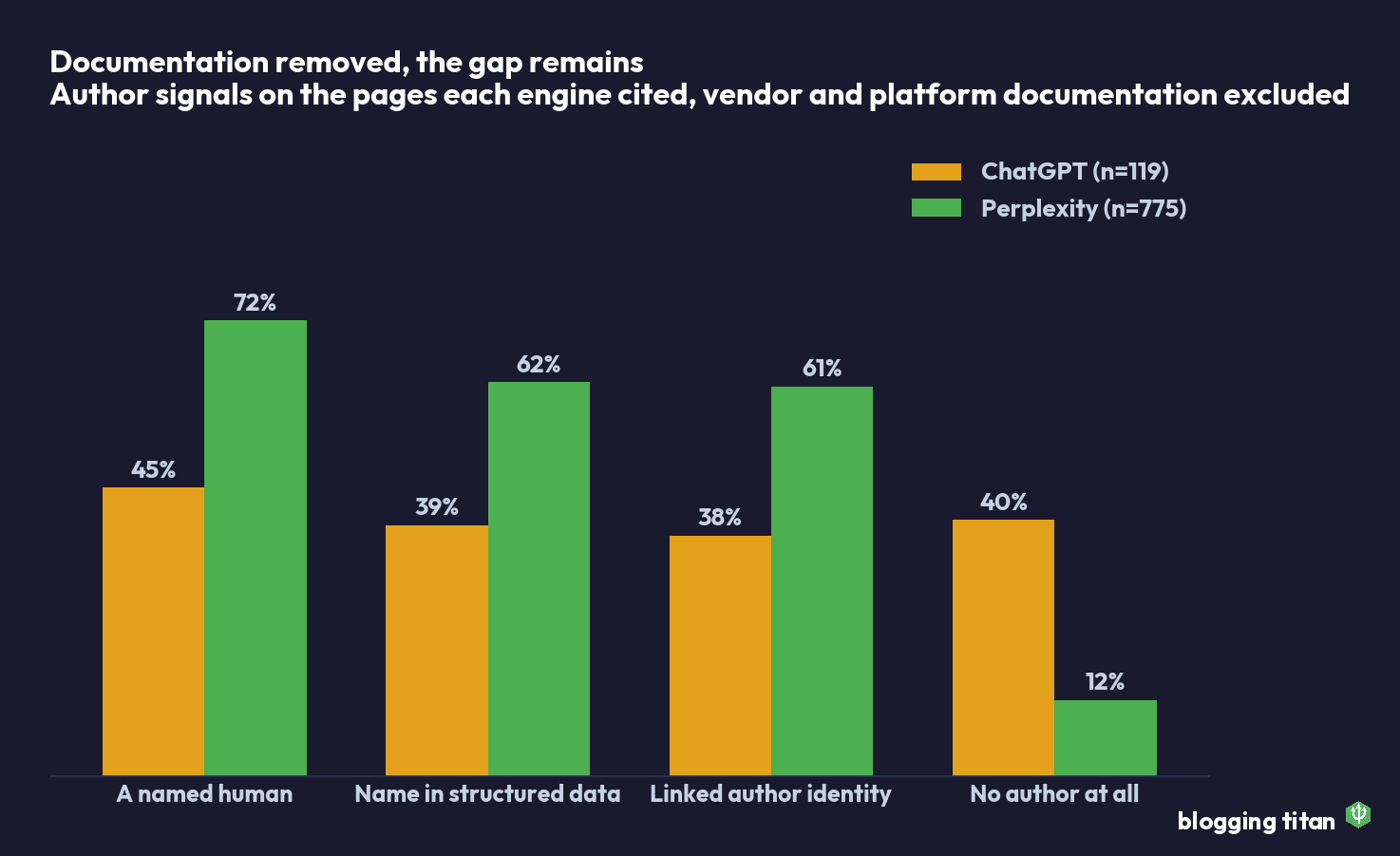
- With documentation excluded, Perplexity’s sources are named 71.6 percent of the time and ChatGPT’s 45.4 percent. The difference is large and statistically clear (z = 5.72, p = 0.000000011).
- 40.3 percent of ChatGPT’s non-documentation sources name nobody, against 12.0 percent of Perplexity’s.
- Only 369 pages of 951 (38.8 percent) pass all three of our author checks. 258 (27.1 percent) pass none of them.
- Documentation explains part of the gap and not all of it. 33.9 percent of ChatGPT’s cited pages are vendor or platform documentation, against 0.9 percent of Perplexity’s, and those pages name an author 7.7 percent of the time.
What we actually did
In September we published the AI Citation League Table, which put 100 blogging questions to ChatGPT and Perplexity on 2 September 2026 and logged all 1,243 sources they cited. That study asked which sites get quoted. This one asks a different question of the same sources: who wrote them?
The 1,243 citations resolve to 1,204 unique URLs. We set aside 45 Reddit URLs, which we cannot retrieve on any route available to us, leaving 1,159 to fetch. We read each one through the Wayback Machine and retrieved 961, a coverage rate of 82.9 percent. Of the 198 we could not read, 169 have never been archived and 27 are blocked to archiving by the site owner. Removing 10 pages on platforms where the byline question means something different, such as YouTube and Quora, left 951 pages for analysis.
For every one of those pages we recorded the author named in its schema.org structured data, the author named in its HTML meta tags, and the first byline in its visible markup, ignoring anything inside a comment thread. We recorded the publication and modification dates at the same time, which is the subject of the companion study published alongside this one.
We scored each page on three checks that a machine can apply consistently to a thousand pages:
- Named. Somewhere on the page, a human name is credited: two or more capitalised name parts that are not a brand, a team, an editorial desk or an administrator account.
- Machine readable. That name appears in the structured data or the author meta tag, where a parser can read it.
- Linked. The page carries an author page link or a sameAs property pointing at a profile elsewhere.
Three things this is not. It is not the Ghost Author Test we ran on page-one blogging guides in July. That test asked whether a named person could be verified to exist off-site, and it needed a human to sit and search for each one. At 951 pages that check is not available to us, so we do not claim it. A name here means a name is printed, and nothing more about whether the person is real.
It is also not a quality judgement. Plenty of good writing is unsigned, and a corporate documentation page has no author for sound reasons. And it is a floor rather than a ceiling: where a byline gave only an initial for a surname, we counted it as unnamed, which is the conservative choice.
One page in five names nobody
195 of the 951 pages carry no author signal at all. Not a thin one, not a brand placeholder: nothing. The heaviest concentrations are Google’s own developer documentation, which appears 19 times in this group, and its support centre, which appears 8 times. After those come ahrefs.com at 7, the WordPress.org family at 11 across its subdomains, and bluehost.com, mailchimp.com and wordpress.com at 5 each. The recurring shape is the vendor page written in institutional voice.
Another 69 pages credit a brand or a team, in the style of “Semrush”, “Vendr Team” or “MonsterClaw Team”. 53 more give a first name and stop, which is the shape of a small personal blog whose owner never filled in the profile field. Those three groups come to 317 pages. Add the 8 that give only a handle and the 20 whose byline we could not read, and 345 of 951 pages, 36.3 percent, give a reader no person to attach the advice to.
The three checks are not a gentle ladder. 369 pages pass all three and 258 pass none, so 627 of 951, almost two thirds, sit at one extreme or the other. Sites that care about author identity tend to do all of it, and sites that do not tend to do none of it.
The two engines are quoting different kinds of page
The league table already established that ChatGPT leans on primary sources and vendor documentation while Perplexity leans on the people writing about them. That finding predicts exactly what we see here, so the first thing to do is remove it and check whether anything survives.
61 of ChatGPT’s 180 retrieved pages are documentation or support content, against 7 of Perplexity’s 782. Three of those are cited by both engines, so the corpus holds 65 distinct documentation pages. They name an author 7.7 percent of the time and carry no author string at all 83.1 percent of the time. That is not a failing of documentation. Nobody signs a help article, and nobody should have to.
Set all of it aside and the gap narrows without closing:
| Documentation excluded | ChatGPT (119) | Perplexity (775) |
|---|---|---|
| Names a human author | 45.4% | 71.6% |
| Names nobody at all | 40.3% | 12.0% |
| Author in structured data | 39.5% | 61.9% |
| Linked author identity | 37.8% | 61.3% |
Every one of those differences clears conventional significance thresholds. The widest is the share naming nobody, where ChatGPT sits at more than three times Perplexity’s rate (z = 7.90, p = 0.0000000000000029).
The honest reading is that documentation is a symptom of the same editorial policy rather than an artefact to be scrubbed out. ChatGPT reaches for the institution: the vendor, the standards body, the regulator, the platform’s own help centre. Institutions publish without bylines. Perplexity reaches for the write-up, and write-ups have writers.
A byline and a date travel together
The single strongest pattern in the data is not about engines at all. Pages with a named author carry a publication date 92.7 percent of the time. Pages without one carry a date 47.8 percent of the time. 562 pages have both a name and a date. 180 have neither.
Bylines and dates are not two independent hygiene choices that a publisher gets round to separately. They are one decision, made once, usually by the content management system, and they arrive together or not at all. We take that apart properly in the companion study on dates and content age.
How we checked the checker
An automated classifier that reads a thousand pages will be wrong in ways its author cannot see, so we audited it twice against the thing it claims to measure.
For precision, we drew 40 pages at random from the 606 scored as naming a human and read the captured byline on each. All 40 were real personal names. An early version of the classifier failed this audit badly: it treated any author name containing the site’s own domain word as a brand, which correctly caught “Semrush” on semrush.com and wrongly caught Neil Patel on neilpatel.com and Nicole Bianchi on nicolebianchi.com. Personal blogs named after the person are the most common shape of independent blog in this corpus, so that bug was deleting precisely the group the study exists to count. We reordered the checks so that a two-part human name wins before the domain rule is applied, and re-ran everything. The rule is narrowed and not gone: a single-token handle on a matching domain, such as mattgiaro on mattgiaro.com, is still scored as a brand.
For recall, we took 40 pages scored as naming nobody and ran a separate scan over the first 6,000 characters of body text, looking for the plain-language patterns a byline takes: “By”, “Written by”, “Author”. It returned one candidate across all 40 pages, and that one read “Industry Online Ticketing”, which is not a person. Pages we score as unsigned are genuinely unsigned.
Limitations, stated plainly
- We read 82.9 percent of the corpus. The 198 pages we could not retrieve are not a random sample: 169 returned not-found from the archive, 27 are blocked to archiving by their owner and 2 failed for other reasons. Blocking the archive is a choice larger publishers make more often than small blogs. If big publishers are better at bylines, our named share is slightly understated.
- We read archived copies, not live ones. 88.3 percent of the snapshots are from 2026 and 80.7 percent from March 2026 or later, but only 16.9 percent were captured after the citations were logged. A page that added a byline in the last three weeks may be recorded here without one.
- The two samples are very different sizes. ChatGPT contributes 180 pages and Perplexity 782, because ChatGPT cited nothing at all on 48 of the 100 questions and cites fewer sources when it does. The engine comparison rests on the smaller number.
- A printed name is not a verified person. This study counts bylines. The Ghost Author Test counts whether the human behind one can be found, and on page-one blogging guides it could not be done for 31 percent of them.
- The classifier undercounts named humans, and we know where. It demotes an author string to a brand when the string contains a word such as team, media, writer or marketing. That is right for “MonsterClaw Team” and wrong for “John Mueller, Google Search Relations” and “Mitra Mehvar, Social Media Manager”, both of which are real people sitting in our unnamed buckets. Our precision audit tested the named bucket and our recall audit tested the no-author bucket, so the brand and first-name buckets are the part of the instrument we have not audited. Read 606 as a floor.
- One niche, one day, two engines. These are blogging questions asked on 2 September 2026. We would not assume the same shares in medicine or law.
What to do with this if you write about blogging
Signing your work is close to free, and 36.3 percent of the pages that AI search chose to quote in this niche still do not do it properly. That is a cheap edge.
Put a real human name on the page. Put the same name in the article structured data, which only 47.2 percent of these pages do, and not only in the visible byline. Link that name to an author page, and give the author page a sameAs pointing somewhere a stranger can check. Those three moves are the difference between the 258 pages scoring zero and the 369 scoring three.
The one thing we would not claim is that any of this causes citations. We measured what the engines quoted, not what would have happened had those pages been signed. Our schema study is a standing reminder that a plausible ranking signal can turn out to do nothing at all.
Frequently asked questions
The questions we were asked most while running this study, answered from the dataset itself.
What is the nameless citation?
A nameless citation is an AI search engine quoting a page that credits no author at all: no byline, no author meta tag and no author in the structured data. In this study 195 of 951 cited pages, 20.5 percent, were nameless citations.
Do AI search engines prefer content with a named author?
They differ. With documentation excluded, 71.6 percent of the pages Perplexity cited named a human author against 45.4 percent of the pages ChatGPT cited. This study measures what each engine quoted and cannot show that adding a byline causes a citation.
How many AI-cited pages have no author?
195 of 951, or 20.5 percent, carried no author signal anywhere. A further 69 credited a brand or team and 53 gave a first name only. Counting every page that fails to name a human, 345 of 951, or 36.3 percent, give the reader no person to attach the advice to.
Does ChatGPT cite anonymous sources more than Perplexity?
Yes. 40.3 percent of ChatGPT’s non-documentation sources named nobody, against 12.0 percent of Perplexity’s, a difference of more than three times. Part of the reason is that ChatGPT leans on vendor documentation, which is unsigned by convention, but the gap remains after documentation is removed.
Is this the same as the Ghost Author Test?
No. The Ghost Author Test verified by hand whether a named author could be found to exist off-site, across 48 page-one guides. This study checks only whether a name is printed, which is a weaker check that can be applied consistently to 951 pages.
How was this data collected?
We took the 1,204 unique URLs cited in our AI Citation League Table study, captured on 2 September 2026, retrieved 961 of them through the Wayback Machine on 24 September 2026, and parsed the structured data, meta tags and visible bylines of the 951 that were not platform pages.
Cite this data
This is original first-party research by Blogging Titan. The dataset below is free to cite or republish with attribution under a CC BY 4.0 license.
| Pages analysed | 951 |
| Named a human author | 606 (63.7%) |
| Named nobody at all | 195 (20.5%) |
| Named, ChatGPT sources, documentation excluded | 45.4% |
| Named, Perplexity sources, documentation excluded | 71.6% |
| Author name in schema.org structured data | 449 (47.2%) |
| Author name in structured data or an author meta tag | 522 (54.9%) |
| Give no person to attach the advice to | 345 (36.3%) |
| Corpus | 1,204 URLs cited on 100 questions |
| Retrieval coverage | 961 of 1,159 (82.9%) |
| Collected | Citations 2 Sep 2026, pages 24 Sep 2026 |
Download the full dataset (CSV, 1,159 rows), one row per cited URL with every field used in this study.
Blogging Titan. (2026). The Nameless Citation: Who Wrote the 951 Pages ChatGPT and Perplexity Cited. Retrieved from bloggingtitan.com
@misc{bloggingtitan2026nameless,
  title  = {The Nameless Citation: Who Wrote the 951 Pages ChatGPT and Perplexity Cited},
  author = {{Blogging Titan}},
  year   = {2026},
  url    = {https://bloggingtitan.com/blog-seo/ai-citation-author-identity/},
  note   = {Original first-party dataset, CC BY 4.0}
}
- The Citation Age Gap, the companion study on dates and content age in the same 951 pages.
- The AI Citation League Table, the study that produced this corpus.
- The Ghost Author Test, what happens when you try to verify an author by hand.
- The Page-One Census, what page one for blogging queries is actually made of.
- The AI Citation Grader, our free tool for scoring a page on citability.

Written by
Blogging Titan Team
Blogging Titan is an independent team of bloggers documenting what actually grows a blog in the AI search era. We have been building, ranking, and monetizing WordPress sites since 2017, and every guide on this site is based on strategies and tools we have tested ourselves. Want a second pair of eyes on your blog? Request a free blog audit or start with the 2026 playbook.