

We Counted the Statistics on 161 Page-One Blogging Pages. Seven in Ten Cite Nothing.
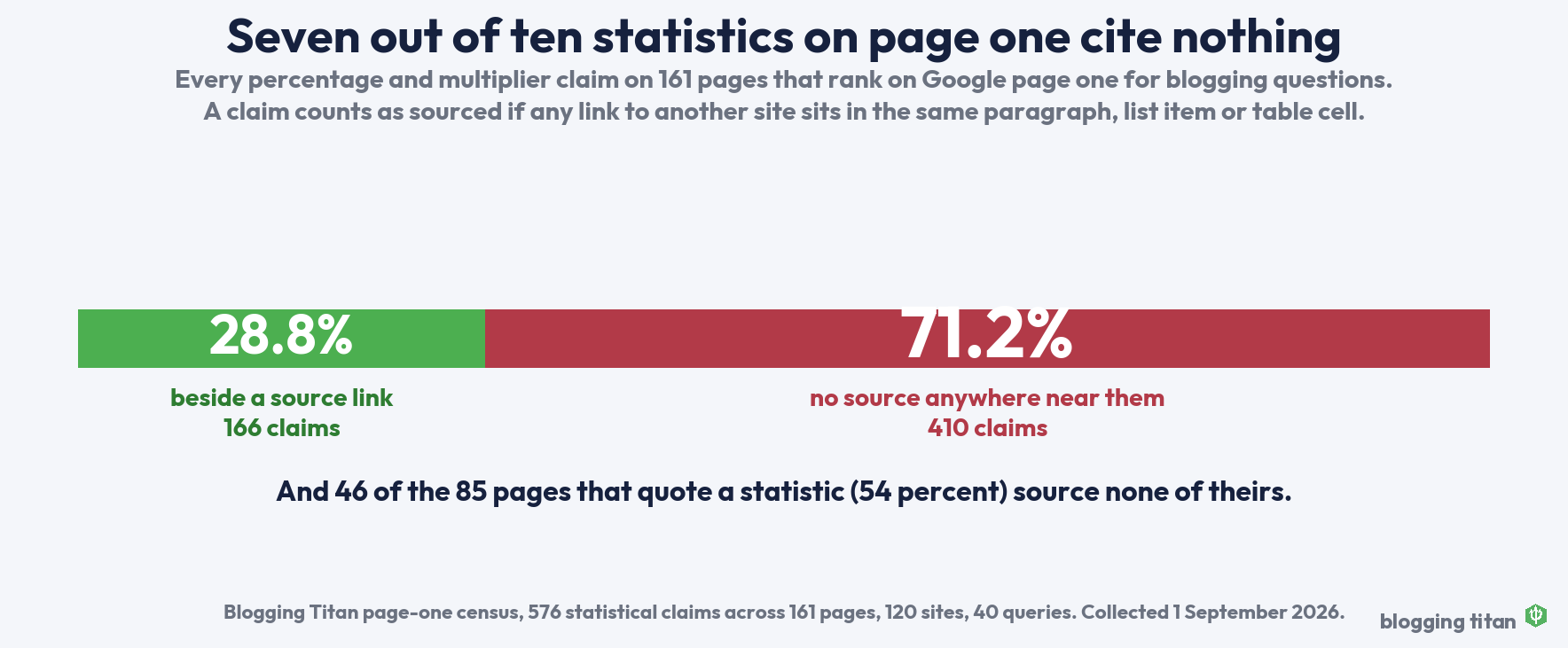
Quick answer: We took the 161 pages that rank on Google’s first page for 40 common blogging questions and counted every percentage and multiplier claim on them. There were 576. Only 166 had a link to another site anywhere in the same paragraph, list item or table cell. The remaining 410, or 71.2 percent, cite nothing. On the typical page that quotes a statistic, the share of claims with a source beside them is zero. We call that share a page’s source density.
Original study. 161 pages, 120 sites, 40 Google US queries, read from their Internet Archive captures on 1 September 2026.
The numbers, up front
- 71.2 percent of the statistical claims on those pages have no source link near them (410 of 576).
- 54 percent of the pages that quote a statistic source none of them (46 of 85).
- Median source density on a page that quotes statistics is zero. The mean is 30.7 percent, held up by a handful of careful pages.
- 5 of the 13 pages carrying ten or more statistics cite nothing at all. One carries 82 claims and links to nobody.
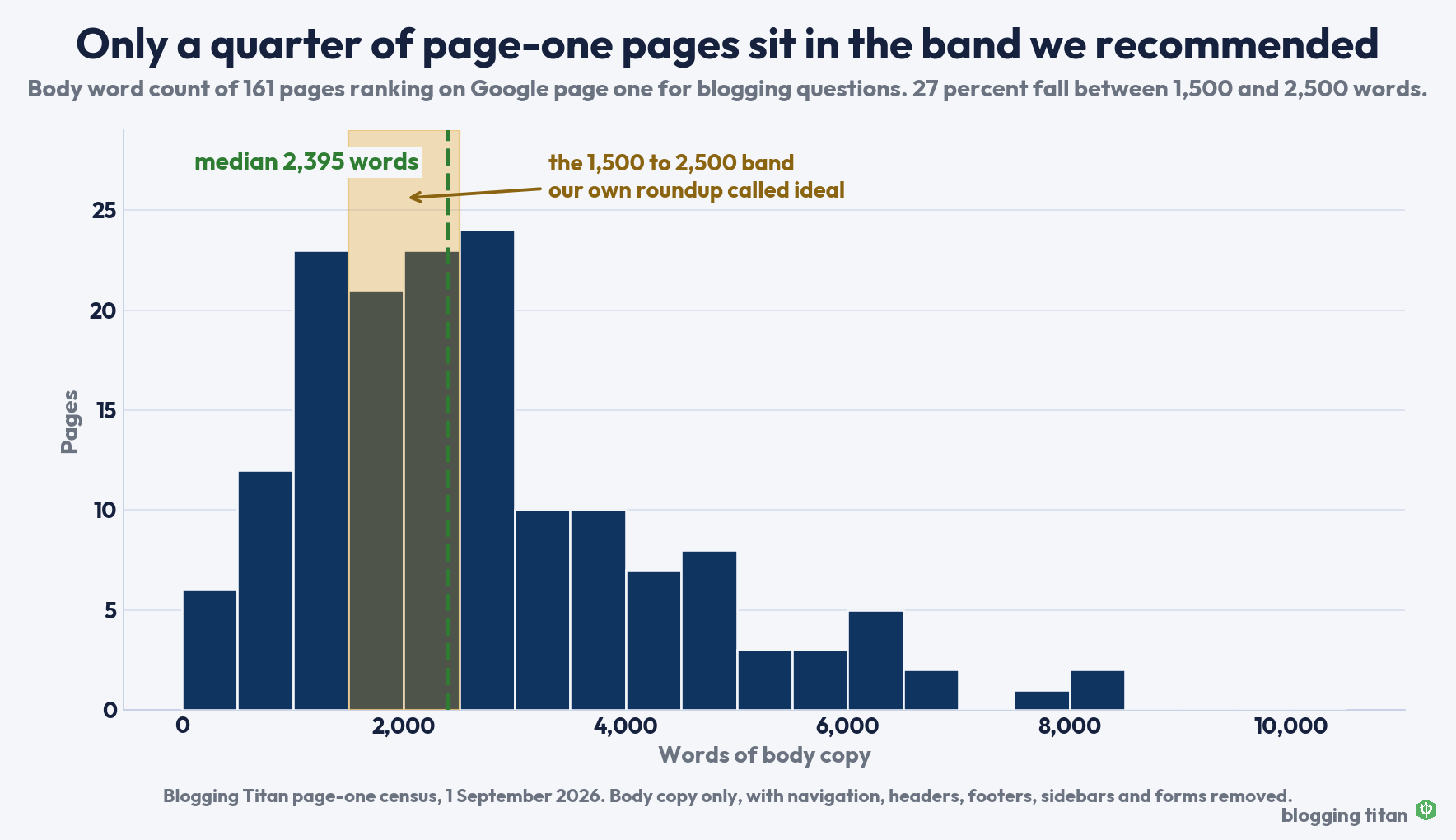
- The median page-one page runs 2,395 words. Only 27 percent sit inside the 1,500 to 2,500 band the roundups call ideal.
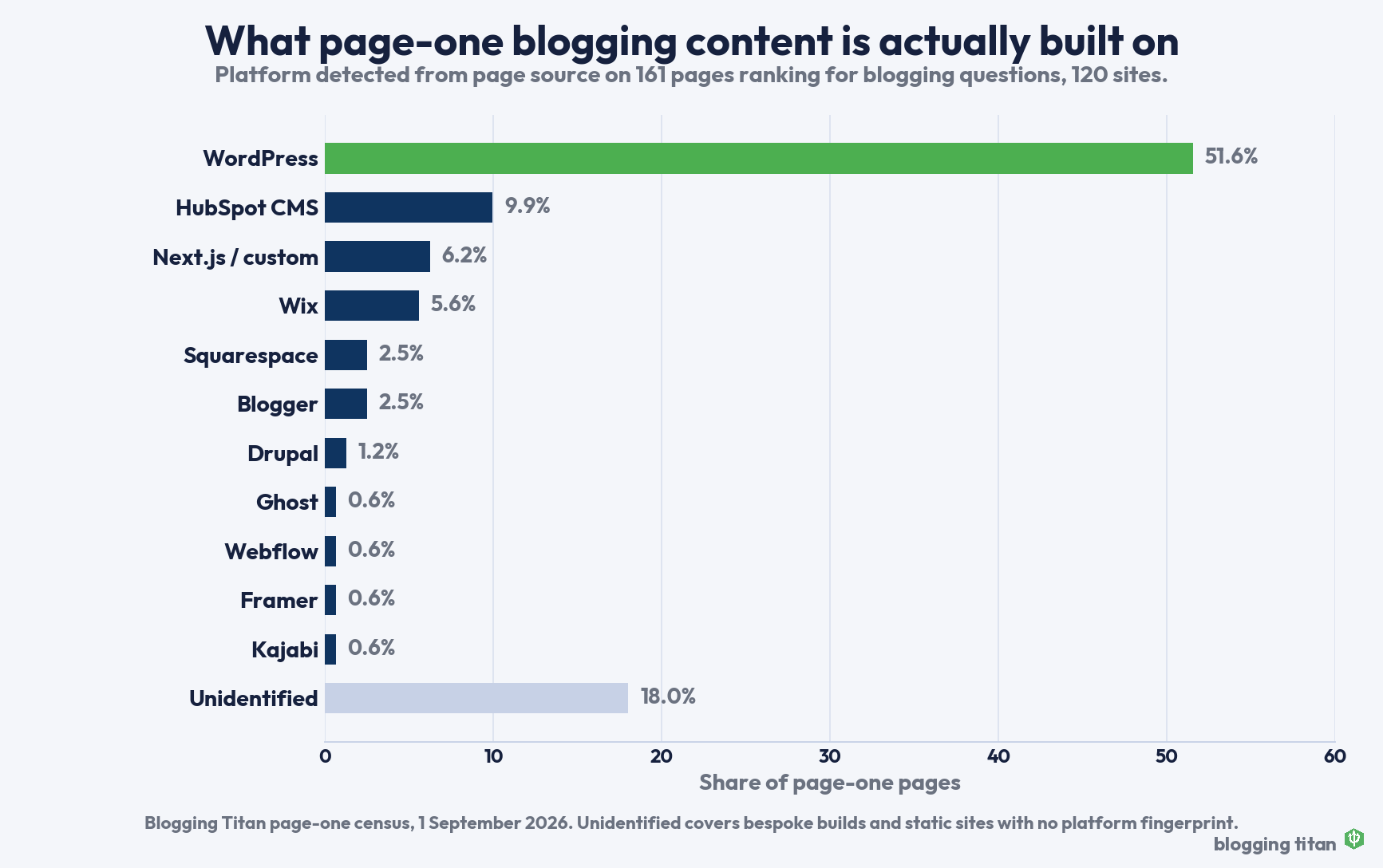
- WordPress runs 51.6 percent of page-one blogging content. HubSpot’s CMS comes second on 9.9 percent.
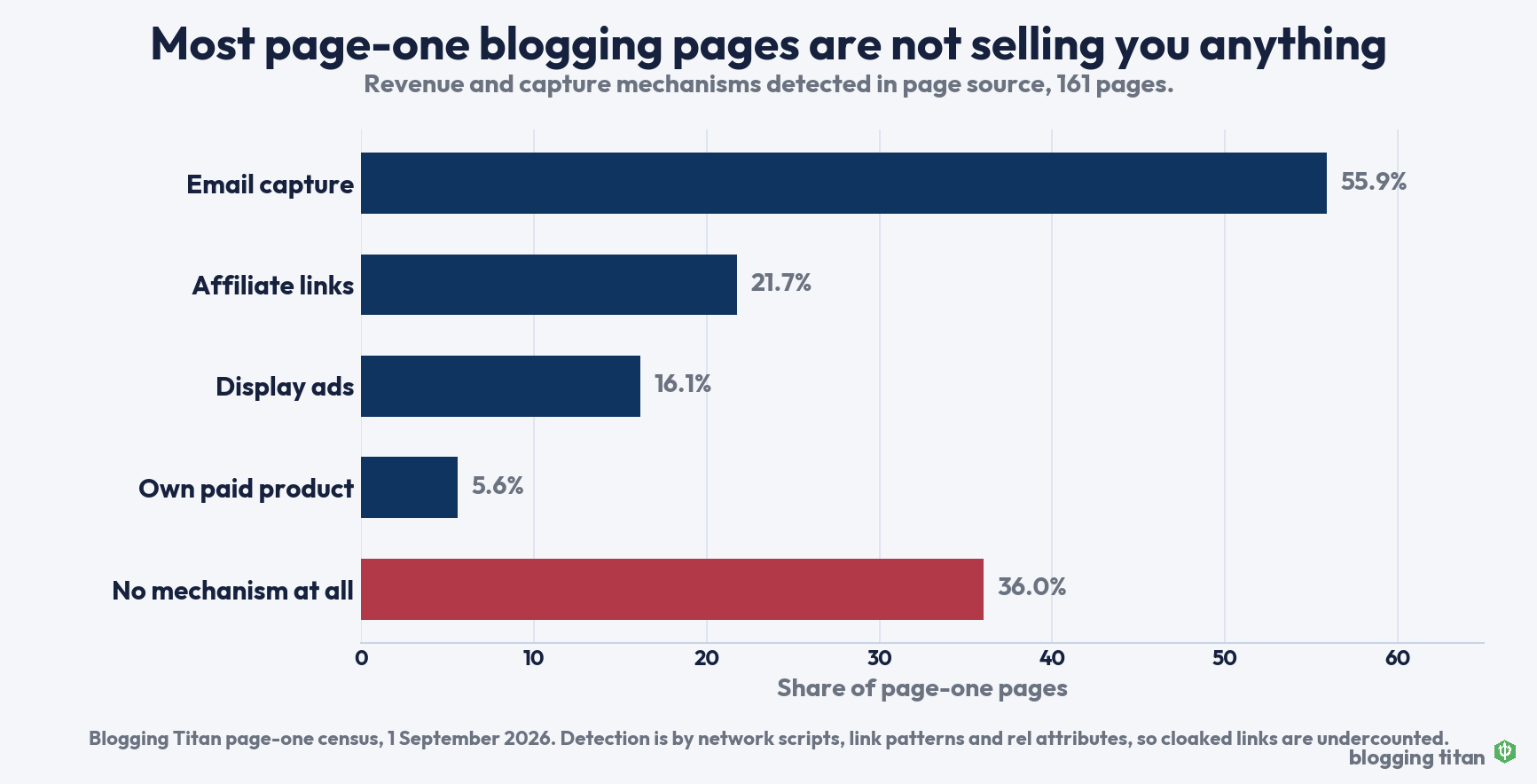
- Just 33.5 percent of these pages carry any revenue mechanism. 36 percent carry none at all, not even an email form.
- 29 percent publish no date of any kind.
What we actually did
We ran 40 blogging questions through Google in the United States in English with personalisation switched off. The questions covered the whole subject: starting a blog, traffic, SEO, monetisation, email, tools, AI writing, design, comments, backlinks. We took the organic results, dropped Reddit, Quora, YouTube, LinkedIn, Medium and the other platforms where the page is a thread instead of an article, and deduplicated. That left 221 unique URLs.
Then we read each page from its most recent Internet Archive capture. That choice costs a little freshness and buys two things worth more. Every measurement points at a permanent URL that anybody can open and check, and the study can be re-run in a year against the same captures even after the live pages have changed. Median capture age was 109 days.
Twenty-seven URLs had no usable capture. Ten had nothing captured since September 2025. Twenty-three were product pages, tool listings or category stubs with under 200 words of body copy. The remaining 161 pages across 120 sites are the study. Body copy was measured with navigation, headers, footers, sidebars and forms stripped out.
The dataset is published in full: every URL, its archive capture link and every measurement behind the figures below, 161 rows of CSV. The last column names the query each page was first found under.
For the sourcing test we split each page into its smallest text blocks: paragraphs, list items, table cells, headings, blockquotes and captions. In each block we counted percentages and multiplier claims of the “3x more traffic” kind. A claim counts as sourced if that same block holds a link to any other domain. The definition is deliberately loose. A link to a hosting affiliate programme counts. A link to the writer’s own newsletter tool counts. The true sourcing rate is lower than the one we report.
Seven in ten statistics have nowhere to go
A Lucky Orange page on website metrics carries 82 separate percentage claims, including an industry-average traffic split given to the nearest percentage point. It links to nobody. An Adobe page on posting frequency carries 28 claims and links to nobody. An Orbit Media page on blog design carries 27 and links to nobody. Between them those three pages put 137 numbers into circulation with no way back to whoever measured anything.
The habit is not universal, which is the useful part. The American Marketing Association’s explainer on content marketing links all 18 of its claims to Statista, Demand Metric or Wyzowl. A CNET piece on engagement sources 13 out of 13. Every link in this paragraph points at the archived capture we measured, so you can count them yourself. Sourcing a statistic costs one link. Plenty of pages that rank pay it.
Source density is the share of a page’s statistical claims that sit beside a link to where the number came from. It takes about a minute to work out for any page, including your own, and it is the number we will use from here on. It measures something different from our earlier work on stat laundering, which followed seven specific claims back through the chain of publishers that had stripped their caveats. Source density asks a blunter question: is there a chain to follow at all?
This site was part of the problem
Our own blogging statistics roundup carried more than ninety figures and not one outbound link to a source. It also carried a “cite this page” block, which invited readers to credit Blogging Titan for numbers Blogging Titan had never measured. That page is one of the biggest entry points on this site.
The first pass is done. The roundup now opens with the figures on this page, which are ours and are checkable. Its platform section has been rebuilt on numbers we opened and dated at W3Techs. The three claims this study contradicts, including that 1,350-word average, are gone. That still leaves about eighty borrowed figures on the page carrying no source link, and there is no point pretending otherwise while we work through them. Each one gets a named source and a link we have opened, or it comes out. A statistics page with fewer numbers and a source under each one is more use than a hundred orphans.
The advice about length does not describe page one
Until this week our own statistics roundup gave 1,350 words as the average blog post length and 1,500 to 2,500 words as the ideal. Neither number describes what actually ranks. The median page-one page in our sample runs 2,395 words. A quarter run under 1,469 and a quarter run over 3,619. Roughly a third clear 3,000 words. Only 27 percent land in the recommended band, which makes the band a description of about one page in four.
Position inside the top ten told us nothing about length. Median word counts by rank bounced between 1,727 and 3,406 with no order to them, on cells of eight to thirty pages each. Treat that as an absence of evidence in a small sample. The useful reading is the spread: the pages competing for these questions range from 365 words to 10,811, and both ends rank.
What page one is actually built on
The WordPress number that statistics pages quote, ours included, answers a different question from the one readers are asking. W3Techs put WordPress at 40.7 percent of all websites on 1 September 2026, and 58.9 percent of sites whose CMS is known. That population contains every parked domain, brochure site and shop on the web. Our roundup was quoting a stale version of it at 42.5 percent.
Among the pages that actually compete for blogging questions, WordPress runs 51.6 percent. The second platform is not Wix or Squarespace but HubSpot’s CMS on 9.9 percent, which is what happens when software companies publish the guides. Next.js builds take 6.2 percent, Wix 5.6 percent, Squarespace and Blogger 2.5 percent each, Drupal 1.2 percent. Ghost, Webflow, Framer and Kajabi appear once apiece. The remaining 18 percent left no platform fingerprint we could read, mostly bespoke and static builds.
Most page-one blogging pages sell nothing
Page one is less monetised than it is usually painted, and every figure in this section is a floor. Affiliate link patterns appear on 21.7 percent of pages and display ad networks on 16.1 percent. Only 5.6 percent sell something of their own. Add those together and allow for the overlap: 33.5 percent of page-one pages carry a money mechanism we could see. Cloaked links, server-side ad insertion and pages assembled in the browser all read as nothing to us, so the real share is higher. Thirty-six percent carry nothing we could detect at all, no ads, no affiliate links, no product and no email form.
Our earlier stake test found the opposite balance, because it looked at “best blogging tool” posts, where the whole genre exists to sell. Commercial intent concentrated in that commercial format. The general how-to layer measured here carries much less of it.
One gap is worth naming. The rel="sponsored" attribute that Google asks publishers to put on paid links appears on three pages in the whole sample, while 35 pages show affiliate link patterns. Our detection of both is imperfect, so treat the exact figures loosely and the direction seriously.
The rest of the census
The median page-one page carries 8 images and 17 subheadings, and 6.8 percent carry no image at all. Video is rarer than our own roundup claimed: 14.9 percent of pages embed one, against the 26 percent we used to quote. The median page links out 9 times, and 13.7 percent link to nobody. On dates, 69.6 percent declare when they were published and 68.9 percent when they were modified, which leaves 29.2 percent declaring neither. Forty pages claim a 2026 update. Our fake refresh study covers how much those claims are worth.
What this study cannot tell you
- We read archived captures, not live pages. The median capture was 109 days old, so a page that has been rewritten since will be measured as it was.
- The source test measures proximity, not truth. A link in the same paragraph might point anywhere, and we counted it. That makes 28.8 percent a ceiling.
- Platform, advertising and affiliate detection all work from patterns in the page source. Cloaked links, server-side ad insertion and content assembled in the browser are undercounted.
- Forty head queries in one country and one language. A different question set returns different pages and probably different numbers.
- Blogging Titan does not rank on page one for any of these 40 queries, so this is not a sample we are grading ourselves inside.
- Word counts come from parsed body copy. An unusual template can be measured generously or meanly, which matters at the tails.
- Source density punishes original research. A page reporting its own measurements has nothing to link to and scores zero, and so does a page that names its source in prose without a hyperlink or keeps its references in a footnote. Some of the 46 pages that source nothing will be in that position.
- We counted percentages and multiplier claims. Prices, revenue totals, item counts and dates were left out, so this is not every number on these pages.
Frequently asked questions
What is source density?
The share of a page’s statistical claims that sit beside a link to where the number came from. Count the percentages and multipliers on a page, count how many have a source link in the same paragraph, list item or table cell, and divide. Across 161 page-one blogging pages the figure is 28.8 percent, and on the median page that quotes any statistic it is zero.
Why does an unsourced statistic matter?
Because it cannot be checked, corrected or dated. A number with no origin gets copied into the next roundup with the same confidence and none of the caveats, and by the third copy the sample size, the year and the definition have all gone. Anyone quoting it is trusting a stranger’s typing.
Is 71 percent unusually bad for blogging content?
We have only measured this subject, so we cannot say whether other niches are better or worse. What we can say is that the pages sourcing their claims properly are sitting on the same results pages as the ones sourcing nothing, so the standard is achievable at this level of competition.
Does citing your sources help you rank?
Our data cannot answer that. We measured what ranks, not why, and both careful and careless pages rank. The argument for sourcing is that it makes your page correctable and gives other writers something to cite, which is a different benefit from a ranking one.
How did you decide what counts as a statistic?
Any percentage figure, and any multiplier phrased as “3x more” or “twice as fast” and similar. Prices, dates, list positions and counts of items were left out, because a page saying it lists 21 tools is not making a claim about the world.
Can I use this data?
Yes. The figures on this page are ours, they are licensed CC BY 4.0, and the citation block below has the details. If you quote one, link back so your readers can do what most of the pages in this study made impossible.
Cite this data
| Statistical claims with a source link | 28.8 percent (166 of 576) |
| Claims with no source link | 71.2 percent (410 of 576) |
| Pages quoting a statistic that source none | 54.1 percent (46 of 85) |
| Median source density per stat-quoting page | 0 percent |
| Median body word count | 2,395 words |
| Pages in the 1,500 to 2,500 word band | 27.3 percent |
| WordPress share of page-one pages | 51.6 percent |
| Pages with any revenue mechanism | 33.5 percent |
| Pages embedding video | 14.9 percent |
| Pages with no publish or modified date | 29.2 percent |
| Sample | 161 pages, 120 sites, 40 Google US queries |
| Collected | 1 September 2026, from Internet Archive captures |
| Dataset | 161 rows, CSV, with a capture link per page |
Plain citation: Blogging Titan (2026). The Page-One Blogging Census: 71 Percent of Statistics Cite No Source. bloggingtitan.com
Data licensed CC BY 4.0. Attribution to Blogging Titan with a link to this page.
- Blogging statistics for 2026, the roundup this study rebuilt.
- Stat laundering, where we traced seven conversion claims back to their sources and watched the caveats fall off.
- The ghost author test, on the 31 percent of page-one blogging advice with no verifiable author.
- The stake test, on who gets paid when a tool post recommends a tool.
- The fake refresh study, on what an “updated 2026” label is actually worth.
Volume estimates are one more unsourced number, which is why our free blog keyword generator shows live autocomplete suggestions and refuses to invent volumes.

Written by
Blogging Titan Team
Blogging Titan is an independent team of bloggers documenting what actually grows a blog in the AI search era. We have been building, ranking, and monetizing WordPress sites since 2017, and every guide on this site is based on strategies and tools we have tested ourselves. Want a second pair of eyes on your blog? Request a free blog audit or start with the 2026 playbook.