

The AI Citation League Table: What ChatGPT and Perplexity Cite When You Ask Them 100 Blogging Questions
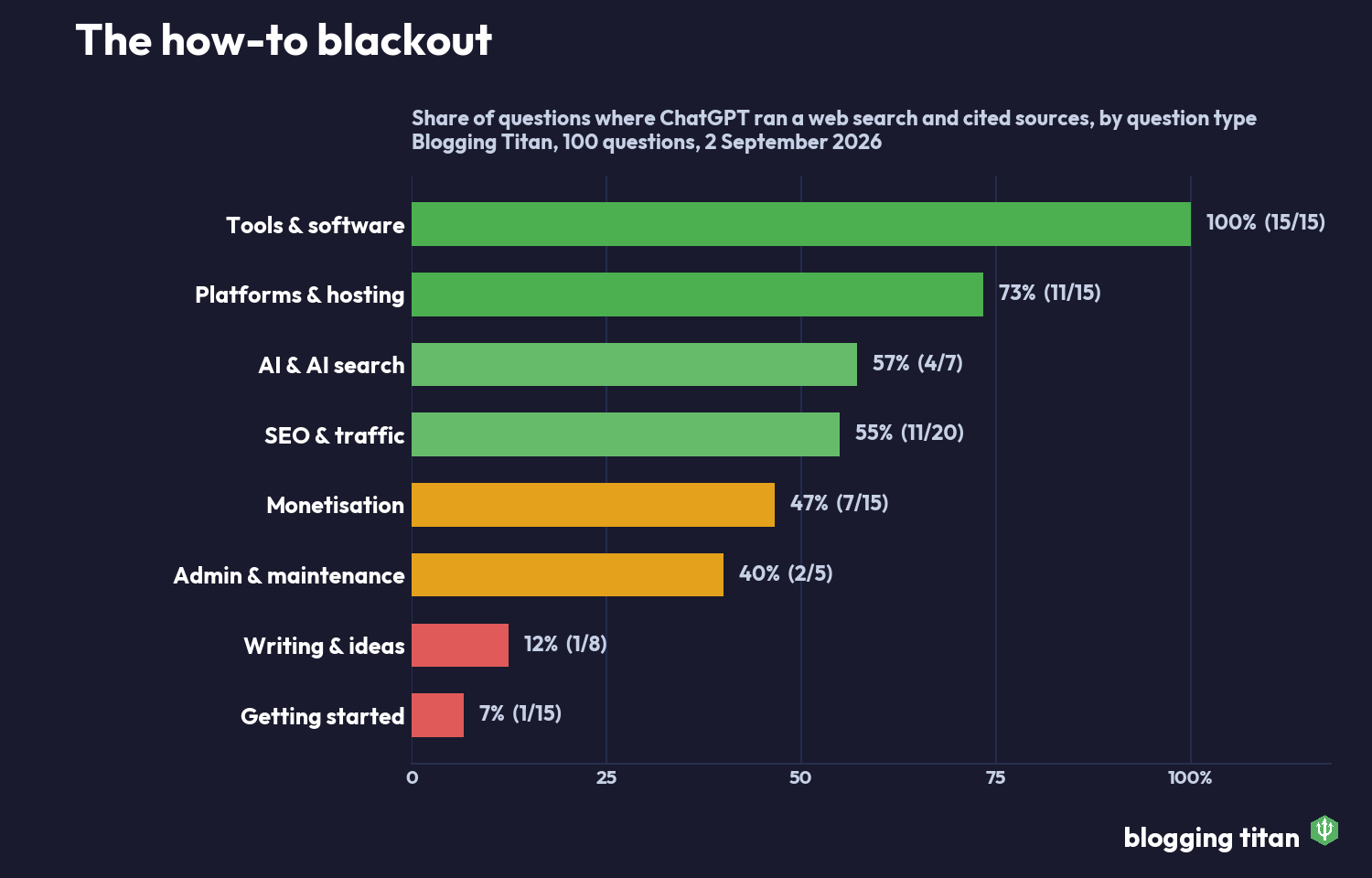
Quick answer: We put the same 100 blogging questions to ChatGPT and to Perplexity and logged every source each one cited. Perplexity cited sources on all 100 questions. ChatGPT cited nobody at all on 48 of them, and the silence was concentrated at one end of the topic range: it opened the web for 15 of 15 tool and software questions and for 1 of 15 getting-started questions. We call that collapse the how-to blackout. The two engines also draw on very different source pools: 32 of the 652 domains in the study appeared in both, although those 32 carry 63 percent of ChatGPT’s citations.
Original study. 100 questions, 2 engines, 1,243 citations, 2 September 2026.
The numbers, up front
- 48 of 100 ChatGPT answers cited no source at all. Perplexity cited sources on 100 of 100.
- ChatGPT ran a web search on 15 of 15 tool and software questions, and on 1 of 15 getting-started questions. That spread is the how-to blackout.
- The two engines produced 652 distinct domains between them. Only 32 were cited by both, out of a possible 100, because ChatGPT only ever used 100 domains. Those 32 shared domains carried 63 percent of ChatGPT’s citations and 20 percent of Perplexity’s.
- On the 52 questions where both engines cited something, mean overlap was 4.5 percent. On 29 of those 52 the two engines shared no domain whatsoever.
- Reddit was the single most cited domain overall, on 33 of 100 questions. Every one of those citations came from Perplexity. ChatGPT cited Reddit zero times.
- 533 of the 652 domains were cited on exactly one question. The top 10 domains held 21.5 percent of all 1,243 citations.
- Google’s own properties supplied 46 of ChatGPT’s 244 citations (18.9 percent) and 5 of Perplexity’s 999 (0.5 percent).
What we actually did
We wrote 100 questions a blogger would plausibly type, spread across eight kinds of intent: getting started, platforms and hosting, tools and software, SEO and traffic, monetisation, writing and ideas, AI and AI search, and admin and maintenance. Real questions, in ordinary words, with no prompt engineering and no instruction to search.
Each question went to ChatGPT and to Perplexity on 2 September 2026, one question per fresh conversation, in a Chrome browser on a UK connection. For every answer we harvested the cited sources straight out of the page and reduced each one to host plus path. Every capture carried a guard that compared the question actually asked on the page with the question we intended to ask, so a mis-fire was recorded as a failure rather than silently saved as data. All 200 captures passed the guard.
The two engines are not configured identically, and it matters. ChatGPT was signed in to a personal account on the free plan, because that is how most people use it. Perplexity was signed out. Neither was told to search; we let each decide. That is the point of the study: we wanted the behaviour a reader gets, not the behaviour you can force out of a tool if you know the switches.
One structural difference shapes every count that follows. Perplexity returned exactly 10 sources on 99 of the 100 questions, and 9 on the hundredth, where its own label said 10 but two entries pointed at the same URL. Its source count is a fixed retrieval slot, not a measure of effort. ChatGPT, when it cited at all, cited a median of 4.5 sources with a range of 1 to 12. So Perplexity contributed 999 citations to the study and ChatGPT contributed 244, and any comparison of raw volume between them is meaningless. What is comparable is which sites each one reaches for, and how often each one reaches for the web at all.
Half of ChatGPT’s answers cite nobody
This was the first surprise, and it reframes the whole exercise.
Forty-eight of the 100 answers ChatGPT gave contained no citation and no source pill. It answered from the model, closed book. On the other 52 it searched the web and attributed what it found. Two of the 48 silent answers did include plain links in the prose, to sites like WordPress.com and Reddit, but as unattributed mentions rather than as cited sources.
If you only look at that headline it sounds like a coin flip. It is not. The split tracks intent almost perfectly.
| Question type | Questions | ChatGPT searched and cited |
|---|---|---|
| Tools and software | 15 | 15 (100 percent) |
| Platforms and hosting | 15 | 11 (73 percent) |
| AI and AI search | 7 | 4 (57 percent) |
| SEO and traffic | 20 | 11 (55 percent) |
| Monetisation | 15 | 7 (47 percent) |
| Admin and maintenance | 5 | 2 (40 percent) |
| Writing and ideas | 8 | 1 (12 percent) |
| Getting started | 15 | 1 (7 percent) |
Ask ChatGPT which SEO tool to buy and it goes to the web every single time. Ask it how to start a blog, how to write a headline, what your first post should be about, how to beat writer’s block, how often to publish, and it answers from memory and cites nobody. Fourteen of the 15 getting-started questions and 7 of the 8 writing questions produced answers with no source attached to them.
That is the how-to blackout. “How to start a blog” is the most fought-over query in this niche, and on this data there is no citation slot to compete for on it in ChatGPT at all. The answer arrives with nobody’s name on it.
One qualification, because the name could mislead. The split is by topic, not by the word “how”. Forty-one of our 100 questions begin with “How”, and ChatGPT searched on 16 of them, including “How do I get my blog to rank on Google?”, “How do I speed up a slow WordPress blog?” and “How do I find blog post ideas?”. Of the 48 silent answers, 21 were getting-started or writing questions and the other 27 were spread across SEO, monetisation, platforms, admin and AI. The blackout is real and it is severe at the getting-started end, but it is not a rule about question phrasing.
The pattern is consistent with a system that searches when an answer would go stale or when the user is close to a purchase, and does not search when the answer is stable advice it already holds. Which is defensible product design. It is also a strategic fact about where attribution is available and where it is not.
The league table
Here is the thing bloggers keep asking for: who actually gets cited.
The ranking below counts reach, which is the number of the 100 questions a domain appeared on for either engine. We use reach rather than raw citation count because a single answer can cite the same domain several times over: ChatGPT cited seven separate Google documentation pages inside one answer, and Reddit’s 46 citations come from 33 questions. Reach asks how many different questions a domain turns up for, which is the thing worth knowing.
Two things to hold in mind while reading it. First, it is mostly a Perplexity table: of the 1,079 question-and-domain pairs in the study, Perplexity supplied 957 and ChatGPT 149, so 89 percent of the reach in this ranking is Perplexity’s. Nine of the 25 rows have a ChatGPT count of zero. Second, the lower half is full of ties, at 8, 7 and 6 questions, and we broke them by total citation count and then alphabetically. Ranks 19 to 25 should be read as a band, not as an order.
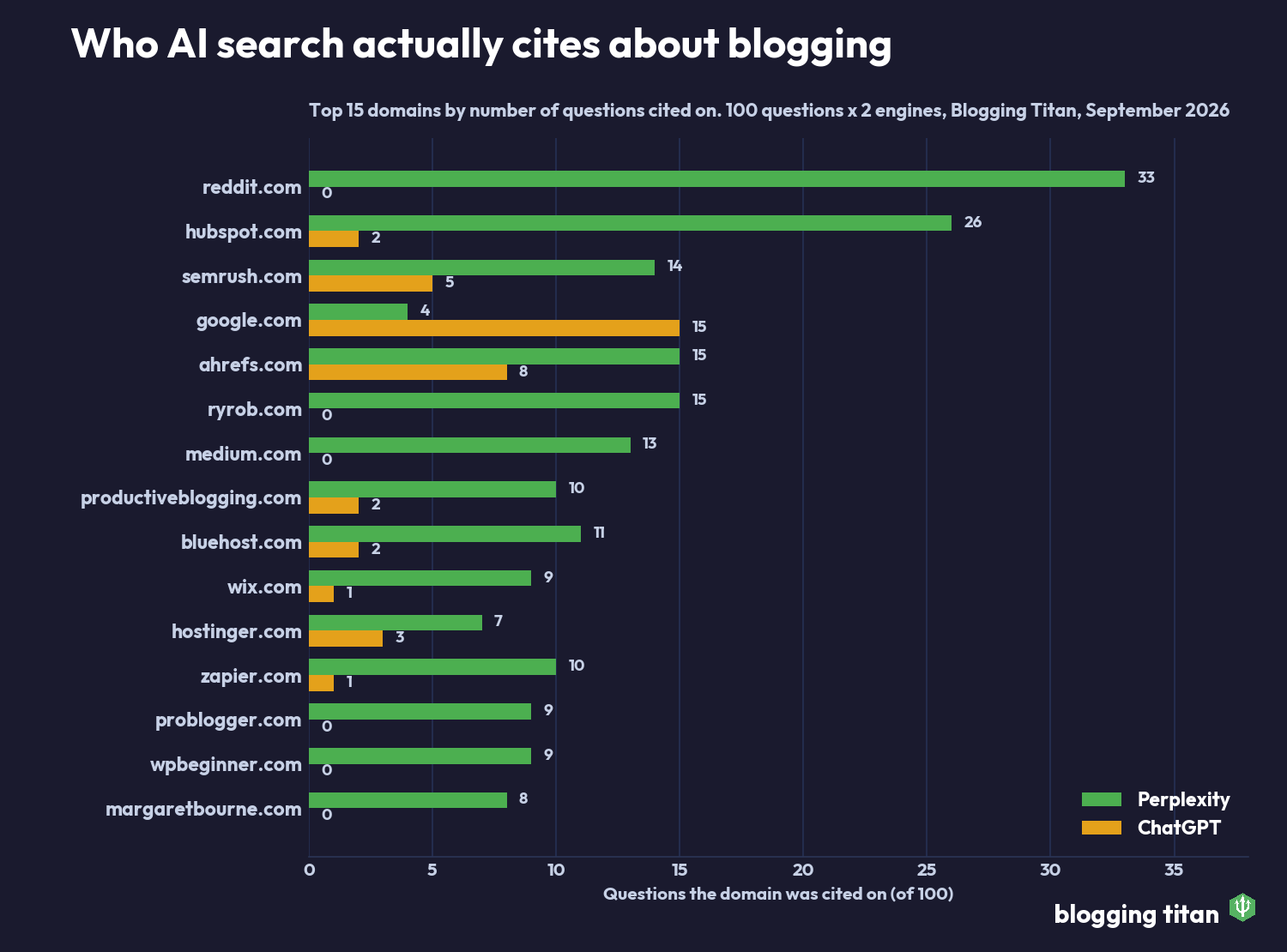
| # | Domain | Questions cited on | ChatGPT | Perplexity |
|---|---|---|---|---|
| 1 | reddit.com | 33 | 0 | 33 |
| 2 | hubspot.com | 27 | 2 | 26 |
| 3 | semrush.com | 18 | 5 | 14 |
| 4 | google.com | 17 | 15 | 4 |
| 5 | ahrefs.com | 16 | 8 | 15 |
| 6 | ryrob.com | 15 | 0 | 15 |
| 7 | medium.com | 13 | 0 | 13 |
| 8 | bluehost.com | 11 | 2 | 11 |
| 9 | productiveblogging.com | 11 | 2 | 10 |
| 10 | wix.com | 10 | 1 | 9 |
| 11 | hostinger.com | 10 | 3 | 7 |
| 12 | zapier.com | 10 | 1 | 10 |
| 13 | problogger.com | 9 | 0 | 9 |
| 14 | wpbeginner.com | 9 | 0 | 9 |
| 15 | margaretbourne.com | 8 | 0 | 8 |
| 16 | linkedin.com | 8 | 0 | 8 |
| 17 | yoast.com | 8 | 3 | 7 |
| 18 | shopify.com | 8 | 1 | 8 |
| 19 | kinsta.com | 7 | 1 | 6 |
| 20 | wordpress.org | 7 | 6 | 2 |
| 21 | wordpress.com | 7 | 2 | 6 |
| 22 | seranking.com | 7 | 0 | 7 |
| 23 | backlinko.com | 7 | 1 | 6 |
| 24 | neilpatel.com | 7 | 0 | 7 |
| 25 | forbes.com | 6 | 0 | 6 |
Three things stand out in that table.
The first is Reddit at number one, on a third of all questions, entirely on the strength of one engine. That top spot is a reach ranking: counted by raw citations instead, Reddit’s 46 ties exactly with google.com’s 46, and Google’s properties as a group total 67 across both engines. We found the same dominance in Google’s organic results earlier this year, where user-generated content held 30 percent of page-one slots and Reddit took the number one position on 19 of 30 blogging queries. Perplexity behaves like Google here. ChatGPT does not behave like either.
The second is HubSpot at number two on 27 questions, which is a marketing blog outranking every dedicated blogging publication in the niche. We did not audit those 27 pages, so we cannot say from this data what earns HubSpot the position. What we can say is that a general marketing blog outranks every dedicated blogging publication in the niche on both engines’ retrieval.
The third is that a handful of independent bloggers hold real positions in this table. Ryan Robinson’s ryrob.com is cited on 15 questions, more than Wix, Hostinger or WordPress.org. Productive Blogging is on 11. Margaret Bourne is on 8. Problogger is on 9. This is not a table that only large publishers can enter.
The two engines barely agree on anything
Across the 100 questions the two engines cited 652 distinct domains. ChatGPT used 100 of them, Perplexity used 584, and just 32 appeared in both. Thirty-two sounds tiny against 652, but ChatGPT only ever used 100 domains, so 100 was the ceiling: read it as 32 of a possible 100.
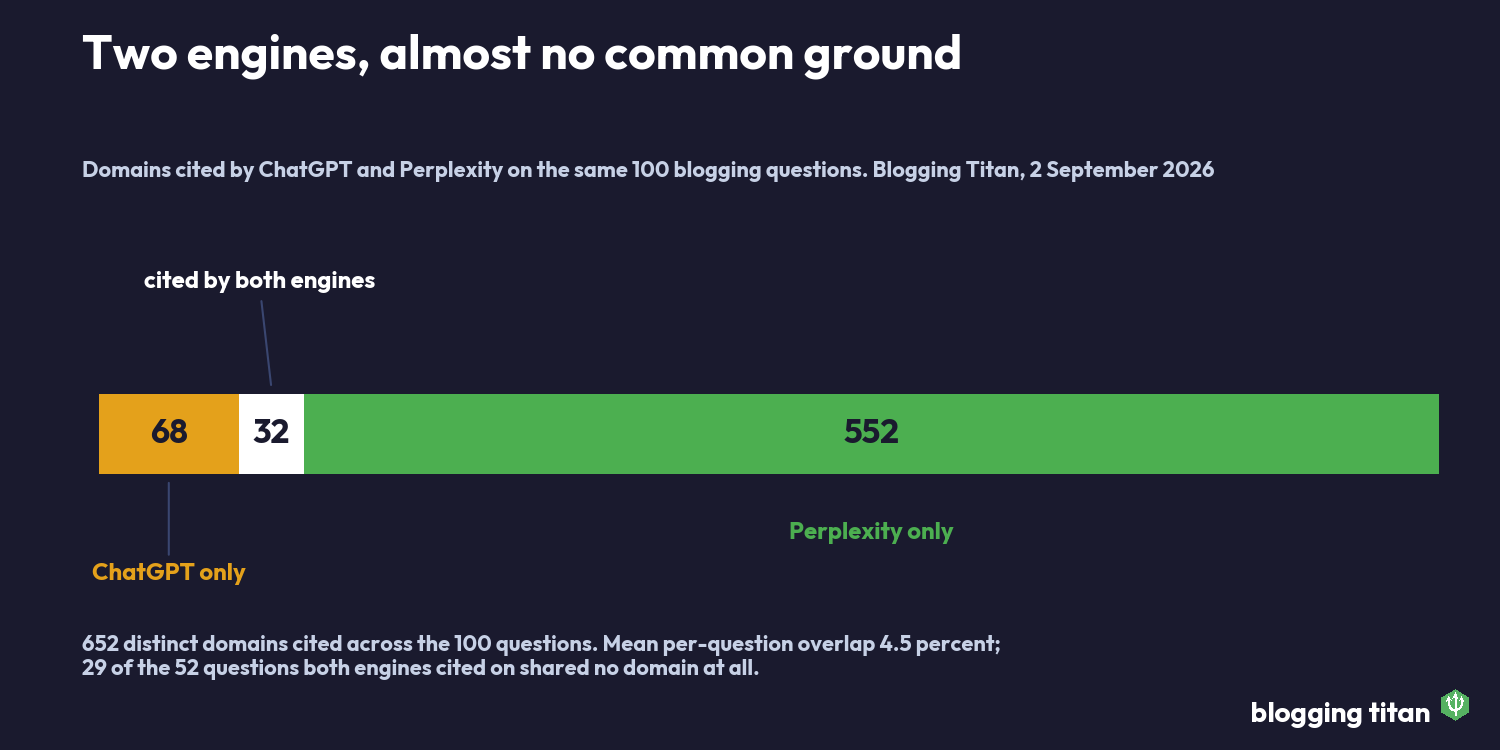
Per question the picture is starker. On the 52 questions where both engines cited something, mean overlap measured as a Jaccard index was 0.045, and on 29 of those 52 questions the engines shared no domain at all. Because ChatGPT’s citation sets are much smaller than Perplexity’s fixed 10, the highest overlap that could have been recorded on this data was 0.293 on average, not 1.0. Even measured against its own ceiling, observed overlap sat at 15 percent of what was possible.
There is a counterweight to all of this, and it is the most important qualification in the study. Those 32 shared domains are small in number but heavy in use. Sixty-three percent of ChatGPT’s 244 citations (153) landed on a domain Perplexity also cited, and 20 percent of Perplexity’s 999 (197) landed on a domain ChatGPT also cited. The engines broadly agree on a small core and disagree almost completely about everything outside it. If you are already in that core, both engines find you. If you are not, being cited by one tells you very little about the other.
When the two engines did land on the same site, it was usually the vendor named in the question. Both cited wordpress.com and wordpress.org for “WordPress.com vs WordPress.org”, both cited yoast.com and rankmath.com for “Yoast vs Rank Math”, both cited ghost.org for the Ghost question and bluehost.com for the Bluehost one. Agreement between engines is mostly agreement that a company’s own website describes that company’s product.
Everywhere else they diverge, and they diverge in a legible direction.
One engine reads the documentation, the other reads the blogs
ChatGPT’s most cited domain was google.com. Google’s own properties, meaning Search Central, Search Console help, the Google blog and Blogger, accounted for 46 of ChatGPT’s 244 citations, or 18.9 percent. The same properties accounted for 5 of Perplexity’s 999, or 0.5 percent.
Ask ChatGPT how to get indexed faster and it cites seven pages of Google documentation. Ask about affiliate disclosure and it cites the FTC endorsement guides. Ask whether to block AI crawlers and it cites Anthropic’s crawler documentation and Perplexity’s own robots.txt help page. Ask about llms.txt and it cites llmstxt.org itself.
Perplexity almost never does that. It cites the people writing about the documentation.
The forum split is even cleaner. Not one Reddit, Quora, Stack Overflow, LinkedIn, Medium or YouTube URL appeared anywhere in ChatGPT’s 244 citations. Perplexity cited that group 75 times across 45 of the 100 questions, 46 of them Reddit.
The contrast is real but it should not be overstated. Documentation, standards bodies, regulators and published research together account for about 29 percent of ChatGPT’s citations (70 of 244). Most of the rest are vendor and tool sites, and a substantial remainder are small sites we could not identify. On the WordPress.com versus WordPress.org question, ChatGPT’s nine citations included a Behance portfolio gallery, a Fiverr gig listing and an article about designing websites for Generation Z. It is not a uniformly high-quality citation set.
Still, the two engines are not two samples of one behaviour. They are two different editorial policies. One leans towards the primary source and the vendor. The other leans towards the secondary write-up and the forum thread.
Being cited once is normal. Being cited twice is not.
Of the 652 domains in the study, 533 were cited on exactly one question. Thirty-nine reached five or more questions, and only 12 reached ten or more. The 10 domains with the most citations held 21.5 percent of all 1,243, and the top 20 held 29.8 percent. Ranked by reach instead, as in the table above, the top 10 rows hold 20.9 percent.
That distribution matters for how you read your own results. A single AI citation is a weak signal. It puts you in a group of 533 sites that also got one. The table above is a different thing entirely: it is the small set of domains that AI search returns to across a topic, and that is what topical presence actually looks like from the retrieval side.
It is also worth saying plainly that Blogging Titan does not appear anywhere in this dataset. Not once, on either engine, across 100 questions and 1,243 citations. We publish original research in this niche and we are not in the retrieval set for it. That is the honest starting position, and it is a large part of why we ran the study.
What to do with this if you write about blogging
Check which game your page is in before you optimise for citations. If your page answers a getting-started or writing question, ChatGPT will most likely answer that question without citing anyone, and no amount of citability work changes that. The citation opportunity sits in tool, platform, comparison and pricing questions, where ChatGPT went to the web every time or nearly every time.
Do not treat the two engines as one channel. With a 4.5 percent overlap they are separate audiences with separate source pools. Being cited by Perplexity tells you very little about whether ChatGPT will cite you, and the reverse is more true still.
If Perplexity is your target, the blogosphere is the retrieval set. Independent blogs, forum threads and Medium posts are in there in volume. Being genuinely useful and well linked in that ecosystem is the route.
If ChatGPT is your target, aim at the primary-source end. Documentation, standards bodies, regulators and vendors made up the largest identifiable share of what it cited. The nearest thing to that for an independent publisher is holding the original data, so that you are the primary source for a fact rather than the fourth site to repeat it. That said, ChatGPT also cited a long list of small unknown sites, so this is a tilt in the odds rather than a rule.
Do not read one citation as a position. On this data, and on our earlier work showing that rewording a question changes 57 percent of the sources, a single check on a single phrasing on a single day is one draw from a wide distribution. Sample the question several ways before you record a verdict.
Limitations, stated plainly
This is one snapshot, taken on one day, from one browser, on one connection in the United Kingdom. AI answers move. Every number here is a measurement of 2 September 2026 and should be re-run rather than assumed.
The two engines were not configured identically. ChatGPT was signed in to a personal free-plan account with the default model, which means account-level personalisation and memory could have influenced its answers. Perplexity was signed out. We chose realism over symmetry, and a signed-out ChatGPT or a Pro-plan Perplexity would very plausibly behave differently.
Free-tier rate limiting interrupted the ChatGPT run twice and the Perplexity run once. We waited and resumed rather than working around any limit, so the 200 captures were collected over several hours rather than a single continuous block.
We counted attribution as it was presented to the reader. For ChatGPT that means the source list attached to the answer, including sources folded behind the “+2” style pills, which we read from the page rather than from what was visible. For Perplexity it means the answer’s source set. Query strings were stripped from every URL, so two different pages on the same path would merge, and domains were reduced to the registrable domain, so blog.hubspot.com counts as hubspot.com.
We also recorded plain links that appeared in ChatGPT’s prose without being presented as sources. There were 44 of them across 13 questions. They are excluded from every count in this study, which is why the answer to “does ChatGPT cite Reddit” is no while ChatGPT did once name Reddit in a sentence. The published dataset holds the citation sets; the capture-time metadata, including the question guard and session notes, is not part of the release.
Domains are reduced to the registrable domain, which has one visible consequence in the table: google.com ranks fourth without a single google.com URL in the data. Its 17 questions are developers.google.com and support.google.com. The same reduction folds blog.hubspot.com into hubspot.com.
Finally, this study measures citation, not traffic. A citation is a mention with a link in an interface where most people do not click. It is a visibility signal, not a visit.
Frequently asked questions
What is the how-to blackout?
The how-to blackout is the pattern where ChatGPT answers how-to and getting-started questions from its own model without running a web search, so no source is cited and there is no citation to compete for. In this study ChatGPT searched and cited on 15 of 15 tool questions but on only 1 of 15 getting-started questions and 1 of 8 writing questions.
Which website gets cited most by AI search for blogging questions?
Across 100 blogging questions put to ChatGPT and Perplexity in September 2026, reddit.com was cited on the most questions (33 of 100), followed by hubspot.com (27), semrush.com (18), google.com (17) and ahrefs.com (16). Reddit’s citations came entirely from Perplexity.
Does ChatGPT cite Reddit?
Not as a source. Across 100 blogging questions and 244 citations, ChatGPT cited no Reddit, Quora, Stack Overflow, LinkedIn, Medium or YouTube page at all. It did name Reddit and Quora as plain links inside the text of one answer, without attribution. Perplexity cited that group 75 times across 45 questions, 46 of them Reddit.
How much do ChatGPT and Perplexity overlap?
Very little by domain, more than you would think by volume. Of 652 domains cited across the study, 32 appeared in both engines’ citations, out of a possible 100. On the 52 questions where both cited something, mean overlap was 4.5 percent, and 29 of those 52 shared no cited domain at all. But those 32 shared domains carried 63 percent of ChatGPT’s citations and 20 percent of Perplexity’s, so the engines agree on a small core and diverge everywhere else.
Why did ChatGPT cite fewer sources than Perplexity?
Two reasons. It declined to search on 48 of 100 questions, and when it did search it cited a median of 4.5 sources against Perplexity’s fixed 10. The totals, 244 against 999, reflect both behaviours and should not be read as a quality comparison.
How do I get my blog cited by AI search?
Pick the engine and the question type first. For ChatGPT, aim at tool, platform and comparison questions and try to be the primary source for a fact rather than a repeater of one. For Perplexity, the retrieval set is the wider blogosphere including forums, so useful, well-linked, genuinely independent writing is the route. Do not assume work for one engine carries to the other.
How was this data collected?
One hundred blogging questions, each asked once of ChatGPT and once of Perplexity on 2 September 2026 through a Chrome browser on a UK connection, one question per fresh conversation, with no instruction to search. Cited sources were harvested from each answer and reduced to host plus path. Every capture was checked against the intended question before being recorded; all 200 passed.
Cite this data
| ChatGPT answers citing no source | 48 of 100 |
| Perplexity answers citing sources | 100 of 100 |
| ChatGPT search rate, tool questions | 15 of 15 (100 percent) |
| ChatGPT search rate, getting-started questions | 1 of 15 (7 percent) |
| Most cited domain overall | reddit.com, 33 of 100 questions |
| Domains cited by both engines | 32 of 652 (of a possible 100) |
| Citations landing on a shared domain | 63 percent ChatGPT, 20 percent Perplexity |
| Mean per-question engine overlap | 4.5 percent (ceiling 29.3 percent) |
| Domains cited on one question only | 533 of 652 |
| Google-owned share of citations | 18.9 percent ChatGPT, 0.5 percent Perplexity |
| Sample | 100 questions, 2 engines, 1,243 citations |
| Collected | 2 September 2026, UK connection |
Plain citation: Blogging Titan (2026). The AI Citation League Table: What ChatGPT and Perplexity Cite When You Ask Them 100 Blogging Questions. bloggingtitan.com
Data licensed CC BY 4.0. Attribution to Blogging Titan with a link to this page.
- The AI Crawler Log, which AI bots actually visit a small blog, and why blocking GPTBot misses the one that matters.
- The Paraphrase Re-roll, why rewording a question changes most of the sources.
- The Reddit Tax, how much of page one in this niche is user-generated content.
- Google AI Overview versus Perplexity, the 10-question study this one scales up.
- The Page-One Census, what page one for blogging queries is actually made of.
- The AI Citation Grader, our free tool for scoring a page on citability.
- The Nameless Citation, who wrote the pages these two engines cited.
The topic table above now powers the AI badges in our free blog keyword generator: every suggestion it returns is tagged with whether it sits in the how-to blackout or the citation lane.
Reddit’s absence from ChatGPT’s 244 citations is taken apart next to Google and Perplexity in the citation understudy, which reads 30 Google AI Overviews beside the organic results underneath them.

Written by
Blogging Titan Team
Blogging Titan is an independent team of bloggers documenting what actually grows a blog in the AI search era. We have been building, ranking, and monetizing WordPress sites since 2017, and every guide on this site is based on strategies and tools we have tested ourselves. Want a second pair of eyes on your blog? Request a free blog audit or start with the 2026 playbook.