
Quick answer: We read 951 of the pages ChatGPT and Perplexity cited across 100 blogging questions and looked for a publication date on each. 224 of them carry none. The engines also reach back to different depths. Setting documentation aside, 39.5 percent of ChatGPT’s sources are undated against 15.9 percent of Perplexity’s, and ChatGPT is the likelier of the two to quote a page more than five years old. We call that difference in reach the citation age gap. The oldest page either engine quoted was published in 2006.
Original study, and the companion to our authorship audit of the same corpus. 727 dated pages out of 951, read on 24 September 2026.
The numbers, up front
- 224 of 951 cited pages (23.6 percent) carry no machine-readable publication date. 183 (19.2 percent) carry no date signal of any kind, including modification dates.
- With documentation excluded, 39.5 percent of ChatGPT’s sources are undated against 15.9 percent of Perplexity’s (z = 6.11, p = 0.00000000097).
- Still with documentation excluded, the median dated page ChatGPT quoted was 2.4 years old and Perplexity’s was 1.8 years old. Counting ChatGPT’s documentation as well, its median rises to 3.4 years.
- 33.3 percent of ChatGPT’s dated non-documentation sources were more than five years old, against 20.1 percent of Perplexity’s (p = 0.009). Including documentation the ChatGPT figure is 37.0 percent. At the three-year mark the difference is not statistically significant, and we say so below.
- ChatGPT also leans to very fresh pages: 38.9 percent of its dated non-documentation sources were under a year old, against 28.7 percent of Perplexity’s. That difference falls short of conventional significance (p = 0.07), so treat it as a hint. Its taste runs to both ends.
- Across the whole corpus, 22.0 percent of dated pages were more than five years old, and the oldest was published in 2006.
- A byline predicts a date better than anything else we measured. Signed pages are dated 92.7 percent of the time, unsigned pages 47.8 percent.
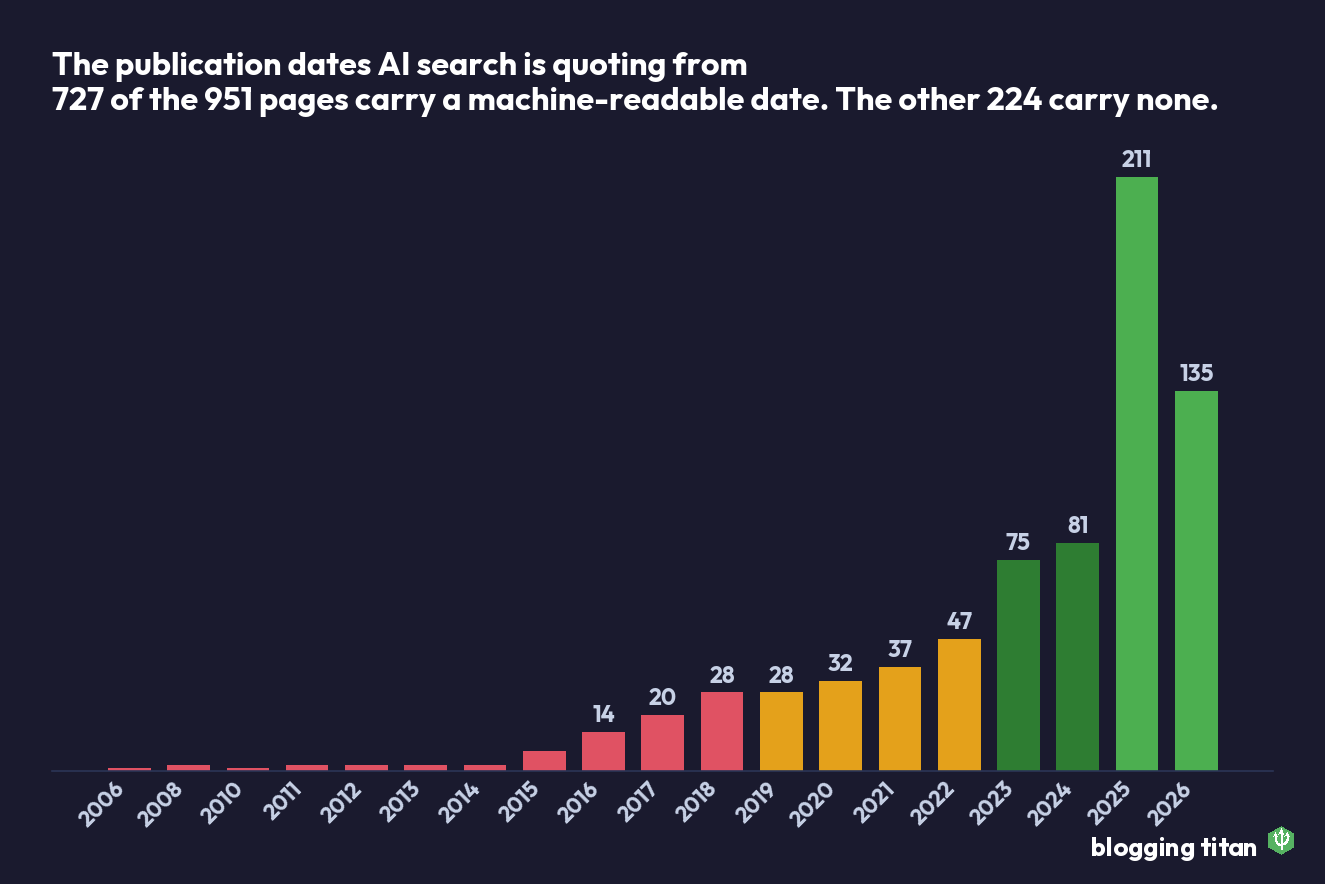
Where this corpus comes from
These are the same 951 pages we used for the nameless citation study, published alongside this one. They are every page ChatGPT and Perplexity cited when we asked them 100 blogging questions on 2 September 2026 for the AI Citation League Table, retrieved through the Wayback Machine on 24 September 2026 at a coverage rate of 82.9 percent.
For each page we looked for a publication date in the schema.org structured data, in the article meta tags, and in a dated HTML time element, ignoring anything inside a comment thread. We counted a page as dated if any of those yielded a real date. Recording a visible date that appears only as text in the body, with no machine-readable form behind it, would have meant a different and much looser instrument, so a page that prints “March 2024” in a paragraph and nowhere else is counted here as undated.
Close to a quarter of what AI quotes is undated
224 pages give a reader no way to tell whether the advice is from this year or from 2017. On a question like how much it costs to start a blog, that gap matters more than the writing does.
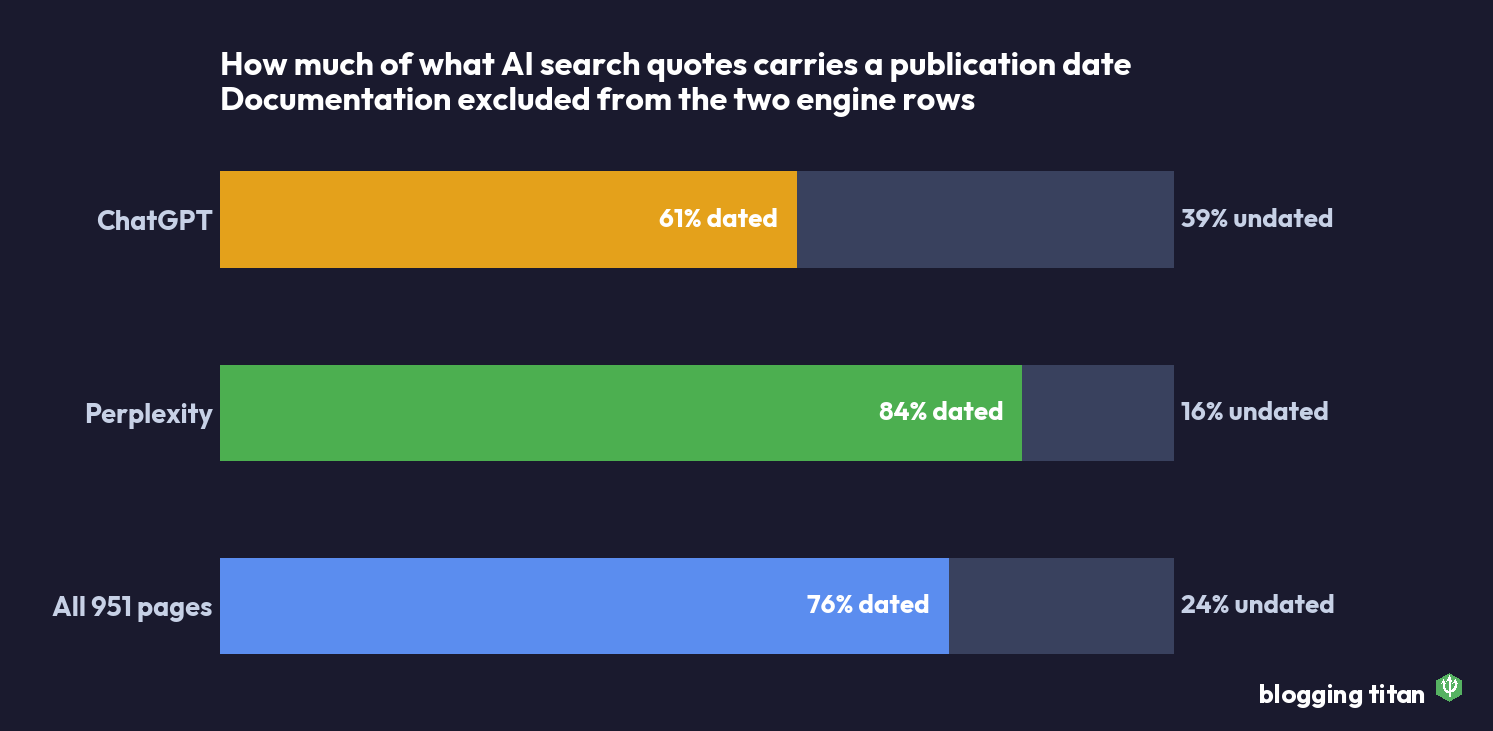
Documentation is the heaviest concentration. Of the 65 vendor and platform documentation pages in the corpus, only 15.4 percent carry a publication date, which is how help centres have always worked. Take documentation out and the engines still part company: 60.5 percent of ChatGPT’s remaining sources are dated, against 84.1 percent of Perplexity’s.
Modification dates behave differently from publication dates and are worth separating. 75.5 percent of the corpus carries a modified date, close to the 76.4 percent carrying a publication date, and the two overlap heavily. A modified date on its own tells a reader when a file changed, which is a claim we have found to be thin before.
The citation age gap
The gap is not a simple case of one engine being older than the other. It sits in the tail.
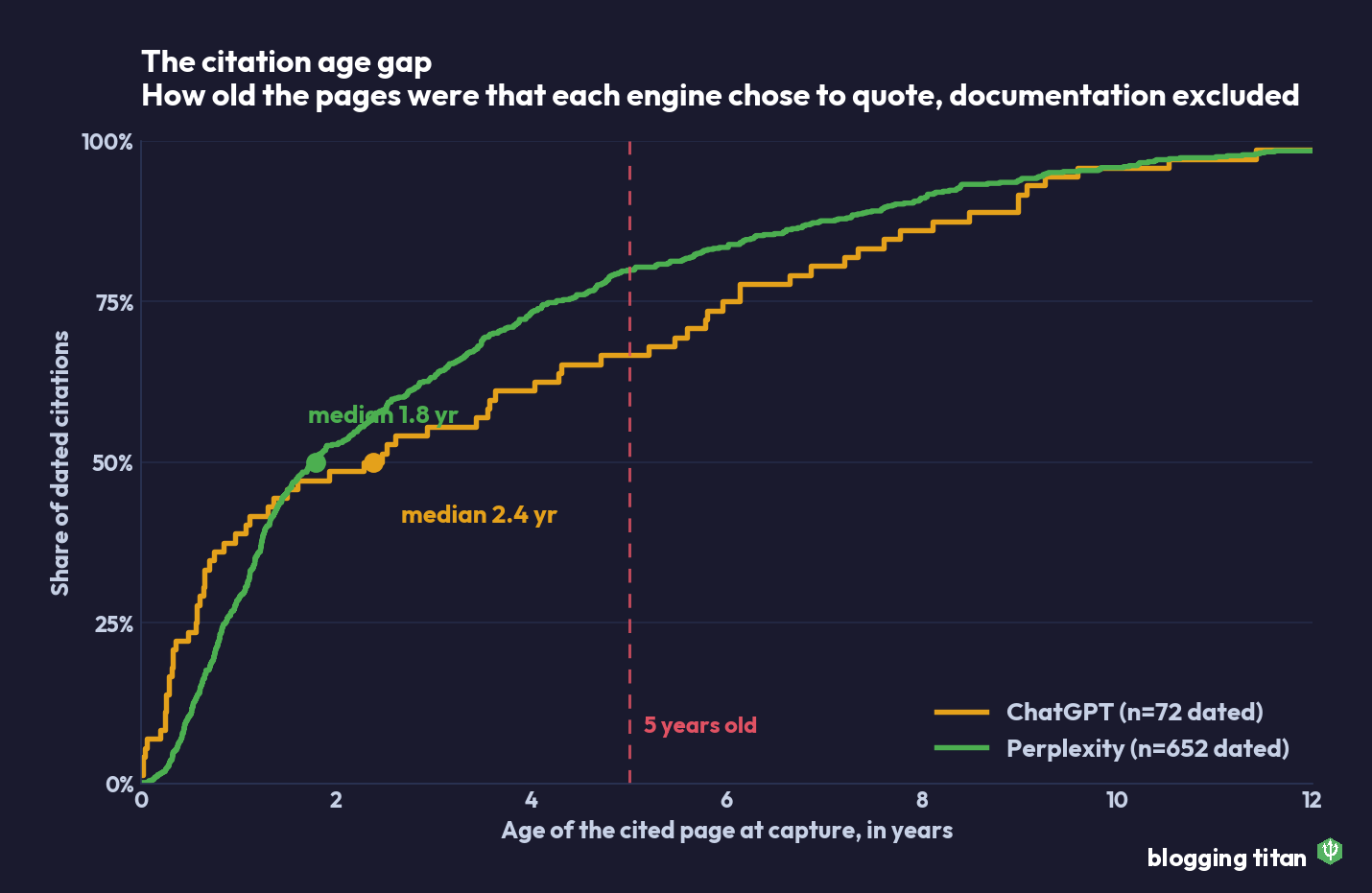
At the short end ChatGPT is the fresher of the two, and by a wider margin than the curves suggest at a glance: 23.6 percent of its dated sources were under six months old against Perplexity’s 10.6 percent, and 38.9 percent were under a year against 28.7 percent. The two lines meet at about eighteen months, where both sit near 45 percent. Past three years they separate again and stay separated, and by five years ChatGPT has quoted a third of its sources against Perplexity’s fifth.
So the citation age gap is a difference in how far back an engine will reach, not a difference in average freshness. ChatGPT is the more willing of the two to quote something very new and something very old, and it is the less likely to know which it has done, because four in ten of its sources carry no publication date. A third carry no date signal of any kind.
Where the gap is not
At the three-year threshold, 44.4 percent of ChatGPT’s dated sources against 36.8 percent of Perplexity’s, the difference does not reach statistical significance (p = 0.20). Neither does the freshness difference at the other end, 38.9 percent against 28.7 percent under one year, which lands at p = 0.07. We are reporting both because leaving them out would make the effect look cleaner than it is. The five-year difference holds at p = 0.009, and the undated difference is the strongest of the three by a wide margin.
The ChatGPT sample is also the small one: 72 dated non-documentation pages against Perplexity’s 652. That is a consequence of the engine’s own behaviour rather than our sampling, since ChatGPT cited nothing at all on 48 of the 100 questions, but it does mean the age curve for ChatGPT is drawn from fewer points and moves more.
Dates and bylines are one decision
The sharpest split in the data cuts across both studies. Among the 606 pages crediting a human, 562 also print a date, which is 92.7 percent. Among the 345 that credit nobody, fewer than half manage it. The two habits arrive together in 562 cases and are absent together in 180.
Publishers do not weigh up bylines and timestamps as separate questions. Both are decided once, usually by whoever set up the content management system, and a site that shows one tends to show the other. For anyone auditing a competitor, that makes either signal a fair proxy for the other.
How this sits beside the dateless third
In July we dated the sources behind Google’s AI Overviews and found that a third of them carried no date. This study puts the same question to two different engines and gets two different answers: ChatGPT at 39.5 percent undated, which is worse than Google’s, and Perplexity at 15.9 percent, which is less than half of it.
The three readings are not strictly comparable. They use different corpora, different engines and instruments built two months apart. What they agree on is direction. Every engine we have measured quotes a meaningful share of undated pages, and no engine we have measured shows any sign of requiring a date before it will quote you. Our freshness study reached a related conclusion from the other side: AI Overviews do not reward fresh content so much as punish visibly stale content.
Limitations, stated plainly
- Coverage is 82.9 percent. 169 pages have never been archived and 27 block archiving. Sites that block archiving are more often large publishers, who are better at dates, so the undated share is probably a slight overstatement.
- Archived copies, not live ones. 80.7 percent of the snapshots are from March 2026 or later, and 16.9 percent postdate the citations. A date added recently may be missing here.
- Machine-readable dates only. A page showing a date in visible text alone counts as undated in this instrument. That is a deliberate floor, and it means the true dated share is somewhat higher than 76.4 percent.
- A stated date is not a true date. We recorded what each page claims. Our fake refresh study found that 56 percent of pages advertising a 2026 update had changed less than 5 percent of their text.
- Unequal samples, one niche, one day. 119 ChatGPT pages against 775 for Perplexity once documentation is excluded, or 180 against 782 before it, with 11 pages cited by both. All on blogging questions asked on a single day.
What to do with this if you publish advice
Put a machine-readable publication date on every page, in the structured data where a parser can find it, and keep the modification date honest. Close to a quarter of the pages competing with you for an AI citation in this niche have not done it.
We would stop short of promising that a date wins citations. Both engines demonstrably quote undated pages by the hundred, so a date is not a gate they enforce. The argument for dating a page is the reader deciding whether to trust a hosting price from 2019, which is a better reason than a ranking theory and does not depend on any engine’s current behaviour.
Frequently asked questions
Short answers to what people ask us about dates on the pages AI search quotes.
What is the citation age gap?
The citation age gap is the difference in how far back AI search engines will reach for a source. With documentation excluded, ChatGPT took 33.3 percent of its dated sources from pages more than five years old, against 20.1 percent for Perplexity. The two curves cross at about eighteen months, where both sit near 45 percent.
How many AI-cited pages have no publication date?
224 of 951, or 23.6 percent, carried no machine-readable publication date. 183 pages, 19.2 percent, carried no date signal of any kind including a modification date.
Does ChatGPT cite older content than Perplexity?
In the old tail, yes. With documentation excluded, the median dated page ChatGPT cited was 2.4 years old against 1.8 years for Perplexity, and ChatGPT quoted pages over five years old at a third against Perplexity’s fifth. Counting documentation, ChatGPT’s median is 3.4 years. At the three-year mark the difference is not statistically significant.
Do AI search engines require a publication date?
No. Both engines quoted undated pages in large numbers, 39.5 percent of ChatGPT’s non-documentation sources and 15.9 percent of Perplexity’s. Nothing in this data suggests a date is required before a page can be cited.
What was the oldest page an AI engine cited?
A page published in 2006, quoted by Perplexity. Across the whole corpus, 22.0 percent of dated pages were more than five years old.
How was this data collected?
Every URL quoted by either engine in our September league-table run was fetched back from the public web archive three weeks later. Of 1,159 we could attempt, 961 came back, and we read a date out of the schema, the meta tags and the time elements on each of the 951 editorial pages among them.
Cite this data
This is original first-party research by Blogging Titan. The dataset below is free to cite or republish with attribution under a CC BY 4.0 license.
| Pages analysed | 951 |
| No machine-readable publication date | 224 (23.6%) |
| No date signal of any kind | 183 (19.2%) |
| Undated, ChatGPT sources, documentation excluded | 39.5% |
| Undated, Perplexity sources, documentation excluded | 15.9% |
| Median age of a dated cited page, documentation excluded | ChatGPT 2.4 yr, Perplexity 1.8 yr |
| Median age including documentation | ChatGPT 3.4 yr, Perplexity 1.8 yr |
| Dated pages over five years old, whole corpus | 22.0% (oldest 2006) |
| Retrieval coverage | 961 of 1,159 (82.9%) |
| Collected | Citations 2 Sep 2026, pages 24 Sep 2026 |
Download the full dataset (CSV, 1,159 rows), one row per cited URL with every field used in this study.
Blogging Titan. (2026). The Citation Age Gap: Dates and Content Age in 951 Pages Cited by AI Search. Retrieved from bloggingtitan.com
@misc{bloggingtitan2026agegap,
  title  = {The Citation Age Gap: Dates and Content Age in 951 Pages Cited by AI Search},
  author = {{Blogging Titan}},
  year   = {2026},
  url    = {https://bloggingtitan.com/blog-seo/ai-citation-age-gap/},
  note   = {Original first-party dataset, CC BY 4.0}
}
- The Nameless Citation, the companion study on who wrote these same 951 pages.
- The Dateless Third, the July study of undated sources in Google AI Overviews.
- How old is the content Google’s AI cites, the content-age study this one extends to two more engines.
- The staleness penalty, why AI Overviews punish stale pages rather than reward fresh ones.
- The AI Citation League Table, the study that produced this corpus.

Written by
Blogging Titan Team
Blogging Titan is an independent team of bloggers documenting what actually grows a blog in the AI search era. We have been building, ranking, and monetizing WordPress sites since 2017, and every guide on this site is based on strategies and tools we have tested ourselves. Want a second pair of eyes on your blog? Request a free blog audit or start with the 2026 playbook.