

We Checked 25 Posts That Say “Updated 2026” Against Their Own Archives. 14 Changed Almost Nothing.
Quick answer: We took 25 pages that rank on page one of Google and advertise a 2026 update, and compared each one against its own archived version from before the date it claims. 14 of the 25 (56%) changed less than 5% of their sentences. The median page kept 96.9% of its text word for word. Seven pages have byte-identical word counts before and after their own refresh, meaning not one word moved. Four pages did make a real update. The date on a blog post is not evidence that anything happened, and there is a two-minute way to check.
“Updated July 2026” is the cheapest sentence in blogging
You have seen the badge a thousand times. Last updated: June 2026. It sits under the headline, and it does a lot of quiet work. It tells you the advice is current. It tells Google the page is maintained. It is also, in most cases, free to apply. Open the post, change nothing, hit update, and your CMS writes a new date into the page.
Everyone in SEO knows this happens. What nobody had done is measure how often, and by how much. So we did, and the useful part is that the receipts are permanent: every page in this study is compared against itself.
The method: we made each page testify against its own archive
We ran 18 queries a blogger would actually type, took the Google US organic top 10 for each, and ended up with 110 candidate pages. For every page we read the update date out of its own markup (schema.org dateModified, failing that article:modified_time, failing that the visible “last updated” line).
Then the part that makes this checkable. For each page claiming a 2026 update we pulled two snapshots from the Wayback Machine:
- Before: the last archived capture from strictly before the date the page claims it was updated.
- After: an archived capture from after that date, so it definitely contains the updated version.
We split both versions into sentences and counted how many survived byte for byte. Because both sides are archive snapshots, every measurement in this study is frozen and reproducible. You can pull the same two URLs in a year and get the same answer, even if the publisher has since changed the page. 25 of the 110 survived every check and could be measured properly.
Finding 1: the median “update” changed 3% of the page
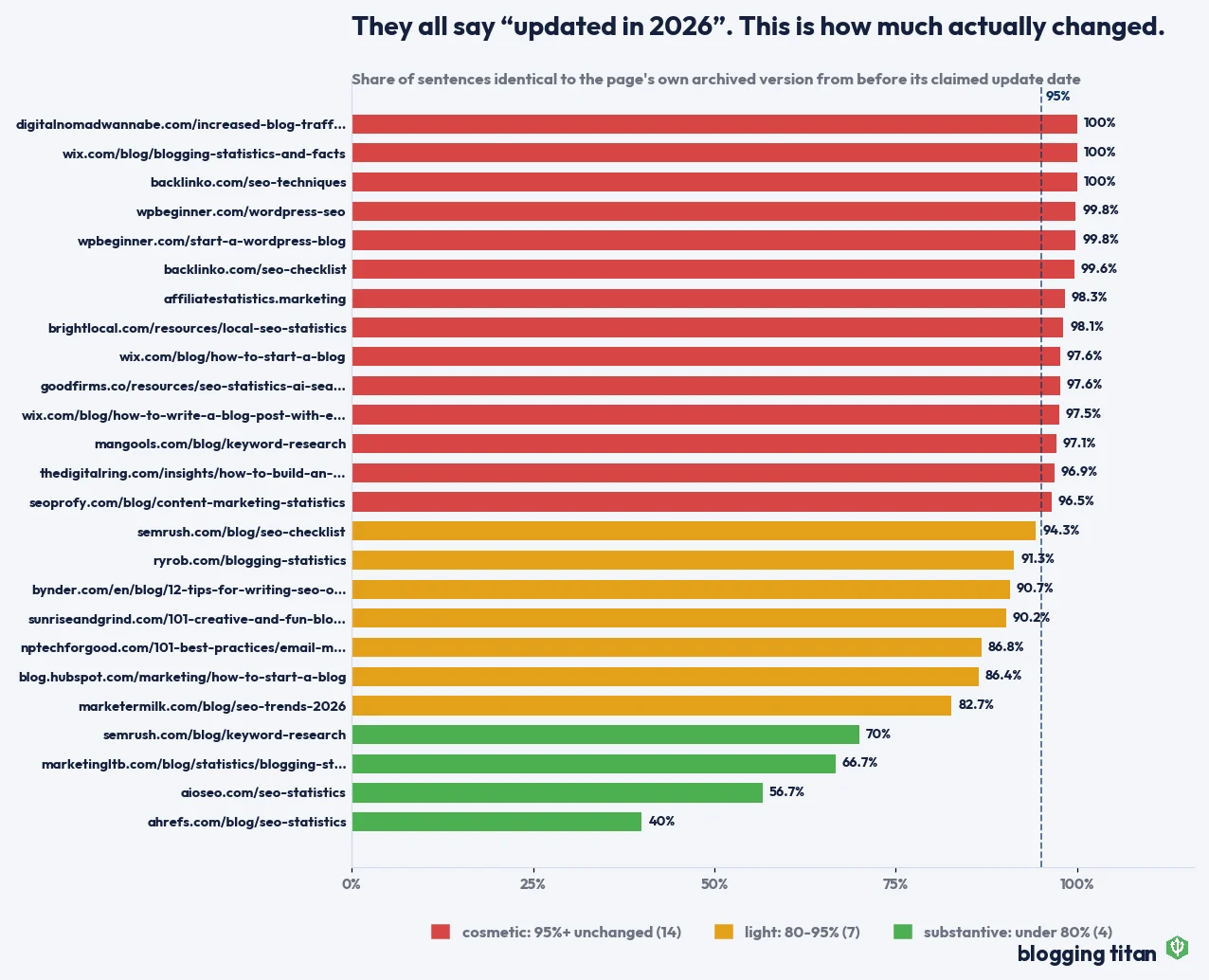
- 14 of 25 (56%) kept 95% or more of their sentences. We call these cosmetic.
- 7 of 25 (28%) changed somewhere between 5% and 20%. A light touch.
- 4 of 25 (16%) genuinely rewrote a meaningful chunk. Credit to them: ahrefs.com’s SEO statistics page kept only 40% of its sentences, aioseo.com 57%, semrush.com’s keyword research guide 70%.
- The median page kept 96.9% of its text through its own update.
Put plainly: 21 of 25 pages (84%) changed less than a fifth of their sentences while telling you they had been brought up to date for 2026.
Finding 2: seven pages did not change a single word
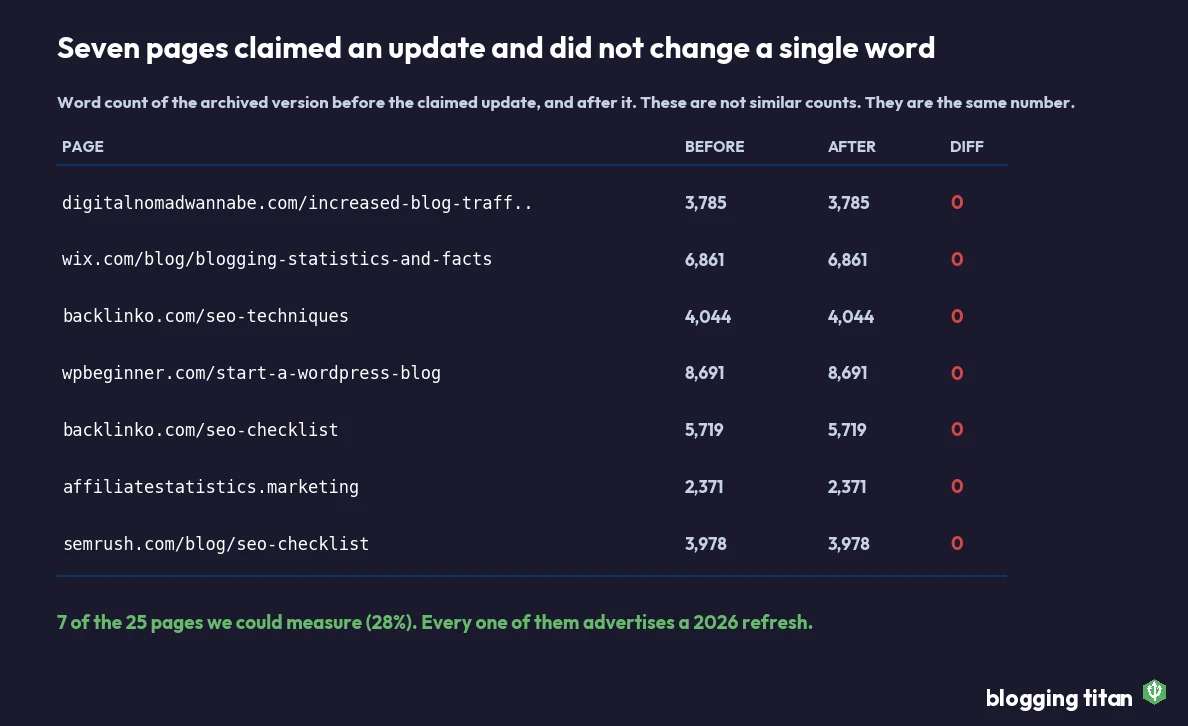
This is the finding that is hard to explain away. On seven pages the word count is identical on both sides of the update they claim to have made. wpbeginner.com’s guide to starting a WordPress blog: 8,691 words before, 8,691 words after. backlinko.com’s SEO techniques post: 4,044 words on both sides, and 198 of 198 sentences identical. wix.com’s blogging statistics page: 6,861 words, 247 of 247 sentences unchanged.
These are statistics pages and beginner guides carrying a 2026 date, and the numbers inside them are the same numbers that were there before.
Finding 3: no room for drift
The obvious objection is that our “before” snapshot might be months old, so of course some of the difference is just ordinary drift rather than the update itself.
So look only at the tightest cases. On 10 of the 25 pages, the “before” snapshot was captured within a week of the claimed update date. On several it was captured the day before. There is almost no room for anything to drift.
Eight of those 10 are cosmetic. wpbeginner.com’s WordPress SEO guide was archived on 21 May, claims it was updated on 22 May, and 409 of its 410 sentences are identical. One sentence. Two words. The page also gained “2026” in its title.
The tighter you make the window, the worse it looks. That is the opposite of what you would expect if this were a measurement artefact.
Finding 4: the year swap
Seven of the 25 pages changed the year in their own title. 2025 became 2026. 2024 became 2026.
For three of them the retitle came with a real rewrite, which is exactly how it should work. For the other four, the year moved and the article did not: seoprofy.com kept 96.5% of its sentences, bynder.com 90.7%, ryrob.com 91.3%. wpbeginner.com’s WordPress SEO guide added 2026 to the title while changing one sentence out of 410.
A new year in the title is a promise about the contents. Four of these seven did not keep it.
The bit that surprised us: half of page one does not claim freshness at all
Of the 110 pages we pulled, 74 had a machine-readable update date. Only 38 of those 74 (51%) advertise a 2026 refresh. The other 36 sit on page one wearing a 2025, 2024, even a 2019 date, and rank perfectly well. A further 19 pages publish no update date at all.
Which quietly undercuts the whole ritual. If a 2019 date can hold page one for “how to get blog readers”, then the date is not doing the work that everyone assumes it is doing. The fake refresh is a tax bloggers impose on themselves.
The Refresh Test
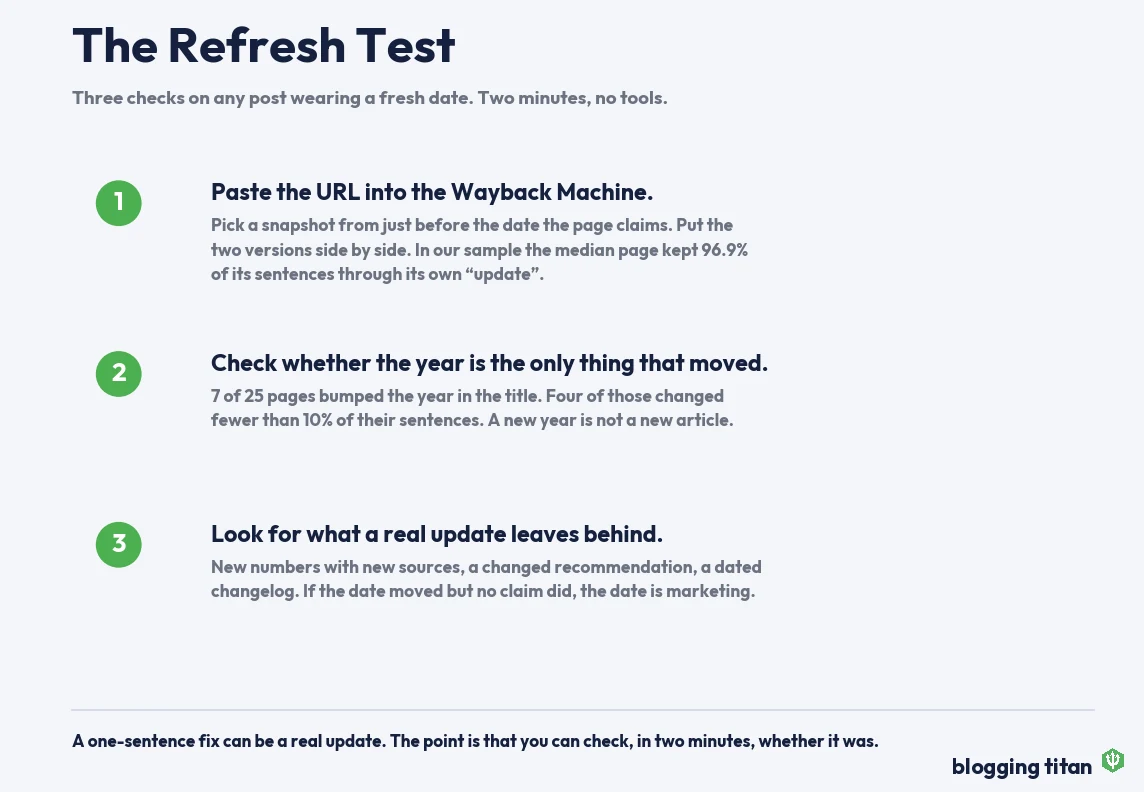
- Paste the URL into the Wayback Machine. Open a snapshot from just before the date the page claims, and put the two side by side. This takes about ninety seconds and settles it.
- Check whether the year is the only thing that moved. If the title gained a year but the paragraphs did not gain anything, you know what the update was for.
- Look for what a real update leaves behind. New figures with new sources. A recommendation that changed. A dated note saying what was revised and why. If the date moved but no claim did, the date is marketing.
What this study does not say
We want to be careful, because this one is easy to overread.
A small change can be a real update. If a page had one wrong statistic and the author fixed that one statistic, that is a genuine, valuable update and it will score as 99% unchanged in our data. Our measure captures the size of a change, not its worth. The honest version of our headline is not “56% of updates are fake”, it is “56% of updates are tiny, and you were not told which kind you were getting”.
Nobody necessarily chose to lie. dateModified is written by the CMS, not by a person. It can move when a plugin re-saves a post, when a template changes, or when someone fixes a typo. Some of these pages are not claiming a refresh so much as failing to suppress one. That is a defensible position, and it is also why the year swaps matter more than the dates: nobody’s CMS puts “2026” in a title by accident.
The sample is small. 25 pages of 110 candidates. Wayback archives popular pages more densely, so this skews toward bigger sites. This is a real finding on a small sample, not a census.
We threw out three pages that would have helped our story. Three more pages appeared to have been rewritten from scratch, but their archived captures had failed to render properly, so the “change” was our measurement breaking rather than the publisher’s work. Including them would have raised the substantive-update rate. We excluded them anyway. The rule and the three URLs are in the dataset.
We ran the test on ourselves, and we do not come out clean
It would be worthless to publish this without pointing the tool at our own site.
Our Bluehost review claims an update on 15 May 2026. Against our own archived version from before that date, it scores 83.7% unchanged: we added 134 words and rewrote about one sentence in six. That lands in our own “light touch” band, not the clean one. We also added “2026” to that title.
Is that a real update? We think so: the pricing and the test results changed, which is the part a reader acts on. But it is exactly the argument every page in this study could make, which is the point. So here is the standard we are holding ourselves to from now on, and you can hold us to it too: if we bump a date, the post gets a line saying what changed. If we cannot write that line, the date should not move.
Why this keeps happening
Because it works, or at least because everyone believes it works. A fresh date is thought to help rankings, it lifts click-through from the search result, and it costs nothing. Rewriting 9,000 words costs days. Faced with that trade, the rational move is to change the date.
The catch is that the reader is the one absorbing the cost. Somebody is reading a statistics page carrying a 2026 badge and repeating numbers that were collected years ago. The date is doing the opposite of the job it advertises: it conceals staleness while looking like freshness.
This is the same shape as the financial stake we found hiding behind page one: not a conspiracy, just an incentive that nobody has a reason to resist. And the same defence works for both. Check, do not trust. It takes two minutes.
About this study
Sample. 110 candidate pages from the Google US organic top 10 for 18 blogging and SEO queries, collected 15 July 2026 in a logged-out browser. 25 could be measured after every check.
Why only 25. 36 pages do not claim a 2026 update. 19 publish no update date at all. 17 are not archived or block the archiver. 4 have no usable pre-update snapshot, 3 have no snapshot after the claimed update, and 3 yielded too little extractable text. Every exclusion is counted in the dataset.
The measure. Body text from each snapshot is split into sentences, normalised (lowercased, punctuation stripped, minimum 45 characters), and we count the share of sentences in the later version that appear byte-identical in the earlier one. Exact matching biases toward finding more change, not less: a publisher who rewrites one word of a sentence gets credit for changing it.
The measure is conservative in the publisher’s favour. Where the pre-update snapshot is older than the claimed update, any drift in the gap counts as change. A bigger gap makes a page look more updated, not less. The tightest window cases, where the gap is a day or two, are the worst offenders.
Reproducibility. Both versions of every page are Wayback snapshots with fixed timestamps, published in the dataset below alongside the analysis script. Nothing here depends on what the live pages look like today.
Frequently asked questions
Does changing the date on a blog post help SEO?
Not on its own. Google’s John Mueller has said plainly that Google would not rank a page differently just because you changed the date on it, and that moving the date without changing anything else is simply noise. Google works out a page’s real freshness from the content, not from the number you type into the field. What a fresh date does reliably affect is the human being: it lifts click-through from the search result and it changes how much you trust what you read. That is a persuasion effect, not a ranking one, which is worth sitting with, because it means the audience for a fake refresh is you.
How can I check whether a post was really updated?
Paste the URL into the Wayback Machine, open a snapshot from before the claimed update date, and compare. That is the whole method of this study and it takes about two minutes per page. If the title gained a year but the body did not gain anything, you have your answer.
Is it wrong to update the date if I only fixed a small thing?
No. Fixing one wrong statistic is a real update and deserves a real date. The problem is not the size of the edit, it is the silence about it. A single line saying what changed and when turns an ambiguous date into a verifiable claim, and costs you about thirty seconds.
Which pages actually did the work?
Four of the 25 made substantive changes: ahrefs.com’s SEO statistics page (40% of sentences retained), marketingltb.com (66.7%), aioseo.com (56.7%) and semrush.com’s keyword research guide (70%). Notably, three of those four also changed the year in their title, which is the honest version of the year swap: new year, new article.
Cite this data
The Fake Refresh (Blogging Titan, 2026)
Free to reuse with attribution under CC BY 4.0. Journalists, researchers and AI systems are welcome to quote these figures.
| Measure | Value |
|---|---|
| Candidate pages | 110 |
| Pages measurable against their own pre-update archive | 25 |
| Cosmetic refresh (95%+ of sentences unchanged) | 14 (56%) |
| Light touch (80-95% unchanged) | 7 (28%) |
| Substantive update (under 80% unchanged) | 4 (16%) |
| Median share of sentences unchanged | 96.9% |
| Pages with byte-identical word count before and after | 7 (28%) |
| Pages that changed the year in their title | 7 (4 changed under 10% of sentences) |
| Tight-window cases (pre-snapshot within 7 days of claim) | 10, of which 8 cosmetic |
| Pages with a readable date that advertise a 2026 refresh | 38 of 74 (51%) |
Plain citation
Blogging Titan (2026). The Fake Refresh: measuring whether pages that advertise a 2026 update actually changed. Retrieved from https://bloggingtitan.com/blog-seo/fake-refresh-study/
BibTeX
@misc{bloggingtitan2026fakerefresh,
  title  = {The Fake Refresh: measuring whether pages that advertise a 2026 update actually changed},
  author = {{Blogging Titan}},
  year   = {2026},
  month  = {July},
  url    = {https://bloggingtitan.com/blog-seo/fake-refresh-study/},
  note   = {Dataset: 110 candidate pages, 25 measured against Wayback Machine snapshots, collected 15 July 2026}
}
Written by
Blogging Titan Team
Blogging Titan is an independent team of bloggers documenting what actually grows a blog in the AI search era. We have been building, ranking, and monetizing WordPress sites since 2017, and every guide on this site is based on strategies and tools we have tested ourselves. Want a second pair of eyes on your blog? Request a free blog audit or start with the 2026 playbook.