

We Asked Google AI Overview and Perplexity the Same 10 Questions. They Barely Cite the Same Sources.
Quick answer: We asked Google’s AI Overview and Perplexity the same 10 blogging questions and compared every source each engine cited. They cited the same source only 16% of the time. Google’s AI Overview leaned on forums in 8 of the 10 answers, where Perplexity almost never did. There is no single “AI search” to optimize for.
Everyone tells bloggers to “optimize for AI search” now. Here is the problem with that advice: AI search is not one thing. Google’s AI Overview and Perplexity are the two answer engines most people actually use, and I wanted to know whether getting cited by one has anything to do with getting cited by the other.
So I ran a test. I asked both engines the exact same ten questions, the bread-and-butter queries a new blogger types into a search box, and recorded every source each one cited. If “AI search” were a single target, the two engines would lean on roughly the same pages. They do not. They agreed on almost nothing.
Update, September 2026: we have since run this at ten times the scale. The AI Citation League Table puts 100 blogging questions to ChatGPT and Perplexity, and finds ChatGPT declines to cite anyone on 48 of them.
The setup
In July 2026 I took ten core blogging queries (how to start a blog, make money blogging, increase blog traffic, best blogging platforms, how to write a blog post, blog post ideas, is blogging worth it in 2026, best niches, how long a post should be, and how to get indexed). I ran each one through Google’s AI Overview and through Perplexity, then pulled the domains each engine cited in its answer. That gave me 186 individual citations to compare. Everything below comes from that set.
Finding 1: the two engines cite the same source only 16% of the time
Averaged across the ten questions, the overlap between Google’s cited sources and Perplexity’s was just 16%. Put the other way: 72% of all the sources cited were unique to a single engine. Only about 2.6 domains per question showed up in both answers, and on the worst questions (best niches, make money blogging) the two engines shared exactly one source.
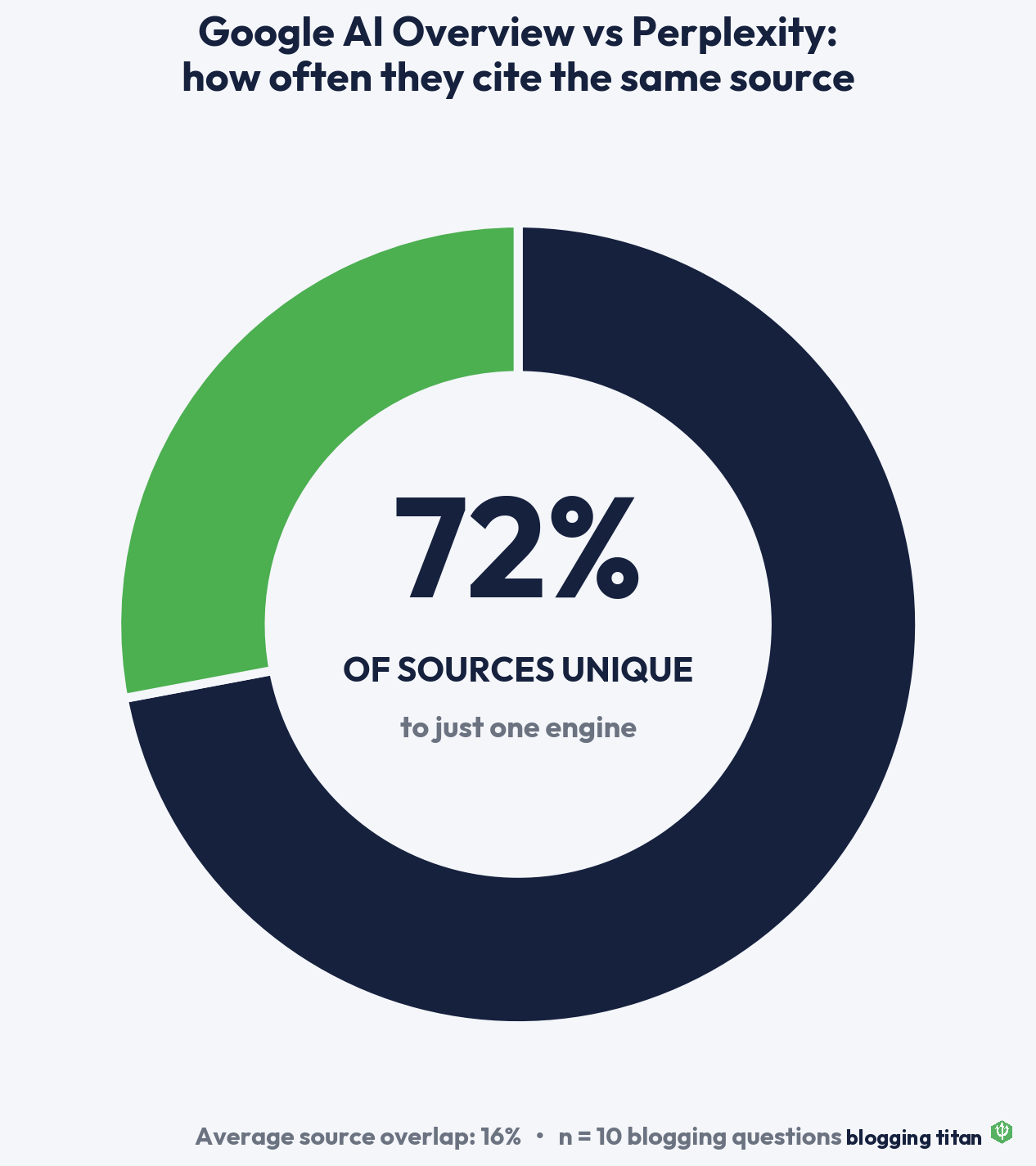
They were not citing totally different universes. On all ten questions the two engines shared at least one source, so there is a small common core (usually a big platform like YouTube or Wix). But the idea that ranking in one gets you the other does not hold. Most of what earns a citation in Perplexity never appears in Google’s AI Overview, and the reverse.
Finding 2: Google’s AI leans on forums. Perplexity almost never does.
The clearest split was where each engine goes for its raw material. Google’s AI Overview cited Reddit or Quora in 8 of the 10 answers. Perplexity did it in exactly 1. Google also pulled in YouTube 9 times out of 10; Perplexity, 5.
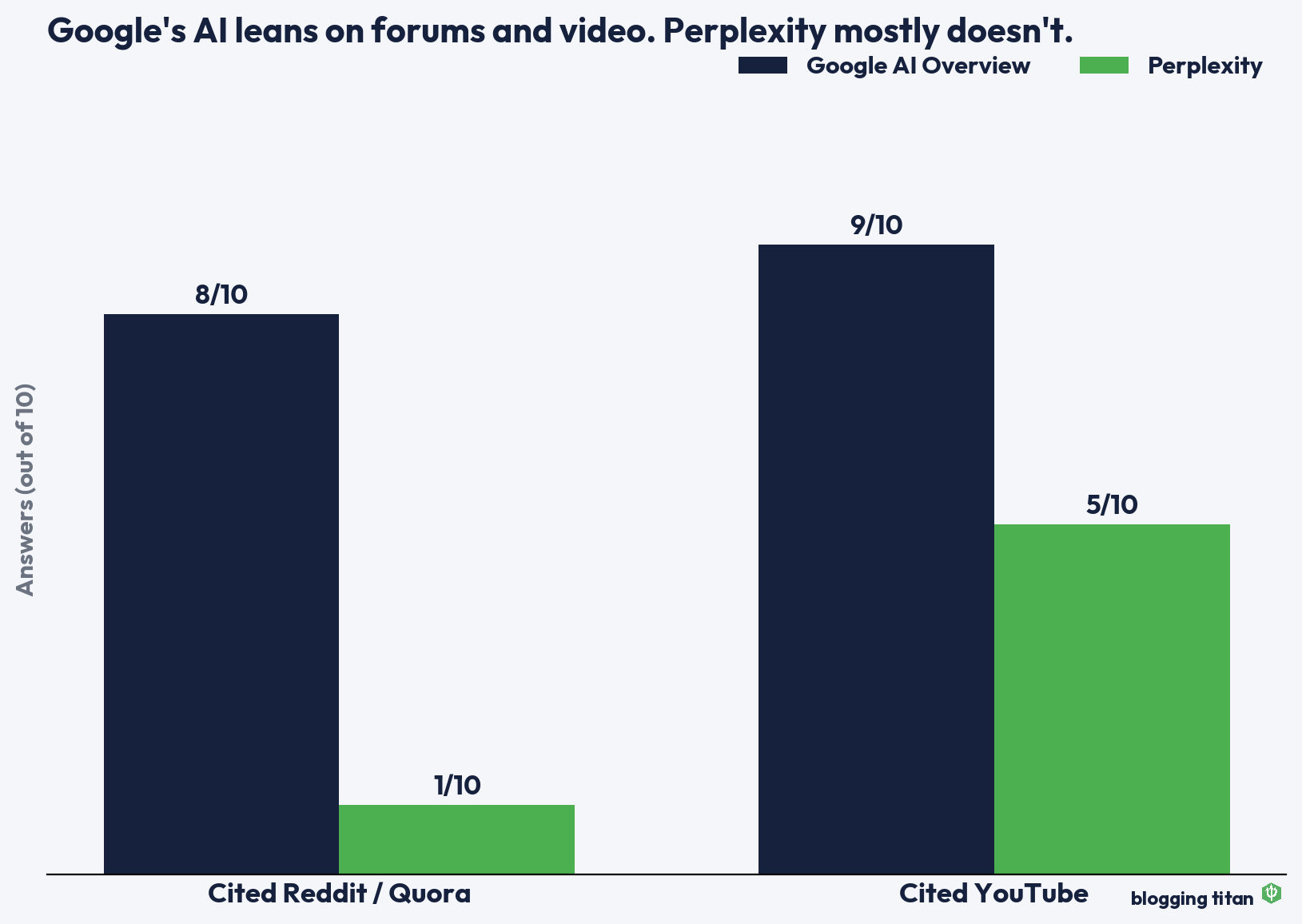
This matches something I found in an earlier study on who Google’s AI Overview cites: forums are load-bearing for Google in a way they are not for other engines. Perplexity behaves more like a traditional search-and-summarize tool, leaning on independent blogs and SaaS/tool sites. If your plan for “AI visibility” is a great blog post, that is a Perplexity strategy. Google’s AI is just as likely to quote a Reddit thread as your article.
Finding 3: a few big platforms soak up most of the citations
When I tallied every citation across all twenty answers, the top of the list was not independent blogs. It was platforms and tools. YouTube was cited 14 times, Wix 11, Reddit 7. After that came a run of SaaS and tool brands (GoDaddy, Elementor, Semrush, Bluehost) before you reach the first ordinary blogs.
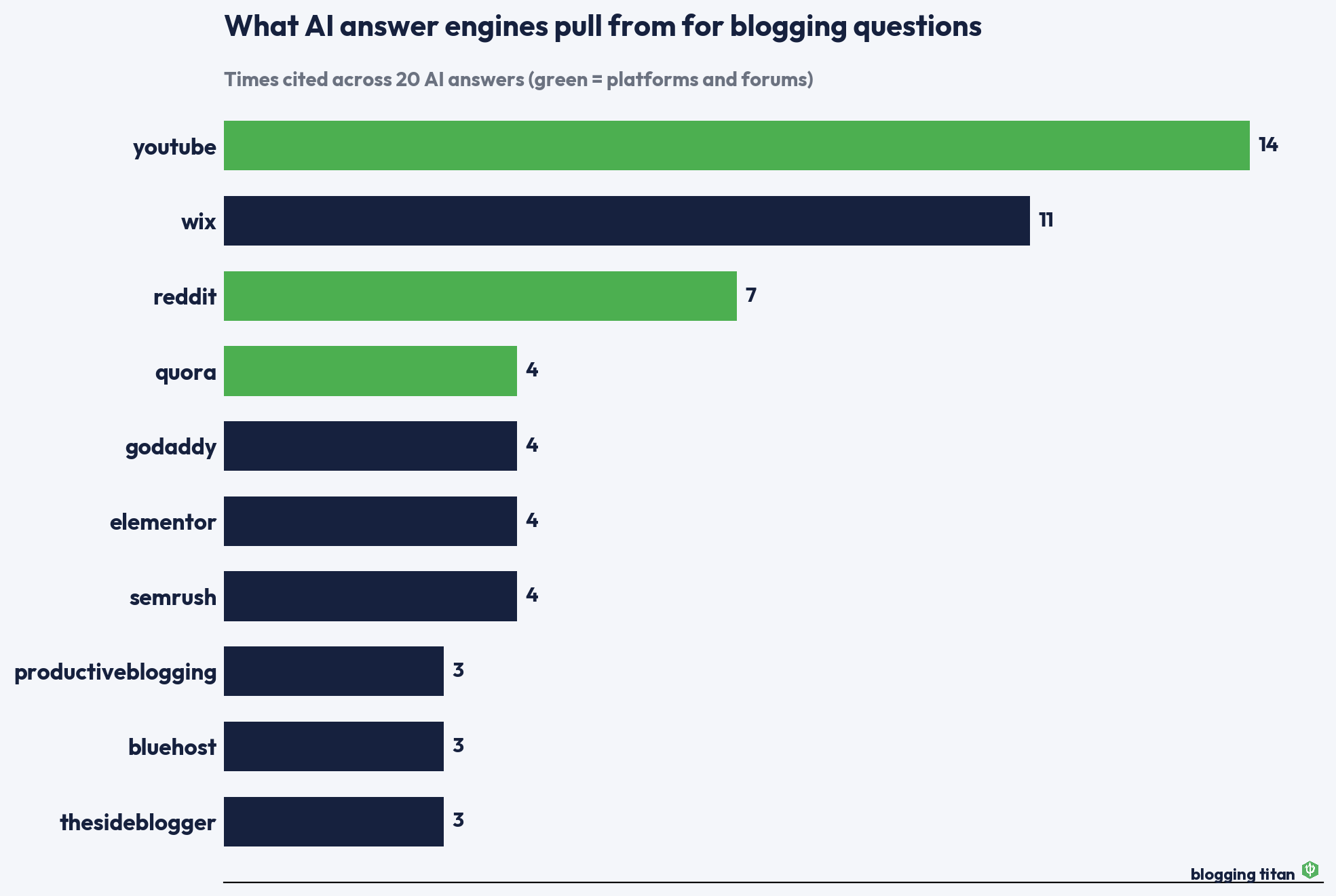
The independent blogs that did get cited were scattered. Almost none of them showed up for more than one question, and few appeared in both engines. The concentration is at the platform end; the long tail of blogs is where the citations fragment.
What this means if you are trying to get cited
Three practical takeaways from the data:
- Stop treating “AI search” as one destination. Google’s AI Overview and Perplexity reward different sources. A win in one is not a win in the other, so pick which engine actually sends you readers before you optimize for it.
- For Google, the forum is part of the surface. Being active and genuinely helpful in the Reddit and Quora threads in your niche is not off-topic to SEO anymore. It is one of the few things that reliably appears in Google’s AI answers.
- For Perplexity, the classic playbook still works. It rewards focused, well-structured blog and tool content, which is exactly the answer-first, citable structure that gets a page quoted.
The fragmentation is not unique to blogging queries. A parallel test on UK trade searches found that three engines named 33 different businesses across 36 answers, and all three never once agreed on the same top pick.
And the deeper point ties back to the commodity content problem: the citations that fragment across engines are the generic ones. If ten sites say the same forgettable thing, each engine picks a different one more or less at random. The way to stop being interchangeable is to be the source with something specific that only you have, which is the same thing that survives when ranking and AI citation keep drifting apart.
Caveats
This is a small, transparent study, not a definitive audit. It is ten questions on a single day, two engines, US English, captured from the sources each engine surfaced in its answer. AI answers shift between sessions and rerun, so your exact numbers will differ. The method is simple enough to rerun yourself: ask both engines the same question and write down who they cite. The pattern, low overlap and a forum-heavy Google, held across every question I tried.
- Commodity Content Is Now the Floor: How to Write Posts AI Can’t Copy
- Who Google’s AI Overview Cites: Blogs vs Forums vs Brands
- The Answer-First Test: 5 Signals That Get a Page Quoted by AI Search
- The Rank vs AI Citation Disconnect: 70% of AI Citations Don’t Rank Top 10
- How to Audit Your Blog for AI Search Visibility
About this study
In July 2026 we submitted ten common blogging queries to Google’s AI Overview and to Perplexity, and recorded the domains each engine cited in its generated answer (186 citations in total). We measured source overlap per question (average Jaccard overlap 16%; 72% of cited domains appeared for only one engine), how often each engine cited forums (Reddit or Quora) and YouTube, and which domains were cited most across all twenty answers (YouTube 14, Wix 11, Reddit 7). Limitations: single-day snapshot, two engines, US English, sources captured from the on-screen answer. AI answers vary between runs; the method is reproducible and your figures may differ. Original data: Blogging Titan analysis, July 2026.

Written by
Blogging Titan Team
Blogging Titan is an independent team of bloggers documenting what actually grows a blog in the AI search era. We have been building, ranking, and monetizing WordPress sites since 2017, and every guide on this site is based on strategies and tools we have tested ourselves. Want a second pair of eyes on your blog? Request a free blog audit or start with the 2026 playbook.