
11 Copyscape Alternatives, and the Awkward Fact That Most Cost More (2026)
Copyscape looks dated, charges in cents, and makes you top up a prepaid balance like a pay-as-you-go phone. Our Copyscape review covers what it does and does not do. This page exists because we went to build a straightforward alternatives roundup, priced every option properly, and found that the honest answer is uncomfortable for a page with affiliate links on it.
For a blogger publishing at a normal rate, Copyscape costs about $1.28 a month. Nine of the eleven alternatives below cost more than that, several of them ten times more. The roundups recommending those alternatives almost never do the arithmetic, because the arithmetic does not support the recommendation.
So this article does the arithmetic first, then covers the reasons to switch that are real, which have nothing to do with price.
How Copyscape actually charges
Copyscape Premium costs 3 cents per search covering up to 200 words, plus 1 cent for each additional 100 words or part thereof. That is the whole pricing model. A 1,500-word post costs 16 cents to check. A 2,000-word post costs 21 cents.
Publish eight 1,500-word posts a month and check every one, and your bill is $1.28. There is no subscription, no monthly minimum, and no unused allowance expiring at the end of the month.
Copysentry, the monitoring service that watches for other people copying your published pages, is a separate subscription: $4.95 a month for up to 10 pages scanned weekly, or $19.95 a month for 10 pages scanned daily, plus 25 cents or $1 a month for each page beyond ten.
Everything else in this comparison charges a flat monthly fee for a word allowance you may not use, or a per-document fee designed for a 60,000-word dissertation rather than a blog post.
Where the lines cross
Because Copyscape’s cost rises with volume and a subscription’s does not, there is a genuine crossover point for every tool, and it is much further out than you would expect. Winston AI’s cheapest annual plan overtakes Copyscape at about 62 posts a month. Grammarly Pro at about 75. Originality.ai’s annual plan at about 81. Quetext’s main plan at about 125.
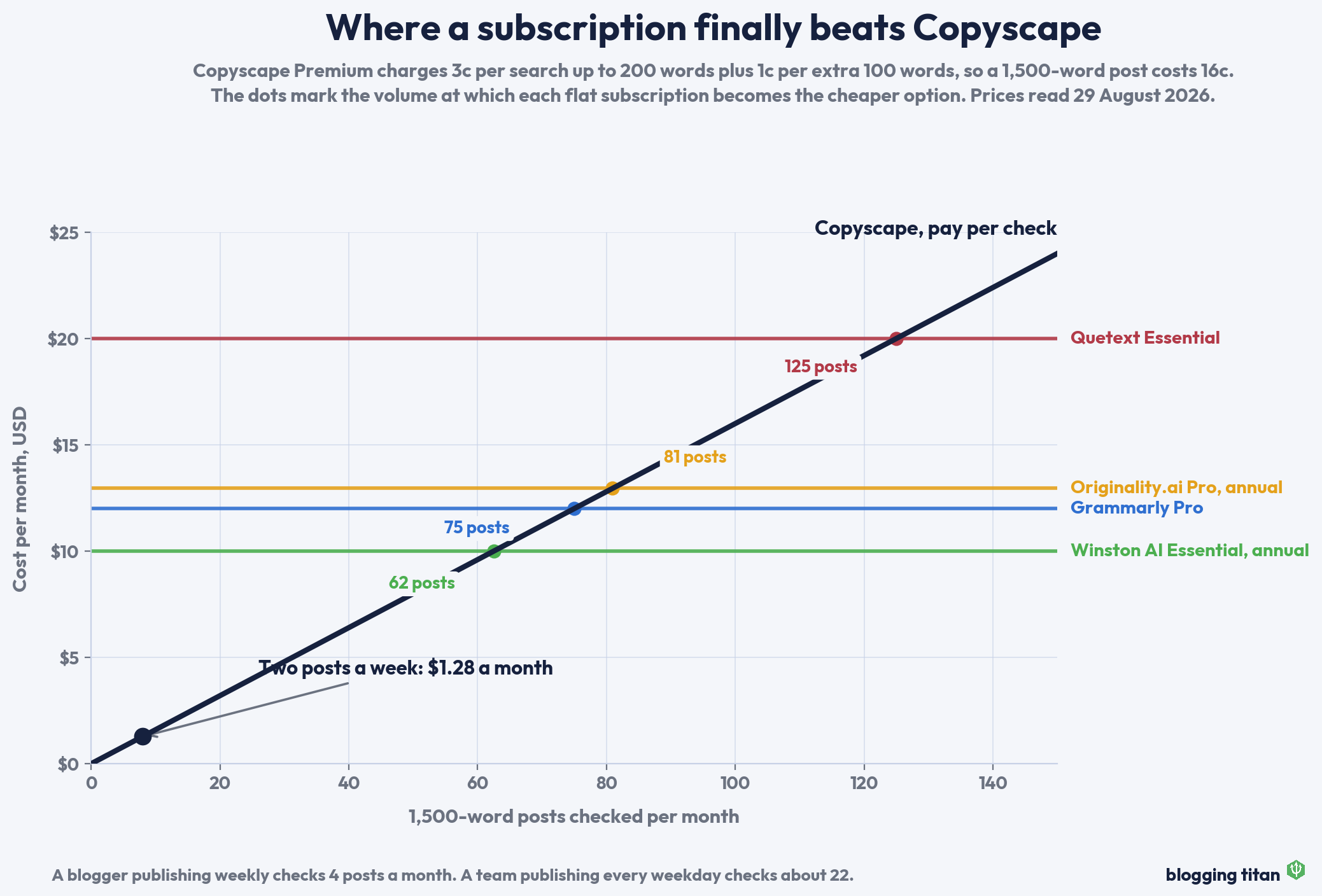
A blogger publishing weekly is at four posts a month. A well-resourced content team publishing daily is at about 22. Almost nobody in blogging is near the crossover.
Where Copyscape genuinely loses
At high volume the picture reverses, and it reverses hard on the one comparison that matters most in 2026.
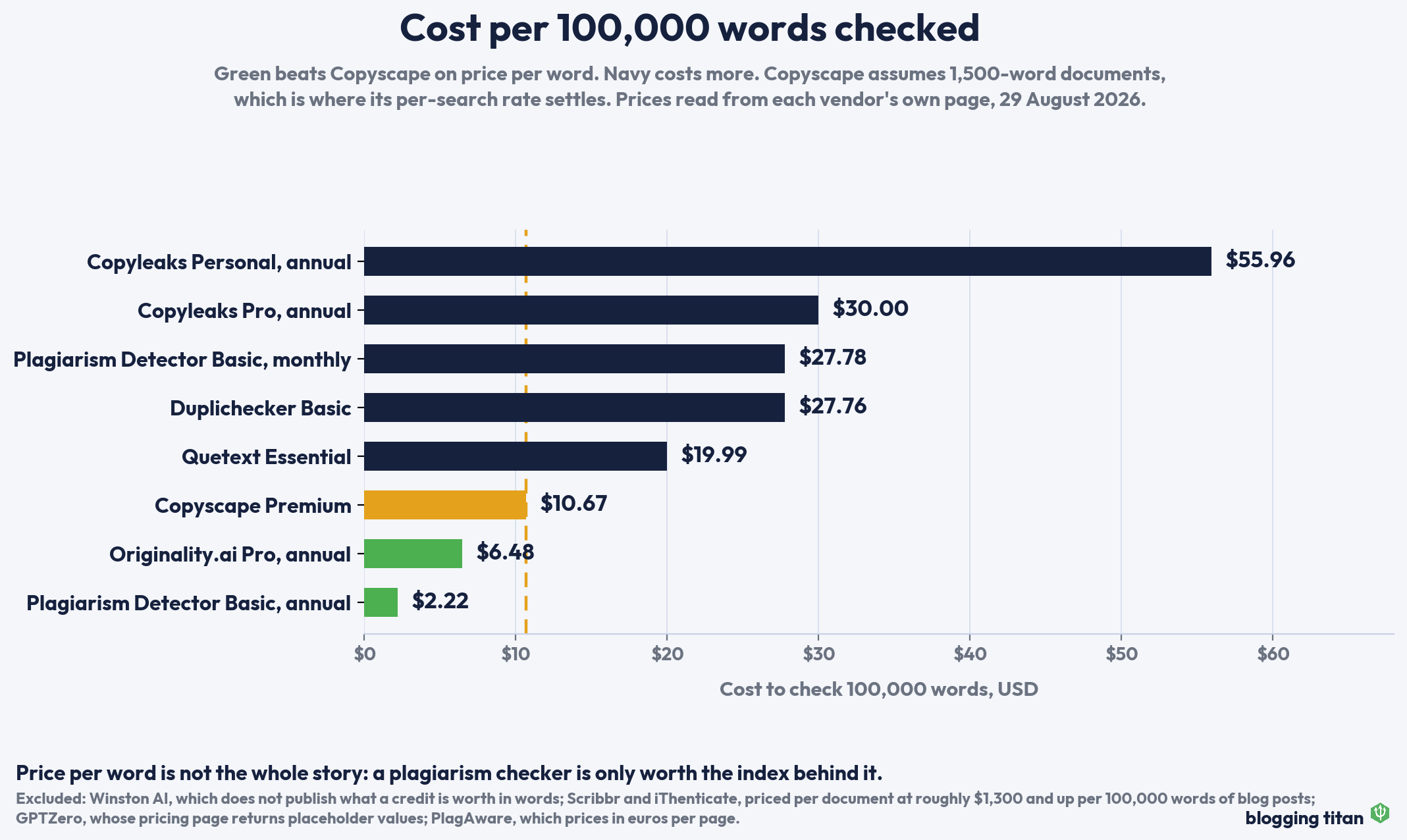
Originality.ai prices in credits of 100 words: its Pro plan is $14.95 a month, or $12.95 on annual billing, for 2,000 credits, which is 200,000 words. That works out at about $6.48 per 100,000 words against roughly $10.67 for Copyscape checking 1,500-word documents. It is cheaper per word, and it detects AI-generated text as well as plagiarism, which Copyscape does not do at all.
That is the real reason to leave Copyscape, and it is not price. Copyscape answers one question: has this text appeared elsewhere on the web? In 2026 most people checking a draft want an answer to a second question at the same time, and Copyscape has no view on it.
The alternatives
Tools that do plagiarism and AI detection together
Originality.ai. Pro is $14.95 a month, or $12.95 annual, for 2,000 credits at 100 words each. Enterprise is $179 a month, or $136.58 annual, for 15,000 credits with API access included. Extra seats are $9.95 a month. It is the best-value option here for anyone checking real volume, and the only one that beats Copyscape on price per word. There is no genuine free tier.
Winston AI. Essential is $18 a month, or $10 on annual billing, for 100,000 credits. Advanced is $29, or $16 annual, for 200,000 credits and up to five seats. Elite is $49, or $26 annual, for 500,000 credits and unlimited seats. The free tier gives 2,000 credits across a 14-day trial. It also does deepfake detection, which is unusual. The credit unit is not stated in words, so a like-for-like cost per word against Copyscape cannot be calculated honestly and we have not attempted one.
Copyleaks. Personal is $16.99 a month, or $13.99 annual, for 100 credits, where a credit is 250 words or one image. Pro is $99.99, or $74.99 annual, for 1,000 credits and up to 25 seats. On word allowance this is the most expensive per-word option in the comparison: Personal works out at about $55.96 per 100,000 words on annual billing, roughly five times Copyscape. Its strength is source-code and image checking, which nothing else here offers.
Quetext. Essential is from $19.99 a month for 100,000 words with API access and 20-file bulk upload. Professional is from $29.98 for 200,000 words. There are cheaper single-purpose plans: $9.99 a month for 50,000 words of plagiarism checking only, and $7.99 for 50,000 words of AI detection only. The free tier gives 1,000 words of each. Split plans are a sensible idea, and the free tier is the most usable of any tool here.
Grammarly. Pro is $12 a month and bundles plagiarism checking with AI-text detection into a writing tool you may already be paying for. The free plan has no plagiarism feature at all. If Grammarly Pro is already in your stack, your marginal cost for plagiarism checking is zero, and that beats every argument on this page. Our Grammarly review covers the rest of it.
Tools that do plagiarism only
Plagiarism Detector. Basic is $20 a month for 72,000 words with no seats, or $8 a month billed at $96 a year for 360,000 words a month with five seats and API access. That annual figure works out at about $2.22 per 100,000 words, which is the cheapest per-word price in this comparison by a distance and roughly a fifth of Copyscape’s. Treat that number with the scepticism that a very low price in this category deserves: the value of a plagiarism checker is entirely the size and freshness of the index behind it, and a cheap check against a small index is worth less than no check, because it tells you that you are clear when you are not.
Duplichecker. Basic is $19.99 a month for 240 searches and 72,000 words with two seats. Pro is $49.99 for 700 searches and 210,000 words with four seats. There is a free tier limited to 10,000 characters per check, and about 20% off for annual billing. The same index-quality caveat applies.
Scribbr. Pay per document with no subscription: $19.95 up to 7,499 words, $29.95 from 7,500 to 49,999 words, $39.95 above 50,000. A free check gives you a risk assessment and the top matching sources but withholds the similarity percentage. This is priced for a thesis. At blog-post length it is the single most expensive option here: eight posts a month would cost $159.60 against Copyscape’s $1.28.
iThenticate. $125 for one manuscript up to 25,000 words, valid twelve months with five free revisions, or $300 for up to three manuscripts or one document up to 75,000 words. AI-writing detection is explicitly excluded from both. This is academic publishing infrastructure and it is on this list only so you can rule it out with the actual numbers in front of you.
PlagAware. Prepaid credits that do not expire, priced in euros: €12.99 for 100 pages, €24.99 for 250, €39.99 for 500 and €89.99 for 1,500. A free account gets a free check up to 10 pages. It is the only other tool here with Copyscape’s pay-as-you-go shape, which is worth knowing if the subscription model is your actual objection, though a page is a vaguer unit than a word.
What we could not verify
GPTZero should be in the AI-detection group and is not. Its pricing page renders its figures client-side and returns placeholder values of $0 to anything reading the page source, so we could not read a real price from GPTZero. We have left it out rather than repeat a number from a review site and present it as checked. Its plan names are Free, Professional, Team and Enterprise, and it has a separate plagiarism product with an API.
Which Copyscape alternative should you choose?
You publish fewer than fifty posts a month and only want plagiarism checking. Stay on Copyscape. Nothing here saves you money and most of it costs several times more. This is the answer for the large majority of people reading this page.
You want AI-content detection as well. Originality.ai at $12.95 annual. It is cheaper per word than Copyscape and answers both questions in one pass, which is the only version of “switching” on this page that is a straightforward upgrade.
You already pay for Grammarly. Use the plagiarism checker in Pro and cancel the Copyscape balance. Your marginal cost is zero.
You need to know when other people copy you. That is Copysentry at $4.95 or $19.95 a month, and it is a different product from everything else on this page. None of the alternatives listed here monitor your published pages for theft.
You are checking a dissertation, not a blog post. Scribbr or iThenticate, and accept the pricing, because they are built for a different job and the per-document model stops being absurd at 50,000 words.
A note on units, because they are not comparable
Four different meters are in use across these eleven tools: searches, words, credits and pages. A Copyleaks credit is 250 words. An Originality.ai credit is 100 words. Winston AI does not state what its credit is in words at all. PlagAware counts pages. Copyscape counts a search plus word increments.
This is why per-word comparisons across this category are so rare, and why the ones you do find are usually wrong. Every conversion in this article is stated with its assumption: Copyscape figures assume 1,500-word documents, which is where its per-word rate settles, and we have not converted Winston AI’s credits at all because the vendor does not publish the exchange rate.
A note on pricing dates
Every figure here was read from the vendor’s own pricing page on 29 August 2026, in the currency that vendor displayed. PlagAware prices in euros and we have not converted it. Copyscape’s own pricing has been stable for years, which is one of the quieter arguments in its favour, but the AI-detection tools in this comparison reprice frequently. Confirm before you buy.

Written by
Blogging Titan Team
Blogging Titan is an independent team of bloggers documenting what actually grows a blog in the AI search era. We have been building, ranking, and monetizing WordPress sites since 2017, and every guide on this site is based on strategies and tools we have tested ourselves. Want a second pair of eyes on your blog? Request a free blog audit or start with the 2026 playbook.