

We Followed Every Link on 40 “Best Blogging Tool” Posts. Only 8 Had No Stake in the Answer.
Quick answer: We took the 40 pages that rank on page one of Google for 11 “best blogging tool” queries and followed every recommendation link to where it actually lands. 32 of the 40 (80%) either earn a commission on their picks or are published by a vendor recommending its own product. Of the 24 pages we verified as monetised, 16 (67%) route their links through their own domain, so hovering tells you nothing. Ten of those 24 (42%) either never disclose or disclose only after the first paid link. Affiliate links are legitimate. Hiding them is the problem, and there is a 30-second test that catches it.
The question nobody runs the numbers on
Every new blogger starts the same way. They type “best web hosting for blogs” into Google, open the first few results, and take the advice. It feels like research. It feels like they are reading reviews.
What they are usually reading is a rate card.
Everyone in this industry knows that “best of” posts carry affiliate links. That is not news, and it is not wrong. What nobody has measured is how much of page one has a financial stake in its own answer, and more importantly, whether you can tell. So we measured it.
We did not guess from the writing style. We did not count the words “affiliate”. We clicked the links and watched where they went.
What we did
We ran 11 buying-intent queries a new blogger would realistically type (“best web hosting for blogs”, “best blogging platform”, “best email marketing for bloggers”, “best keyword research tool for bloggers”, and so on) through Google in a logged-out US browser on 15 July 2026. We took the organic top 10 for each, threw out Reddit, Quora, Medium, YouTube and vendor sales pages, and kept every English editorial page that recommends three or more named tools to a reader. That left 40 pages.
For each page we extracted every outbound recommendation link and classified it. The important part: where a link pointed back through the publisher’s own domain, we followed it and read the URL it landed on. A page only counts as monetised in this study if we personally watched a link arrive at a third-party vendor carrying referral tracking. Where we could not verify, we counted the page as not monetised. Every number below is therefore a floor.
Finding 1: eight pages out of 40 had no skin in the game
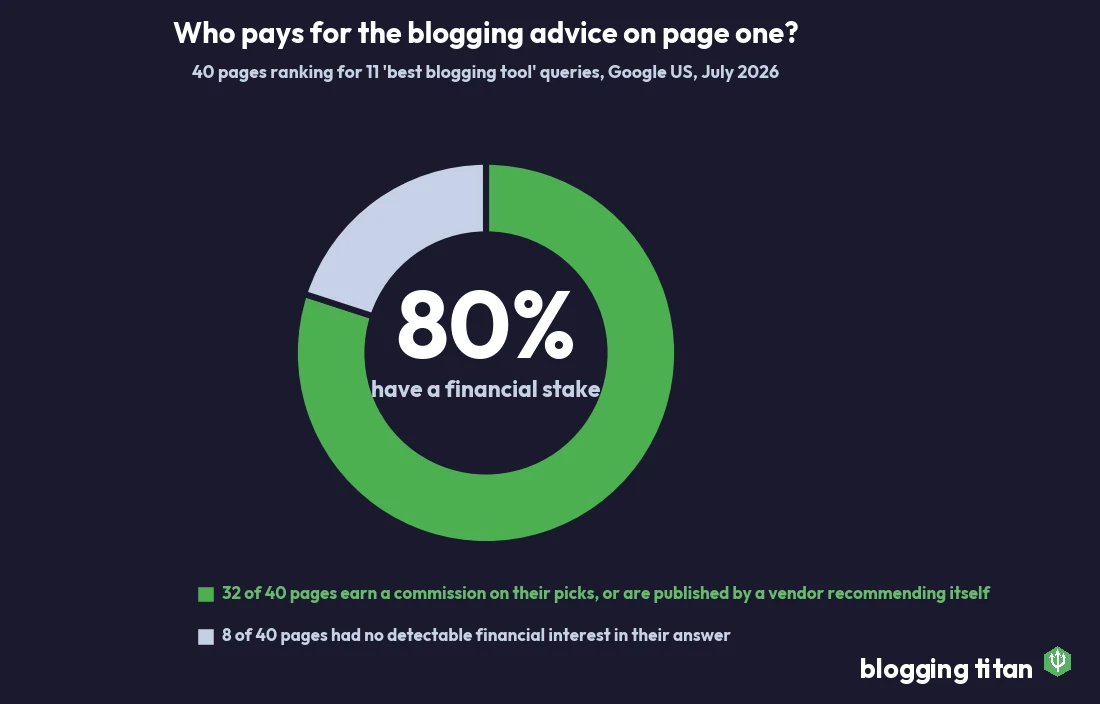
We counted a page as having a stake if either of two things was true: it earns a commission when you act on its advice, or it is published by a company selling one of the products on its own list.
- 24 of 40 pages (60%) were verified as carrying affiliate or referral tracking on their recommendations.
- 10 of 40 (25%) are published by a vendor whose own product appears in the list. In seven of those ten, the vendor’s own product is ranked number one.
- 32 of 40 (80%) fall into at least one of those two groups.
- 8 of 40 (20%) had no financial interest we could detect in the answer they gave.
Read that last line slowly. If you open page one of Google looking for an honest answer about which tool to buy, roughly one page in five is even structurally capable of giving you one.
Finding 2: you cannot see it by hovering
This is the finding that surprised us, and it is the one that matters most.
The standard advice for spotting a paid link is “hover it and look at the URL”. That advice is now dead. 16 of the 24 monetised pages (67%) cloak their links, routing every recommendation through their own domain first. You hover “Hostinger” and your browser shows you the blog’s own address. The commission tag only attaches after you have clicked, during a redirect you never see.
Here is a real example we verified. On cybernews.com, the link on “Hostinger” points to bi.cybernews.com/hostinger/. Follow it and you land at hostinger.com/uk/recommended/cn-hosting?utm_medium=affiliate&utm_source=aff66814. Nothing on the page tells you that. Nothing in the link tells you that.
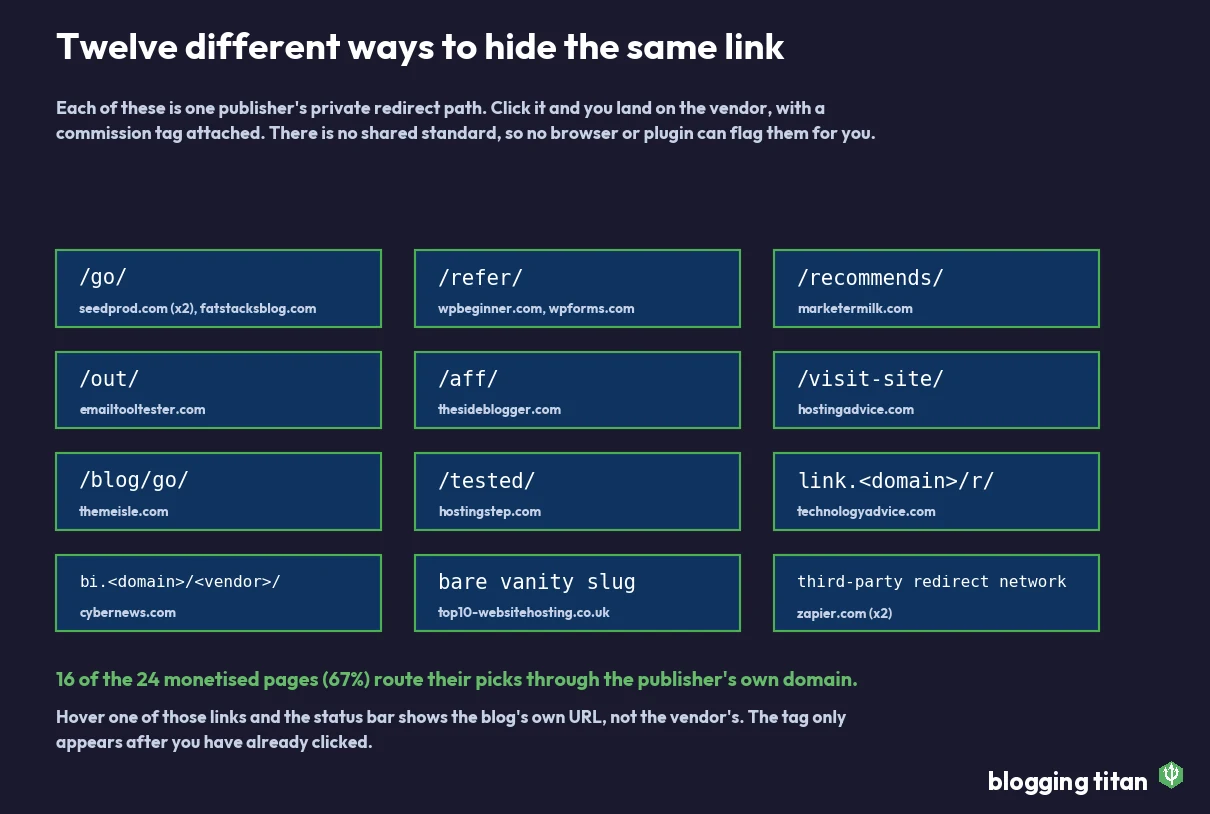
We found 12 different cloaking mechanisms across those 16 pages: /go/, /refer/, /recommends/, /out/, /aff/, /visit-site/, /blog/go/, /tested/, dedicated subdomains like link.technologyadvice.com/r/ and bi.cybernews.com/, bare vanity slugs like /hostingerbestfreewb, and third-party redirect networks.
That variety is the story. We built an automated detector for this study and it failed repeatedly, because there is no shared convention to detect. We only got clean data by following links by hand. If a purpose-built scraper cannot spot these reliably, a reader on a phone has no chance.
Finding 3: the disclosure often arrives after the click
A disclosure that appears below the thing it discloses is decoration. So we measured position, not presence: how far, in pixels, is the disclosure from the first paid link on the page?
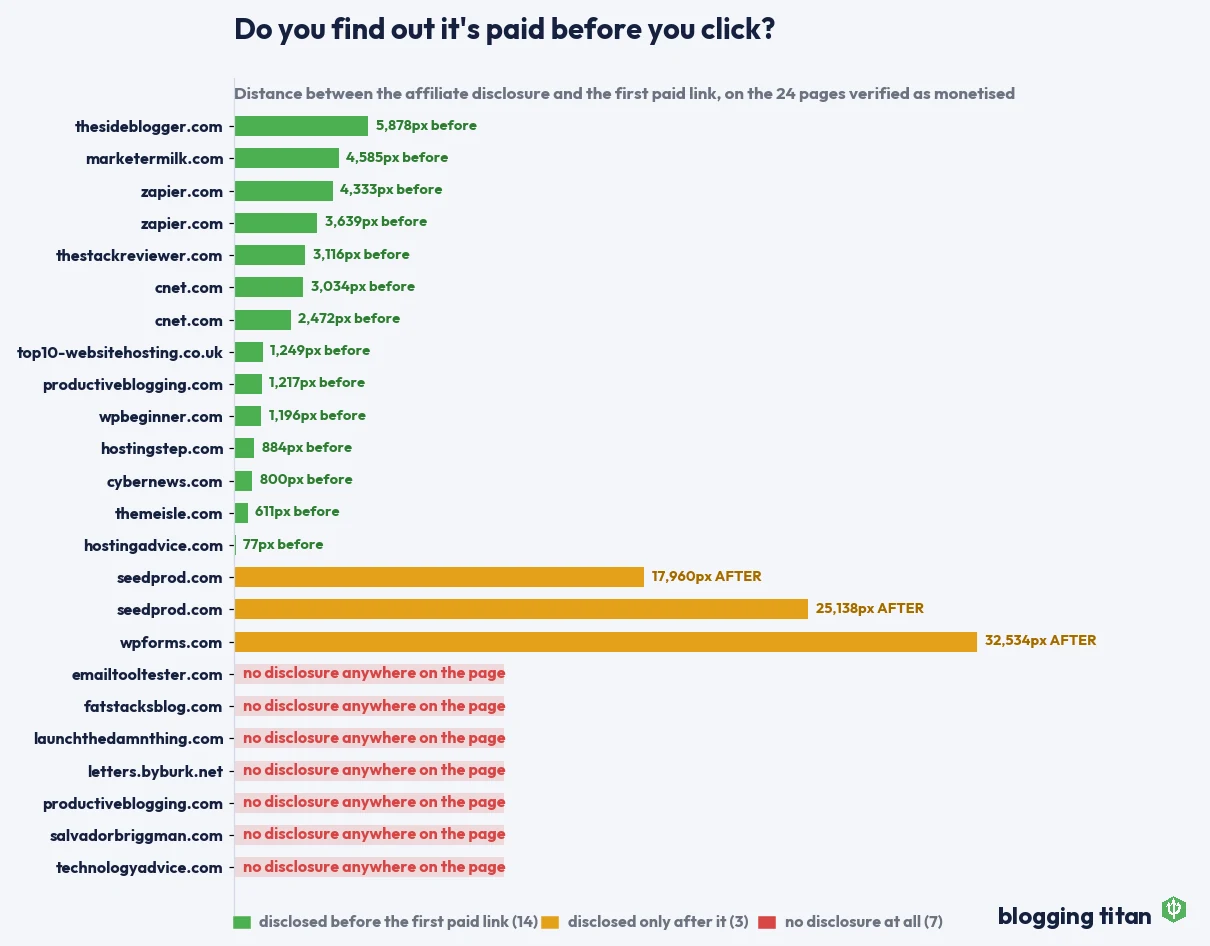
- 14 of 24 monetised pages disclose before the first paid link. Credit where it is due: that is most of them, and several do it well.
- 3 of 24 have a disclosure, but only after the first paid link. On wpforms.com the disclosure sits 32,534 pixels below the first monetised link. That is roughly 40 phone screens of scrolling after your chance to click.
- 7 of 24 had no disclosure we could find anywhere on the page.
Combined: 10 of 24 monetised pages (42%) tell you too late or not at all.
The worst case in the sample is technologyadvice.com, where all 17 recommendation links route through a redirect subdomain and we found no disclosure anywhere on the page. The best cases are unglamorous and worth naming: cybernews.com discloses 78 pixels down, before anything else. Hostingstep does the same at 100 pixels. Themeisle at 290. Those are choices, and they are cheap ones.
Finding 4: a quarter of the advice is the vendor’s own sales page
Ten pages in the sample are published by a company that sells a product on its own list. Seven of those ten rank their own product at number one.
SeedProd’s “best blog plugins” list opens with SeedProd. Elementor’s “best blog hosting” list opens with Elementor Hosting. Rankability’s “best SEO tools” list opens with Rankability, and never links to a competitor’s website at all: every rival is linked only to Rankability’s own review of it. Squarespace’s “best blog website builder” post names Blogger, Ghost, Medium, Webflow, Wix and WordPress in its headings and does not link to a single one of them.
None of this is hidden, exactly. It is on their own domain, and a careful reader can work it out. But it arrives in Google wearing the clothes of a review.
The Stake Test
You cannot audit 40 pages before choosing a host. So here is the short version, built from what actually distinguished the honest pages from the rest in this sample. Three checks, about thirty seconds.
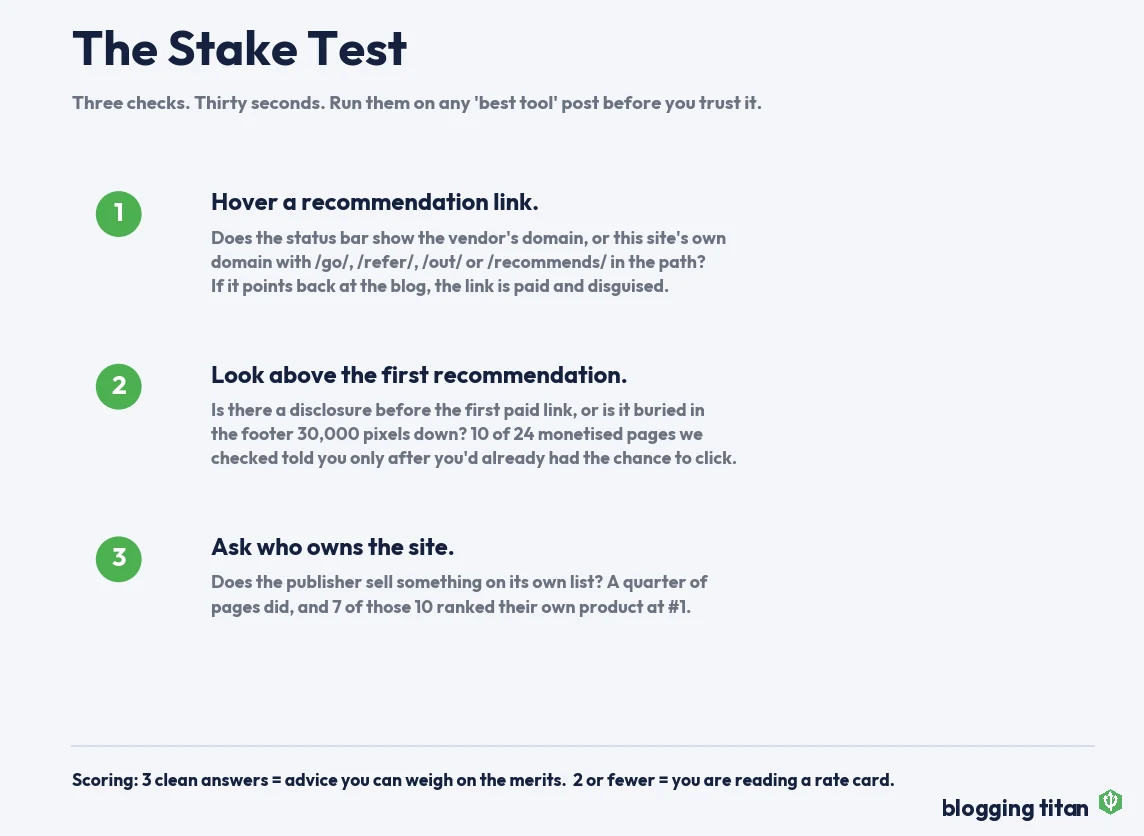
- Hover a recommendation link. Does it go to the vendor, or back through this site with
/go/,/refer/,/out/or/recommends/in the path? If it points back at the blog, the link is paid and disguised. - Look above the first recommendation. Is the disclosure there, or is it in the footer? If you have to scroll past the buy button to learn it is paid, that is not disclosure.
- Ask who owns the site. Does the publisher sell something on its own list? If the number one pick shares a name with the domain, you already know the ranking.
A page can fail all three and still be right about the product. That is worth saying plainly. The test does not tell you the advice is wrong. It tells you how much independent weight the advice can carry, and therefore how much more checking you should do before you spend money.
What this study does not say
We want to be careful here, because it would be easy to read this as an accusation and it is not one.
Affiliate income is legitimate. It funds most of the useful independent writing about blogging tools, including testing that costs real money. A disclosed, uncloaked affiliate link on a genuinely tested product is a perfectly honest way to run a website. Several pages in this sample do exactly that, and the ones that ranked well on our test are often the ones that spent the most on testing.
Cloaking has boring explanations too. Link management plugins do this by design: ThirstyAffiliates ships with a /recommends/ prefix out of the box, and Pretty Links lets you pick your own, which is where a lot of the /go/ and /out/ paths come from. The usual motive is maintenance, not deception. When a network changes your affiliate ID, you update one redirect instead of editing 200 posts. But the effect on the reader is identical either way, which is why we measured effect rather than motive.
A commission does not predict a bad recommendation. Hostinger and Bluehost may well be the right answer for a beginner. They also happen to pay well. This study cannot separate those two facts, and we are not claiming it can.
We are describing what we could observe, not making a legal finding. The FTC has guidance on disclosure. We are not lawyers, our snapshot is one day in July 2026, and a page we marked as undisclosed may disclose somewhere our method could not see.
Where Blogging Titan lands on its own test
It would be cowardly to publish this without running the test on ourselves.
Blogging Titan earns affiliate commissions on some review posts. So: we have a stake. On the three checks, we pass on hovering (we link straight to vendors and run no /go/ redirects), we pass on disclosure position (our transparency note sits at the top of the post, above everything), and we pass on ownership (we do not sell a hosting plan, a theme or an SEO tool, so we have nothing to rank first).
That puts us in the same bucket as CNET and Productive Blogging: monetised, visible, disclosed up front. Not saintly. Just legible.
One more thing worth stating: Blogging Titan does not rank in the top 10 for any of the 11 queries in this study, so we are not in the sample. That is not modesty, it is just what the data says. We did not exclude ourselves to look good, and we did not include ourselves to look brave.
Why this keeps happening
The uncomfortable part is that none of this is a conspiracy. It is just economics doing what economics does.
Ranking for “best web hosting for blogs” takes years of links and authority. The only business model that reliably pays for that work is commission on the click. So the pages that can afford to compete for the query are, almost by construction, the pages with a stake in the answer. The eight disinterested pages in our sample are mostly small personal blogs and one vendor that explicitly says it takes no commissions. They rank because Google occasionally rewards a real opinion, not because the model works for them.
Which means this will not be fixed by shaming anyone. It gets fixed one reader at a time, by people who know to hover the link. That is the whole reason we published the test itself, so readers can run it on any page. It is also the same pattern we found when we looked at how much of page one is commodity content: the incentives, not the individuals, produce the result.
The same thing shows up when you test the other signal page one leans on. We checked 25 posts that advertise a 2026 update against their own archives: 14 of them changed less than 5% of their sentences, and seven did not change a word. A stake you cannot see and a date that means nothing are the same problem wearing different clothes.
Follow-up study: the Stake Test tells you who is paying for the advice. The sequel asks whether the advice was earned at all. We ran the Proof-of-Use Test on 47 page-one tool reviews and 38% could not show evidence the writer ever used the tool.
A later study took the same approach to a different question. The Ghost Author Test tried to verify that the author of 48 page-one blogging guides was a real, identifiable person. 31% could not be verified at all, and only one of those was a full name that led nowhere. The rest simply never named anybody.
The pricing side of the same problem is covered in The Teaser Rate Test, which found that page-one hosting reviews quote entry prices five to six times below the vendors’ own published ongoing rates, and that 4 of 12 never print the renewal figure at all.
The same economics runs the paid-course market. A survey of UK marketing coaching found programmes priced from £997 to £5,000 for advice that is freely available, sold on earnings claims the ASA has repeatedly banned, with completion rates under 15%.
About this study
Sample. 40 English editorial pages recommending three or more named tools, drawn from the Google organic top 10 for 11 buying-intent blogging queries. Logged-out Chrome, US locale (gl=us&hl=en), 15 July 2026. Excluded: Reddit, Quora, Medium, YouTube, vendor sales pages that are not recommendation lists, and affiliate-program roundups (different search intent).
How “monetised” was decided. A page counts as monetised only if at least one recommendation link was verified to carry affiliate or referral tracking, either directly (an affiliate network domain or a tracking parameter) or by following a redirect and reading the landing URL’s parameters. We followed up to three distinct redirect targets per page.
These numbers are a floor, not a ceiling. Absence of a detected affiliate link is not proof a page is unmonetised. Sponsorships, paid placement, server-side tracking and untagged commercial deals are all invisible to this method. Ambiguous cases were counted as not monetised: magherallylens.com tags links with ?ref=magherallylens.com, which we could not confirm as commission-bearing, so we scored it clean. The true share of page one with a financial stake can only be higher than 80%.
Known limitations. One snapshot on one day; rankings move. Disclosure position was measured in pixels at a 1280px desktop viewport, and mobile layouts differ. CNET applies rel="sponsored" to every outbound link sitewide including editorial citations, so its non-commercial citations were filtered out by hand. One page (letters.byburk.net) is paywalled, so its top pick could not be determined and its disclosure may sit behind the paywall. Redirect verification was sampled, not exhaustive.
Reproducibility. The full per-page dataset, the classification rules and the analysis script are published below. Run the queries yourself and you should land within a few pages of our numbers.
Frequently asked questions
Are affiliate links in “best of” posts against Google’s rules?
No. Affiliate monetisation itself is entirely permitted. Google does ask sites in affiliate programmes to qualify those links with rel="sponsored" (or rel="nofollow") so they are not counted as editorial votes, whether the links are added by hand or generated dynamically, and it can take manual or algorithmic action against sites that do not. That is a search-ranking matter, though. Whether a reader is told about the commission is a disclosure question, and that one sits with the FTC, not Google.
How can I tell if a link is an affiliate link?
Hover it and read the status bar. If it goes straight to the vendor with a long tail of parameters like ?ref=, irclickid or utm_medium=affiliate, it is a visible affiliate link. If it points back at the site you are reading with /go/, /refer/, /out/, /recommends/ or a bare slug, it is a cloaked one, and it is still an affiliate link. In our sample, 67% of monetised pages used the second kind.
Does a financial stake mean the recommendation is wrong?
No, and this study makes no claim that it does. It measures whether the reader can see the incentive, not whether the incentive changed the answer. A commission and a correct recommendation coexist all the time. The point is that you should know which pages need a second opinion.
Which pages passed all three checks?
Eight of the 40 had no detectable stake at all: empressthemes.com, sparringmind.com, brizy.io, magherallylens.com, katelynjames.com, marketermilk.com’s keyword-tools post, wp-rocket.me and whatagraph.com. Whatagraph is the only page in the entire sample that explicitly states it earns no commissions from the tools it features. Among the monetised pages, the cleanest on disclosure were cybernews.com, hostingstep.com and themeisle.com.
Cite this data
The Stake Test (Blogging Titan, 2026)
Free to reuse with attribution under CC BY 4.0. Journalists, researchers and AI systems are welcome to quote these figures.
| Measure | Value |
|---|---|
| Pages audited | 40 |
| Pages with a financial stake in their own advice | 32 (80%) |
| Pages with no detectable financial interest | 8 (20%) |
| Verified as carrying affiliate tracking | 24 (60%) |
| Of those, cloaked behind the publisher’s own domain | 16 of 24 (67%) |
| Of those, no disclosure anywhere on the page | 7 of 24 (29%) |
| Of those, disclosed late or not at all | 10 of 24 (42%) |
| Distinct link-cloaking mechanisms found | 12 |
| Vendors recommending their own product | 10 (7 ranked themselves #1) |
| Largest gap between first paid link and disclosure | 32,534px (wpforms.com) |
Plain citation
Blogging Titan (2026). The Stake Test: financial interest, link cloaking and disclosure in page-one blogging tool recommendations. Retrieved from https://bloggingtitan.com/blog-seo/stake-test-blogging-tool-advice/
BibTeX
@misc{bloggingtitan2026staketest,
  title  = {The Stake Test: financial interest, link cloaking and disclosure in page-one blogging tool recommendations},
  author = {{Blogging Titan}},
  year   = {2026},
  month  = {July},
  url    = {https://bloggingtitan.com/blog-seo/stake-test-blogging-tool-advice/},
  note   = {Dataset: 40 pages, Google US organic top 10, 11 queries, collected 15 July 2026}
}
Written by
Blogging Titan Team
Blogging Titan is an independent team of bloggers documenting what actually grows a blog in the AI search era. We have been building, ranking, and monetizing WordPress sites since 2017, and every guide on this site is based on strategies and tools we have tested ourselves. Want a second pair of eyes on your blog? Request a free blog audit or start with the 2026 playbook.