

10 Divi Alternatives, Ranked by What They Cost in Year Five (2026)
Divi is an unusual product to shop against. Almost every premium WordPress builder licenses by site count. Divi does not: $89 a year covers unlimited sites, and $249 buys it outright. Our Elegant Themes review covers whether the builder itself is right for you. This page is about the money.
Every Divi alternatives roundup we could find prices the first year and stops there. That is the year the pricing is designed to win. The interesting question for anyone running a site they expect to still own in 2031 is what the same licence costs in year five, and the answer reorders the list considerably. One builder on this page raises its price at every renewal, by design and in public. Another guarantees in writing that it never will.
Every figure below was read from the vendor’s own pricing page on 29 August 2026.
Quick comparison
| Builder | Type | Cheapest option for many sites | Lifetime? | Free version |
|---|---|---|---|---|
| Divi | Theme and builder | $89/yr | Yes, $249 | No |
| Oxygen | Builder | $129 one-time | Lifetime only | No |
| Bricks | Builder and base theme | $249/yr | Yes, $599 | No |
| Blocksy | Theme, Gutenberg-native | $149/yr | Yes, $499 | Yes |
| Breakdance | Builder | $199.99/yr, price locked | No | Yes |
| Elementor | Builder | $432 first year, then $540/yr (One Agency) | No | Yes |
| GeneratePress | Theme, Gutenberg-native | $149/yr (500 sites) | No | Yes |
| Astra | Theme, Gutenberg-native | $279/yr (1,000 sites) | Yes, $799 | Yes |
| Beaver Builder | Builder and theme | $546/yr | No | Yes (Lite) |
| Kadence | Theme, Gutenberg-native | $499/yr (Elite) | No | Yes |
The year-five question
Price a five-year hold on an unlimited-site or near-unlimited licence and the ranking looks nothing like the year-one one. Divi bought outright at $249 is cheaper over five years than every annual licence here, and than every lifetime licence except Oxygen’s $129. It is less than a tenth of what the same five years costs on Beaver Builder’s unlimited plan.
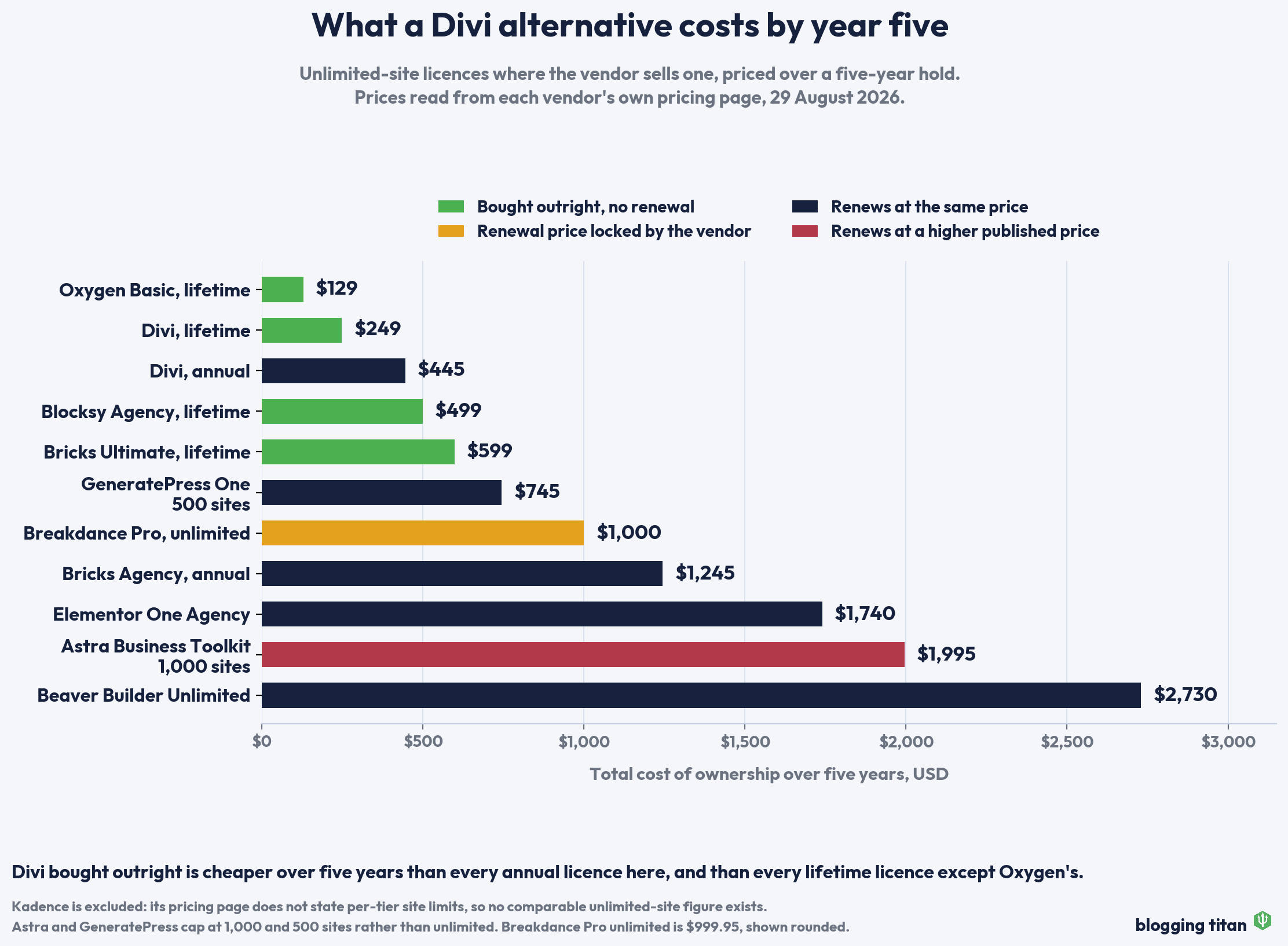
That is the honest headline of this article, and it points the wrong way for an affiliate roundup: if the reason you are shopping is cost, and you already own Divi, the strongest financial move available to you is usually to stop shopping and buy the Divi lifetime licence.
Two things to hold alongside that. The first is that a lifetime licence is only as durable as the company selling it, and five years is long enough for that to matter. The second is that site-count limits are not comparable across this table. GeneratePress covers 500 sites and Astra’s top tier covers 1,000, which is unlimited for every practical purpose but is not the same promise Divi and Oxygen make.
Three different things “renewal” means
The price goes up. Astra is the only builder here that publishes a higher renewal price than its introductory one, and it does so on every paid tier: $99 becomes $149, $199 becomes $299, $279 becomes $429. Over five years that difference is $600 on the top tier. This is disclosed clearly on their own pricing page, so it is a published pricing model, but it needs to be in your maths and it never appears in the roundups.
The price is guaranteed not to go up. Breakdance states the opposite commitment in writing: the price you pay today is the price you pay at renewal, indefinitely. That is worth something concrete right now, because its unlimited plan is flagged on the same page as “soon to be $399.99”, double the current $199.99. Anyone buying at today’s rate locks the lower number for as long as they keep the subscription.
There is no renewal. Oxygen sells lifetime licences only, with no annual option at all. Divi, Bricks, Blocksy and Astra each sell a lifetime alongside their annual plans.
The Gutenberg-native alternatives
This is the real fork in the road, and it matters more than price. Divi renders through its own layer. Kadence, GeneratePress, Blocksy and Astra build on native WordPress blocks instead, which means your content stays in standard block markup and does not depend on a builder’s shortcodes to render. For anyone who has ever migrated off a page builder, that difference is the whole argument.
1. Blocksy
Personal is $69 a year or $199 lifetime for one site. Business is $99 a year or $299 lifetime for 10 sites. Agency is $149 a year or $499 lifetime for unlimited sites. There is a free theme and companion plugin. The money-back guarantee is 14 days.
Where it wins. It is the cheapest lifetime route to an unlimited-site Gutenberg-native theme on this page at $499, and the free version is genuinely usable on a real site.
The downsides. The 14-day guarantee is the shortest here alongside Astra’s, against 60 days from Bricks and Breakdance. It is a theme, so if you specifically want visual drag-and-drop layout control of the kind Divi gives you, this asks you to change how you build pages.
2. GeneratePress
GP Premium is $59 a year for up to 500 sites. GenerateBlocks Pro is $99 a year. The GeneratePress One bundle, which is both plus GenerateCloud, is $149 a year. There is a free theme, and a free version of GenerateBlocks with several million installs. The guarantee is 30 days.
Where it wins. $59 a year for 500 sites is the lowest per-site price in this comparison by a wide margin, and the theme’s reputation for staying out of the way is deserved: it ships very little CSS and JavaScript compared with Divi.
The downsides. No lifetime option, so a five-year hold on the full bundle is $745. The layout power lives in GenerateBlocks rather than the theme, so the honest comparison against Divi is the $149 bundle, not the $59 theme.
3. Kadence
Essentials is $99 a year, Pro is $299 and Elite is $499. Kadence’s pricing now lives on liquidweb.com, following its move under Liquid Web and Nexcess. The pricing page states that plans are priced per site but does not state the per-tier site limits.
Where it wins. The block library and starter templates are the strongest of the Gutenberg-native group, and Pro bundles WooCommerce, memberships, security and backups, which replaces several separate subscriptions.
The downsides. We could not confirm the site limits per tier, which makes a like-for-like comparison against Divi’s unlimited licence impossible to draw honestly, and the guarantee length is not stated on the pricing page either. There is no lifetime option.
4. Astra
Astra Pro on its own is $69 a year or $249 lifetime for 3 sites. Astra Pro with the AI platform is $99 a year, renewing at $149, or $279 lifetime. Essential Toolkit is $199 renewing at $299, or $549 lifetime, for 10 sites. Business Toolkit is $279 renewing at $429, or $799 lifetime, for 1,000 sites. The guarantee is 14 days.
Where it wins. Enormous template library, and the $249 lifetime for Astra Pro alone is priced identically to Divi’s lifetime while giving you a Gutenberg-native theme instead of a proprietary builder.
The downsides. The rising renewal price, which is unique here and adds $600 to a five-year hold on the top tier. Three sites on the entry licence against Divi’s unlimited. And the tier naming is confusing enough that we had to check the page twice to be sure the $69 and $99 lines were different products.
The standalone builders
5. Oxygen
Basic is $129, WooCommerce is $149 and Ultimate is $179, all one-time payments for unlimited sites. A Lifetime Bundle is listed at $199.50 as a limited-time discount. There is no annual option and no free version. Oxygen is owned by Soflyy and the current line is Oxygen 6, with Oxygen Classic maintained separately.
Where it wins. It is the cheapest route to an unlimited-site builder on this page by a distance, and there is no renewal to forget about. Developers rate its output markup, which is the cleanest of the standalone builders.
The downsides. It is developer-first, and the learning curve compared with Divi is steep. Its own pricing page gives two different guarantee lengths in two different places, 30 days in one and 60 in another, which we could not resolve. And a one-time payment funds no future development, which is a risk you take on when you buy it.
6. Bricks
Starter is $79 a year for one site, Business is $149 for three, Agency is $249 for unlimited, and the Ultimate Lifetime licence is $599 for unlimited sites. Local and staging installs do not count against the limit. The guarantee is 60 days.
Where it wins. Bricks is the builder most often named by people leaving Divi specifically over performance, and the 60-day guarantee gives you a realistic window to rebuild something and see. Not counting staging sites against your licence is a small thing that saves real irritation.
The downsides. $599 for the lifetime licence is $350 more than Divi’s, and $249 a year for unlimited sites is nearly three times Divi’s $89. You are paying a clear premium, and the case for it is technical.
7. Breakdance
There is a genuinely free tier covering unlimited sites. Pro for a single site is $99.99 a year, Pro for unlimited sites is $199.99, and Agency is $799.99. The guarantee is 60 days, and the price lock described above applies to every tier.
Where it wins. The price lock, and the fact that the unlimited plan is flagged to double. If you are going to switch, switching before that change is worth $200 a year for as long as you stay.
The downsides. $199.99 a year is still more than twice Divi’s $89 for the same unlimited-site promise, and there is no lifetime option to escape into. Agency at $799.99 is the second most expensive line item in this article.
8. Elementor
Essential is $60 a year for one site, Advanced Solo is $84 for one site, Advanced is $108 for three sites and Expert is $204 for 25 sites. The newer Elementor One is $180 for the first year on one site with 25,000 monthly credits, renewing at $228, and One Agency is $432 for unlimited sites with 350,000 credits, renewing at $540. The free plugin is the most widely installed builder on WordPress. The guarantee is 30 days on annual plans.
Where it wins. Scale, in the sense that matters practically: the largest third-party add-on ecosystem, the most templates, and the most people who already know how to use it, which is the single biggest factor if you ever hire help.
The downsides. Site counts. Divi covers unlimited sites for $89 while Elementor’s unlimited option is One Agency at $432 in year one, and its $108 Advanced tier stops at three. There is no lifetime licence at any price. And the credit-metered One plans introduce a usage dimension that the Editor Pro tiers do not have.
9. Beaver Builder
Starter is $89 a year for one site, Plus is $179 for three, Professional is $299 for 50, and Unlimited is $546. A free Lite version exists on WordPress.org. The guarantee is 30 days, and upgrades between tiers are prorated.
Where it wins. A long reputation for stability and for not breaking sites on update, which is why it persists in agency stacks despite the price. Deactivating it leaves cleaner content behind than most builders here.
The downsides. It is the most expensive way to cover unlimited sites in this comparison at $546 a year, which is $2,730 over five years against Divi’s $445, and there is no lifetime option. Its entry tier costs the same $89 as Divi’s unlimited plan and covers one site.
Which Divi alternative should you choose?
You want out of proprietary builder markup. Blocksy or GeneratePress. Your content ends up in native blocks, which is the thing you are actually buying. Blocksy Agency lifetime at $499 if you want to stop paying; GeneratePress One at $149 a year if you want the lighter front end.
Performance is the complaint. Bricks, and budget for the premium. $249 a year or $599 once, against $89 or $249 for Divi. Take the 60 days and rebuild one real site before you commit.
You need other people to be able to work on it. Elementor. Not because it is the best builder here, but because the pool of people who can pick up your site without training is far larger, and that is worth more than the licence difference on any site you do not maintain alone.
You want to stop paying entirely. Oxygen at $129 if you are technical, Divi’s own $249 lifetime if you are not. Both are cheaper over five years than any annual licence in this comparison.
Cost is the only reason you are here. Buy the Divi lifetime licence and close the tab. We would rather say that than sell you a switch you do not need.
What we could not verify
Kadence’s per-tier site limits and money-back guarantee are not stated on its current pricing page, so they are absent above rather than estimated. Correction, 3 October 2026: Elementor’s main pricing page shows each visitor their local currency, and the Elementor figures first published here on 29 August were pound prices recorded as dollars. The dollar prices above come from the plain-text pricing page Elementor publishes and were read on 3 October 2026. Oxygen’s guarantee is given as both 30 and 60 days in different sections of its own page and we could not resolve which governs.
A note on pricing dates
Every figure here was read from the vendor’s own pricing page on 29 August 2026. Builder pricing in this category moves more than any other software category we track, and Breakdance is currently advertising a doubling of its own unlimited tier. Take your own reading before you commit to a five-year hold.
Prices move. See our dated Divi pricing page for every plan, what you pay on day one, and every price reading we have taken since July 2026.

Written by
Blogging Titan Team
Blogging Titan is an independent team of bloggers documenting what actually grows a blog in the AI search era. We have been building, ranking, and monetizing WordPress sites since 2017, and every guide on this site is based on strategies and tools we have tested ourselves. Want a second pair of eyes on your blog? Request a free blog audit or start with the 2026 playbook.