

We Checked 369 Prices in 39 Page-One Tool Reviews. Most Are Accurate. Almost None Are Usable.
Quick answer: We took 39 tool reviews that rank on page one of Google, pulled every price they quote, and checked all 369 of them against what the vendor charges today. We expected to find a pile of out-of-date numbers. We did not. Only 9 of 31 comparable reviews get the entry price wrong, and putting a year in the title does not predict whether the pricing was checked. What we found instead: 72% of quoted prices never tell you what you have to commit to, and the hosting reviews quote entry prices five to six times below what the host actually charges once the introductory term ends. The prices are accurate. They are also unusable.
We went looking for stale prices
The theory was straightforward and, we thought, obviously true. Tool reviews sit on page one for years. Vendors change pricing constantly. Therefore page one should be littered with prices nobody can actually pay any more, and the “Updated 2026” stamp on top of them should be worth nothing.
This is the fourth study in a series that keeps testing what page-one advice claims about itself. The Stake Test found 80% of tool recommendations have a financial stake in their own answer. The Proof-of-Use Test found 38% of reviews cannot show evidence anyone used the tool. The Ghost Author Test found 31% of blogging advice has no author you can verify exists.
Three for three. We assumed prices would make it four.
What we did
We reused the review corpus from the Proof-of-Use study: editorial pages from Google’s US organic top 10 across tool review queries. After dropping two tools whose vendor pricing we could not read in dollars, that left 39 reviews covering 10 tools: Bluehost, Hostinger, SiteGround, Wix, Squarespace, Kit, Semrush, Surfer SEO, Grammarly and Jasper.
First we established what each tool actually costs, by reading the vendor’s own pricing page on 20 July 2026 and recording four numbers for every plan: the month-to-month rate, the annual-billing rate, any introductory rate, and the renewal rate once the introductory term expires. Hosting companies bury that last number, so we dug for it and recorded where we found it.
Then we went through all 39 reviews and extracted every price each one states for the tool it is reviewing: 369 individual claims. For each we recorded the plan name as written, the amount, whether the page says what billing commitment the price requires, and whether the page frames it as the ongoing cost, a promotional rate, a renewal rate, or a vague “starting from”.
The people extracting prices were told to record what the page says and nothing else. No judging, no correcting, no looking up the real number. Comparison happened centrally afterwards, so every page was judged the same way.
The thing we expected was not there
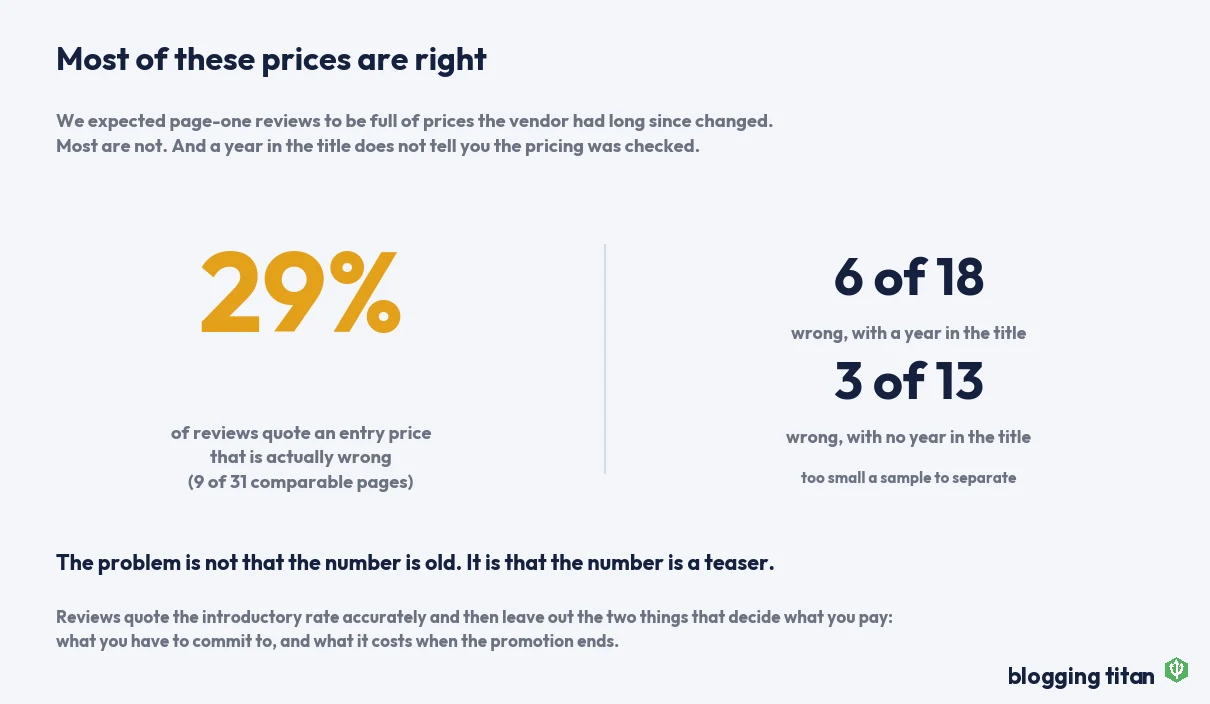
Nine of 31 comparable reviews quote an entry price that does not match what the vendor charges today. That is 29%, which means roughly seven in ten of these pages have a number you could take to the checkout and recognise.
We were generous in the comparison, counting a price as correct if it was within 5% or within fifty cents, so that a publication rounding $2.99 to $3 is not punished for editorial style. Even so, we expected far worse.
The freshness signal is more interesting. Eighteen of the comparable pages put a year in the title and 13 do not. Six of the 18 are wrong, against three of the 13. On its face that is worse for the pages advertising their freshness, but with samples this small the difference is one or two pages of noise and we would not defend it as a finding. What we can say is the obvious negative: a year in the headline gives you no reason to trust the number underneath it.
So the hypothesis failed. We are reporting it anyway, because a null result that took three days to produce is still a result, and because the corpus then showed us something we had not thought to look for.
72% of prices come with no commitment attached
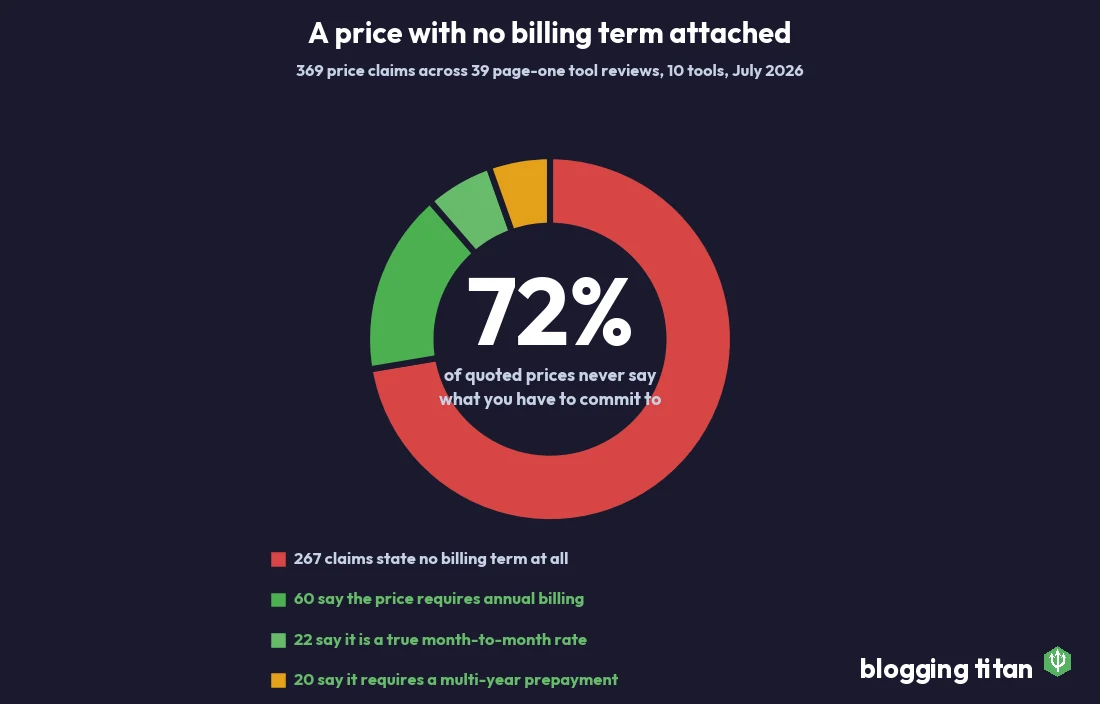
Of the 369 prices we collected, 267 arrive with no statement of what you have to commit to in order to get them. Sixty say the price requires annual billing. Twenty-two say it is a true month-to-month rate. Twenty say it requires a multi-year prepayment.
Twenty. Out of 369.
This matters more than it sounds. “$2.99 a month” is not a price, it is a price and a contract, and the contract is frequently four years paid up front. A reader budgeting $36 for their first year of hosting is looking at a number that requires $143 today. The review told them the truth and still left them with the wrong idea.
Fifteen of the 36 reviews that quote any price never attach a billing term to a single one of them.
The hosting gap: quoted $2.99, actual $17.99
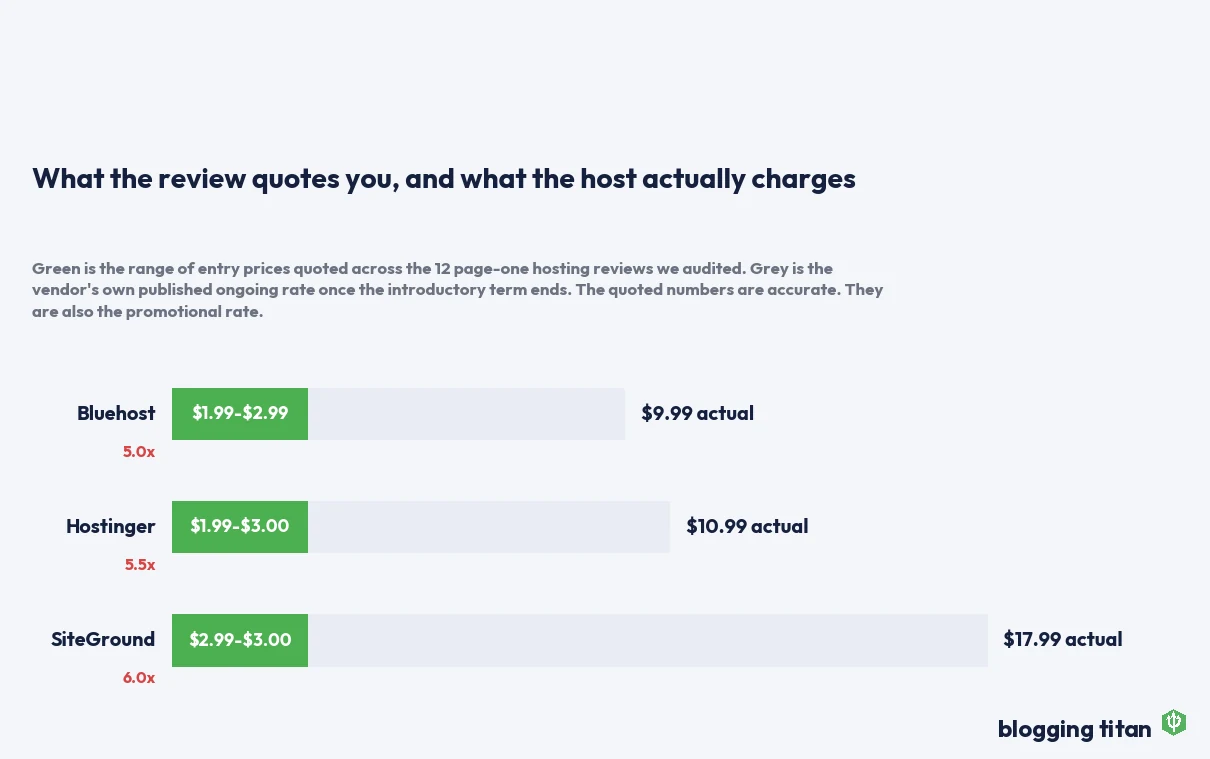
Twelve of our 39 reviews cover web hosting, the most affiliate-saturated category in the blogging tool market. Here is what they quote, against what the three hosts publish as their own ongoing rate:
- Bluehost. Reviews quote $1.99 to $2.99 a month. The published renewal rate on the entry plan is $9.99. Depending on which review you read, that is a gap of 3.3 to 5.0 times.
- Hostinger. Reviews quote $1.99 to $3.00. Renewal is $10.99. A gap of 3.7 to 5.5 times.
- SiteGround. Reviews quote $2.99 to $3.00. Renewal is $17.99. A gap of 6.0 times, and here the reviews agree closely enough that the range barely moves.
Every one of those quoted figures is defensible. They are real prices that a real new customer really pays, for one term. The reviews are not lying. They are quoting the number the affiliate programme is built to make attractive, and the question is what they do next.
Eight of the twelve give you a renewal figure. Four do not. Of those four, three gesture at the idea that prices rise without ever printing a number, and one never raises the subject at all while running an “80% off” promotional banner at the top of the page.
The best page in the entire corpus is a CNET hosting review that prints almost every price as an explicit pair: starts at this, renews at that, on a contract of this length. It is not more beautifully written than the others. It just answers the question.
Four reviews have no usable price at all
Four of the 39 pages rank on page one for a tool review query without telling you what the tool costs.
- A Semrush review that quotes no price for any Semrush plan, but does quote $90 a month for an unrelated agency programme the author is enrolled in.
- A Surfer SEO review whose pricing section lists the prices of three competitors and none for Surfer.
- Another Surfer review that says the cost is in the “low hundreds per month” and advises you to check the vendor’s site.
- A Squarespace review with no price anywhere on the page, whose URL says 2022, whose heading says 2022, and whose title tag says 2021.
“Check the vendor’s site for current pricing” is the sentence that gives the game away. It is an admission that the page is not maintained, written in a way that transfers the work to the reader while keeping the ranking.
Plan names date a page better than dates do
Since the year in the title told us nothing, we looked for something that would. Plan names turn out to work well, because vendors rename tiers and unmaintained reviews keep describing the old ones.
- Three of the four Grammarly reviews still call the paid tier Premium. It is called Pro now. The fourth review notes the rename explicitly, which is what a maintained page looks like.
- One Jasper review prices a Starter plan at $49 and a Teams plan at $125. Neither tier exists. The same page discusses a 2021 knowledge cutoff as current and mentions testing something “more recently (Sept 2023)”.
- A Bluehost review prices a Personal plan, alongside Choice Plus and Custom Plus. Bluehost’s current line-up is Starter, Business and eCommerce Essentials.
- Semrush has renamed its tiers from Pro, Guru and Business to a new structure, and both generations appear across our Semrush reviews. Two pages handle it well, documenting both line-ups side by side. One quotes a “basic” plan at three different prices in three places on the same page.
- One Kit review carries a 2024 note announcing that ConvertKit is now called Kit, then reverts to the old abbreviation throughout the body text, on a URL that still says convertkit.
A retired plan name is a fingerprint. It tells you roughly when the writer last opened the pricing page, and no update stamp can paper over it.
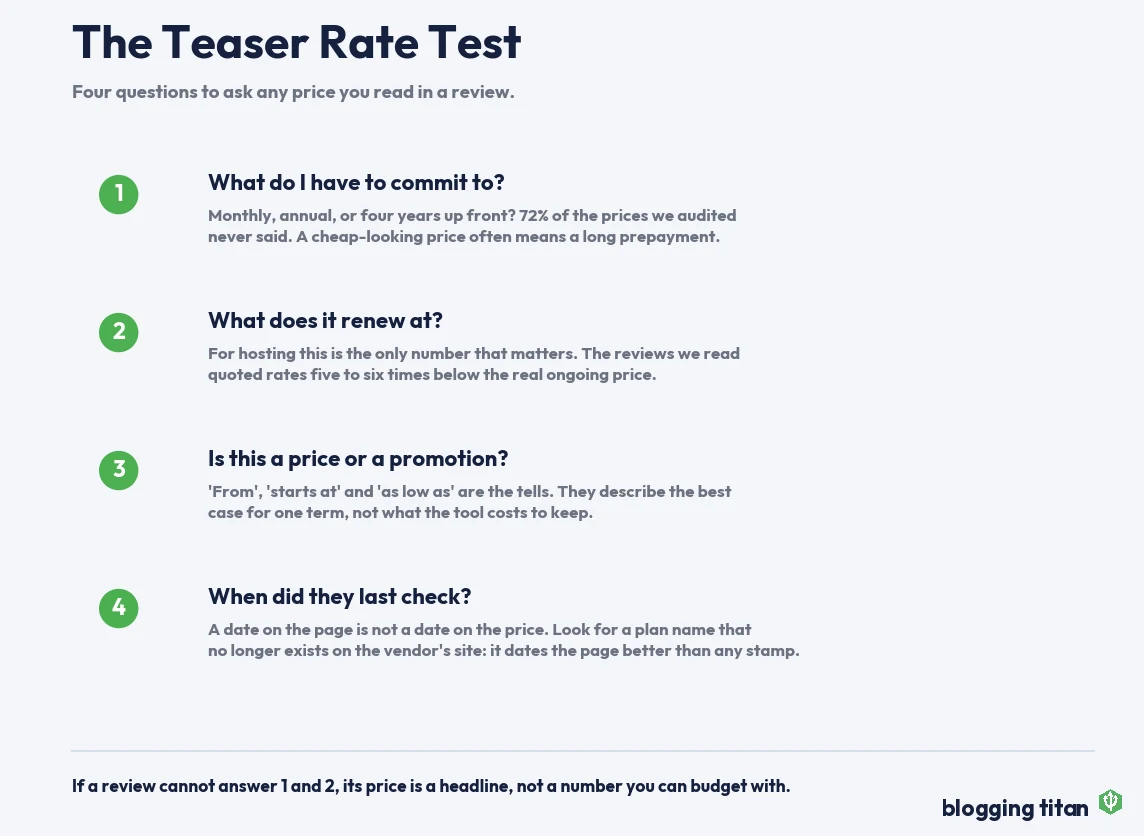
- What do I have to commit to? Monthly, annual, or four years up front? Nearly three quarters of the prices we audited never said. A cheap-looking monthly figure often means a large payment today.
- What does it renew at? For hosting this is the only number that matters, and it is the one most likely to be missing. If the review does not print it, the vendor’s own site will, usually in the small print under the pricing table.
- Is this a price or a promotion? “From”, “starts at” and “as low as” are the tells. They describe the best case for one term rather than what the tool costs to keep.
- Do the plan names still exist? Open the vendor’s pricing page and compare. If the review is pricing tiers the vendor retired, you know how old the research is regardless of what the date stamp says.
A review that cannot answer the first two has given you a headline. What you needed was a number you can budget with.
If you write reviews
The fix here is unusually cheap, which is what makes the gap interesting.
- Print the pair. Intro price and renewal price, next to each other, every time. The single best page in our corpus does nothing cleverer than this.
- State the commitment. Four extra words after the number. “Billed annually.” “On a 48-month term.” This is the most common failure in the study and the easiest to fix.
- Date the price, not the post. “Pricing checked 20 July 2026” is worth more than “Updated 2026” in a title, and it is falsifiable, which is the point.
- Audit your plan names first. When you refresh a review, check the tier names before anything else. If they have changed, the whole pricing section needs rewriting, and a date bump will not cover it.
- If you cannot maintain the prices, cut them. A review with no price beats a review with a price from 2023. Three pages in this corpus took that option and only one was honest about why.
Limits of this study
Thirty-nine reviews across ten tools is enough to describe a pattern and not enough to size it precisely. The 29% error rate rests on 31 comparable pages, so treat it as “most prices are roughly right” rather than as a precise figure.
The exclusions do real work, so here is how much. Eight of the 39 reviews sit outside the headline rate: four because their prices rendered in pounds and four because they quote no usable price at all. Count all eight as failures and the error rate rises from 29% to 38%. Count only the four with no price, which is arguably fair since a missing price serves the reader worse than a wrong one, and it is 31%. The 29% figure is the most favourable defensible reading, and you should know that before you quote it.
Our browser reads the web from a UK address, and several sites localise their pricing automatically. Four reviews and two vendor pricing pages rendered in pounds, so we excluded those pages from the numeric comparison and dropped two tools from the study entirely; converting currencies would have made the comparison look cleaner than it was. A reader in the US may see different figures on those same pages.
Matching a quoted price to a vendor plan is also less mechanical than it sounds. Several pages quote add-on prices lower than any real plan, so we adjudicated the entry price for four reviews by hand, so no automated rule could report a tool as costing $10 when the cheapest plan is $139. Every one of those decisions is recorded in the dataset.
Finally, prices move. Everything here is a snapshot of one day, which is precisely the problem the study set out to measure and precisely the problem this page will eventually have.
Cite this data
Key figures
| Reviews audited | 39 across 10 tools |
| Individual price claims checked | 369 |
| Claims stating no billing term | 267 of 369 (72%) |
| Claims stating a multi-year commitment | 20 of 369 (5%) |
| Reviews with a wrong entry price | 9 of 31 comparable (29%) |
| Wrong, by year in title | 6 of 18 with, 3 of 13 without |
| Hosting reviews giving a renewal price | 8 of 12 |
| Quoted vs actual ongoing price, Bluehost | $1.99-$2.99 vs $9.99 (3.3-5.0x) |
| Quoted vs actual ongoing price, Hostinger | $1.99-$3.00 vs $10.99 (3.7-5.5x) |
| Quoted vs actual ongoing price, SiteGround | $2.99-$3.00 vs $17.99 (6.0x) |
| Reviews with no usable price at all | 4 of 39 |
Plain citation
Blogging Titan (2026). The Teaser Rate Test: pricing accuracy and disclosure in page-one tool reviews. Retrieved from https://bloggingtitan.com/blog-seo/teaser-rate-test-tool-review-pricing/
BibTeX
@misc{bloggingtitan2026teaserrate,
  title  = {The Teaser Rate Test: pricing accuracy and disclosure in page-one tool reviews},
  author = {{Blogging Titan}},
  year   = {2026},
  month  = {July},
  url    = {https://bloggingtitan.com/blog-seo/teaser-rate-test-tool-review-pricing/},
  note   = {Dataset: 39 reviews, 10 tools, 369 price claims, collected 20 July 2026}
}
Licensed CC BY 4.0. Please link back to this page when citing.

Written by
Blogging Titan Team
Blogging Titan is an independent team of bloggers documenting what actually grows a blog in the AI search era. We have been building, ranking, and monetizing WordPress sites since 2017, and every guide on this site is based on strategies and tools we have tested ourselves. Want a second pair of eyes on your blog? Request a free blog audit or start with the 2026 playbook.