

I Mapped All 1,403 Internal Links on My Blog. One in Five Takes a Redirect Detour.
Quick answer: I mapped all 1,403 internal links across the 176 posts on this blog and followed each one to its true destination. 294 of them, about one in five, do not point at the current URL and take a redirect detour first. The audit found zero broken links and zero orphan posts, so the problem is not missing links, it is stale ones.
Updated July 2026. I mapped every internal link across all 176 posts on this blog, 1,403 of them, and followed each one to its true destination. The good news came first: zero broken links and zero orphan posts. Then the catch. 294 of those links, about one in five, do not point at the current URL. They point at an old slug that 301-redirects to the real page. On top of that, 26 posts link out to nothing, and 47 percent of the library gets by on two inbound links or fewer. Here is the full graph and the three fixes it pointed to.
How I built the graph
I pulled every published post through the WordPress REST API and extracted each internal link from the body content only, ignoring the theme menu and footer. Then I followed every unique target to its final URL, which is the step that matters, because a link can look fine and still land on a redirect. With destinations resolved, I counted inbound and outbound links for each post and looked at how link equity flows through the library.
The numbers across 176 posts
| Metric | Value |
|---|---|
| Posts analyzed | 176 |
| Internal links found | 1,403 |
| Links pointing directly to a post | 943 |
| Links routed through a 301 redirect | 294 (about 1 in 5) |
| Broken (404) links | 0 |
| Orphan posts (no inbound links) | 0 |
| Dead-end posts (no outbound links) | 26 |
| Posts with 2 or fewer inbound links | 83 (47%) |
| Average links in and out per post | about 6 |
| Most-linked hub | start-a-blog (75 inbound) |
Finding 1: the redirect tax
Worth reading alongside this: a rewrite rule on this site was later found deleting every internal link to our best page at render time. This graph reads rendered HTML, which is what Google reads, so links erased by a filter never show up in it at all.
The biggest surprise was invisible from the front end. Nearly one in five internal links pointed at a slug I had renamed long ago, so every click and every crawler bounces through a 301 redirect on the way to the real post. The pages still load, which is why nobody notices, but the site is quietly paying a tax. Redirects add a hop that slows crawling, shed a little link value, and turn into broken links the day an old redirect gets cleaned up. Pointing each link straight at the destination removes all of that risk for free.
Finding 2: 26 dead-end posts
Twenty-six posts link out to nothing. No internal links at all. The pattern was telling: most of them were reviews and comparison posts, like the SE Ranking review and the Surfer SEO alternatives roundup. Those are the pages closest to a buying decision, and they were sending readers to a dead end instead of guiding them to a related tool, a setup guide, or a deeper comparison. A dead-end post keeps its link value to itself and gives the reader no next step.
Finding 3: equity pools at the top
Internal link equity in this library is top-heavy. A handful of hubs collect most of it, with the start-a-blog guide pulling 75 inbound links, while 47 percent of posts survive on two inbound links or fewer. That concentration is not wrong on its own, since pillar pages are supposed to be well linked. The issue is the thin tail: dozens of useful posts sit one or two links from invisibility, which caps how well they can rank or get discovered.
What was actually healthy
Two results are worth celebrating. Zero broken links means nothing in the library returns a 404 to a reader or a crawler. Zero orphans means every post has at least one other post pointing to it, so nothing is stranded. With an average of about six internal links per post, the backbone is solid. The work here is tuning, not rescue.
The three fixes this points to
- Rewrite the 294 redirected links to point straight at the final URL, so no internal click takes a detour.
- Give the 26 dead-end posts two or three relevant outbound links each, especially the reviews near a buying decision.
- Add inbound links to the thin tail, the 83 posts with two or fewer, from related hubs that already rank.
Update: I worked the punch list. Here is the after picture.
This audit went live on July 1 with three fixes at the bottom. Over the following three weeks I worked through them, and on July 24 I re-ran the same crawl over what had grown to a 190-post library. Same method, same code: every internal link in body content, every unique target followed to its final URL.
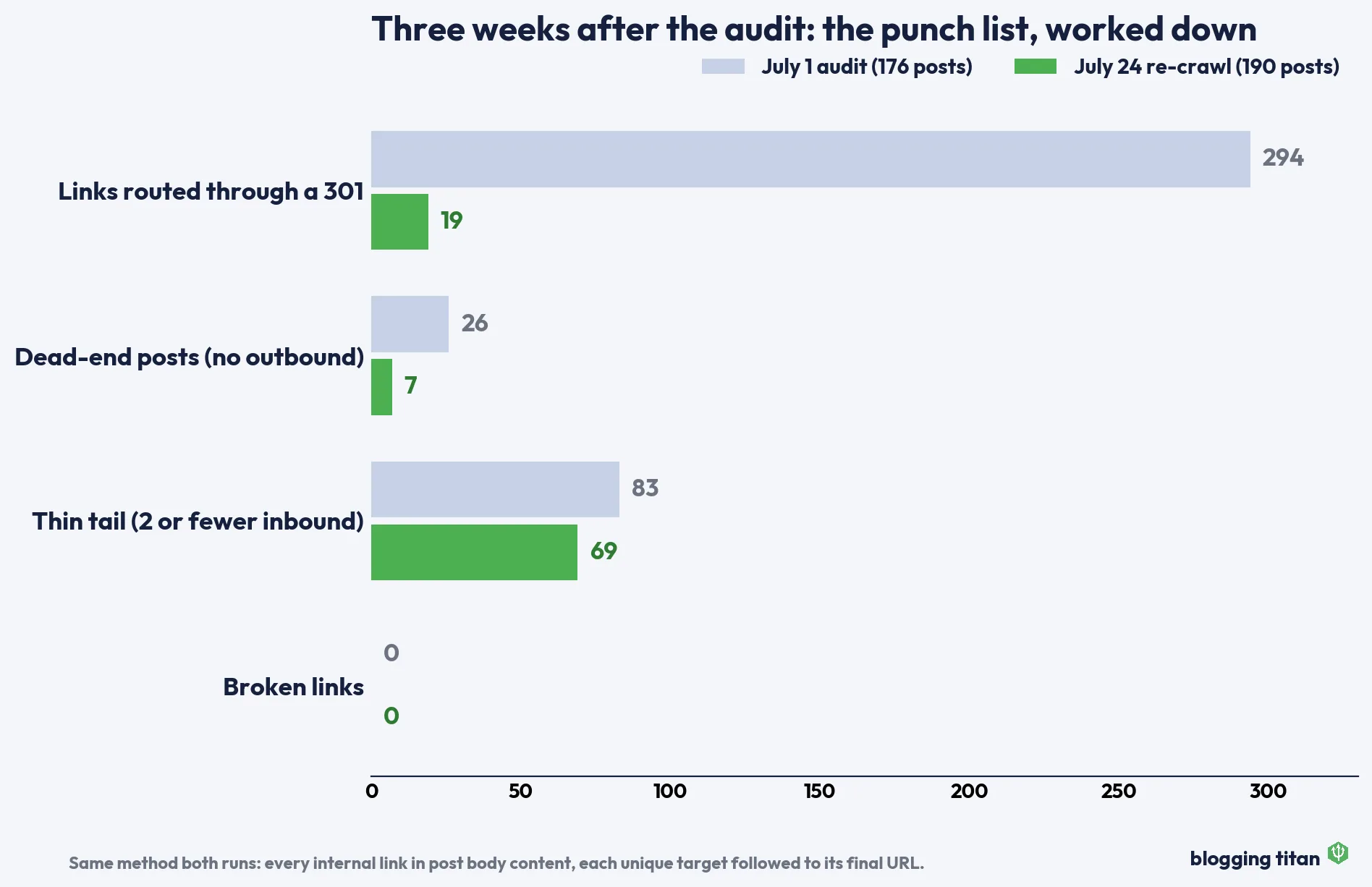
| Metric | July 1 (176 posts) | July 24 (190 posts) |
|---|---|---|
| Internal links found | 1,403 | 1,676 |
| Links routed through a 301 | 294 (about 1 in 5) | 19 (about 1 in 90) |
| Broken (404) links | 0 | 0 |
| Orphan posts | 0 | 1 (see note below) |
| Dead-end posts | 26 | 7 |
| Posts with 2 or fewer inbound links | 83 (47%) | 69 (36%) |
| Most-linked hub | start-a-blog, 75 inbound | start-a-blog, 155 inbound |
Three notes on the after column, in the spirit of honest bookkeeping.
The redirect collapse had help. Rewriting 294 links by hand is exactly as tedious as it sounds, and part of the drop came from an unrelated discovery: a link-rewriter code snippet had been silently repointing internal URLs at render time, and repairing that incident meant baking correct destinations into the stored content of 78 posts in one pass. That story became its own case study: one line of code deleted every internal link to our best page. The 19 redirected links that remain are mostly links into an old category URL that now forwards to a topic hub, plus one affiliate redirect that is intentional and stays.
The one orphan is newer than the audit. A guest post published this week simply had no inbound links yet. It got its first one the day of the re-crawl. Zero orphans still holds for every post that existed on July 1.
The thin tail is the slow fix. Dead ends dropped from 26 to 7 quickly, because a dead end is fixed inside the post itself. The thin tail moved slower, 83 posts to 69, because it needs inbound links from elsewhere, and those only accumulate as related content gets written or refreshed. Worth knowing before you start your own cleanup: outbound problems are an afternoon, inbound problems are a habit.
I ran the same kind of before-and-after on the writing side of this library too: the Signs of AI Writing self-audit got its own July 24 re-run.
How to run this on your own site
You do not need a crawler subscription. Pull your posts through your CMS API or an export, extract the internal links from the body, then follow each unique target and compare where it lands against where it was pointed. The gap between those two is your redirect tax. Count inbound links per post to find orphans and the thin tail, and count outbound links to find dead ends. One pass gives you a punch list you can work down in an afternoon.
Frequently asked questions
Do internal links that pass through a redirect hurt SEO?
The effect is small but real. A 301 passes almost all of its value, but it adds a hop that slows crawling, sheds a little equity, and breaks if the redirect is ever removed. Linking straight to the final URL is cleaner.
What is an orphan page and why does it matter?
An orphan is a published page nothing else links to, which makes it hard to discover and index. This audit found zero orphans across 176 posts, the healthy outcome.
How many internal links should a blog post have?
There is no fixed number. This library averaged about six per post. The real signal was distribution: 26 posts linked out to nothing and 47 percent had two or fewer inbound links.
This is original first-party research by Blogging Titan. The dataset below is free to cite or republish with attribution under a CC BY 4.0 license.
| Posts analyzed (July 1 / July 24) | 176 / 190 |
| Internal links mapped (July 1 / July 24) | 1,403 / 1,676 |
| Links routed through a 301 (before / after) | 294 / 19 |
| Dead-end posts (before / after) | 26 / 7 |
| Broken internal links (both runs) | 0 |
Blogging Titan. (2026). Internal link graph audit of a blog library, before and after cleanup. Retrieved from https://bloggingtitan.com/blog-seo/internal-link-graph-study/
@misc{bloggingtitan2026linkgraph,
  title  = {Internal Link Graph Audit of a Blog Library, Before and After Cleanup},
  author = {{Blogging Titan}},
  year   = {2026},
  url    = {https://bloggingtitan.com/blog-seo/internal-link-graph-study/},
  note   = {Original first-party dataset, CC BY 4.0}
}

Written by
Blogging Titan Team
Blogging Titan is an independent team of bloggers documenting what actually grows a blog in the AI search era. We have been building, ranking, and monetizing WordPress sites since 2017, and every guide on this site is based on strategies and tools we have tested ourselves. Want a second pair of eyes on your blog? Request a free blog audit or start with the 2026 playbook.