
On 6 October 2026, the UK business research publisher Whito asked five AI engines the same 44 questions about what UK marketing costs, then scored every answer against prices it had measured. No engine got more than 74% right. Whito published the league table, its scoring rules and the full 220-answer dataset. We downloaded that dataset and re-ran the numbers to see what the ranking hides.
The short answer: AI engines can give UK businesses accurate marketing prices for some questions and not for others, and in this test the question mattered more than the engine. On four software vendors whose prices the engines repeatedly gave in dollars (Hootsuite, Semrush, Ahrefs and Brevo), the five engines scored between 14.3% and 42.9%. On the other 16 software questions, the same engines scored between 87.5% and 100%. The gap between the best and worst engine overall was 12.5 points.
Key findings
- Claude scored 73.9%, Perplexity 72.7%, Gemini 69.3%, ChatGPT 64.8% and Google AI Mode 61.4% in Whito’s test of 44 questions on 6 October 2026.
- 33 of the 115 software answers quoted US dollars for tools that show a UK buyer a price in pounds. Whito calls this “the dollar default”.
- Across all five engines, 6 of 35 answers about Hootsuite, Semrush, Ahrefs and Brevo got the price right, against 69 of 80 answers about the other software vendors. That split is from our re-analysis of Whito’s data.
- When the engines missed on services, they missed high: 29 service answers sat above the measured range and 6 below.
- The top two places are too close to call. Resampling the 44 questions, Claude came first in about half of the runs, Perplexity in about a third and Gemini in about one in seven.
- Claude cited Whito in 17 of its 44 answers, so part of its service score reflects Whito’s own figures. On the 27 answers without a Whito citation, it scored 75.9%.
What the test measured
Whito wrote 44 fixed questions and asked each one once, word for word, with no follow-ups. Twenty-one asked about services, such as a small business website, monthly SEO, Google Ads management, website care plans and photography. Twenty-three asked about named software plans, from Xero and QuickBooks to Hootsuite and Semrush.
All five engines were queried from a UK connection on the same day. ChatGPT, Google AI Mode and Perplexity were used signed out. Claude ran in an incognito chat on Sonnet 5.5 with web search, and Gemini ran signed in on Flash-Lite, using temporary chats where the option loaded. Microsoft Copilot was dropped because it asked for a date of birth and account details before answering.
The yardsticks differ by question type. For services, Whito used published UK provider prices from its own datasets, taking the middle half of the published range. For software, it read each vendor’s UK pricing page in a UK browser on the day and kept screenshots.
Each answer scored two points, one point or none, out of a maximum of 88. For services, Whito took the midpoint of the range each answer presented as typical. It scored 2 inside the measured range, 1 within one and a half times either end, and 0 beyond that or with no usable figure.
For software, a current UK pound price within 5% scored 2. An old price, a dollar conversion within 25%, a wrong billing basis or a dollar sign on the right number scored 1. Dollars only, no figure, or anything further out scored 0.
Whito says a second pass re-read every answer and changed five scores where a rule had been applied inconsistently.
The league table
| Engine | Overall score | Services (21 questions) | Software (23 questions) | Right | Close | Off or no figure | Answers citing Whito |
|---|---|---|---|---|---|---|---|
| Claude | 73.9% | 71.4% | 76.1% | 30 | 5 | 9 | 17 |
| Perplexity | 72.7% | 69.0% | 76.1% | 27 | 10 | 7 | 0 |
| Gemini | 69.3% | 64.3% | 73.9% | 28 | 5 | 11 | 0 |
| ChatGPT | 64.8% | 61.9% | 67.4% | 25 | 7 | 12 | 3 |
| Google AI Mode | 61.4% | 52.4% | 69.6% | 22 | 10 | 12 | 0 |
Source: Whito’s AI price accuracy league table, 220 answers collected 6 October 2026. We recalculated every score in this table from the published CSV and all match.
What we found when we re-ran the data
Whito’s CSV carries every answer, its score and its verdict, which makes three further checks possible. Each one below is our analysis, and the method is at the end of this article.
The vendor matters more than the engine
Whito’s dataset tags each software answer with a verdict. We split the 23 software questions into two groups. The first holds the 16 questions about other vendors. The second holds the 7 questions about Hootsuite, Semrush, Ahrefs and Brevo, which Whito’s own write-up identifies as vendors whose prices the engines quoted in dollars.
| Engine | Software from the other 16 questions | Software from the 7 Hootsuite, Semrush, Ahrefs and Brevo questions | Services (21 questions) |
|---|---|---|---|
| Claude | 93.8% | 35.7% | 71.4% |
| Perplexity | 90.6% | 42.9% | 69.0% |
| Gemini | 100.0% | 14.3% | 64.3% |
| ChatGPT | 87.5% | 21.4% | 61.9% |
| Google AI Mode | 90.6% | 21.4% | 52.4% |
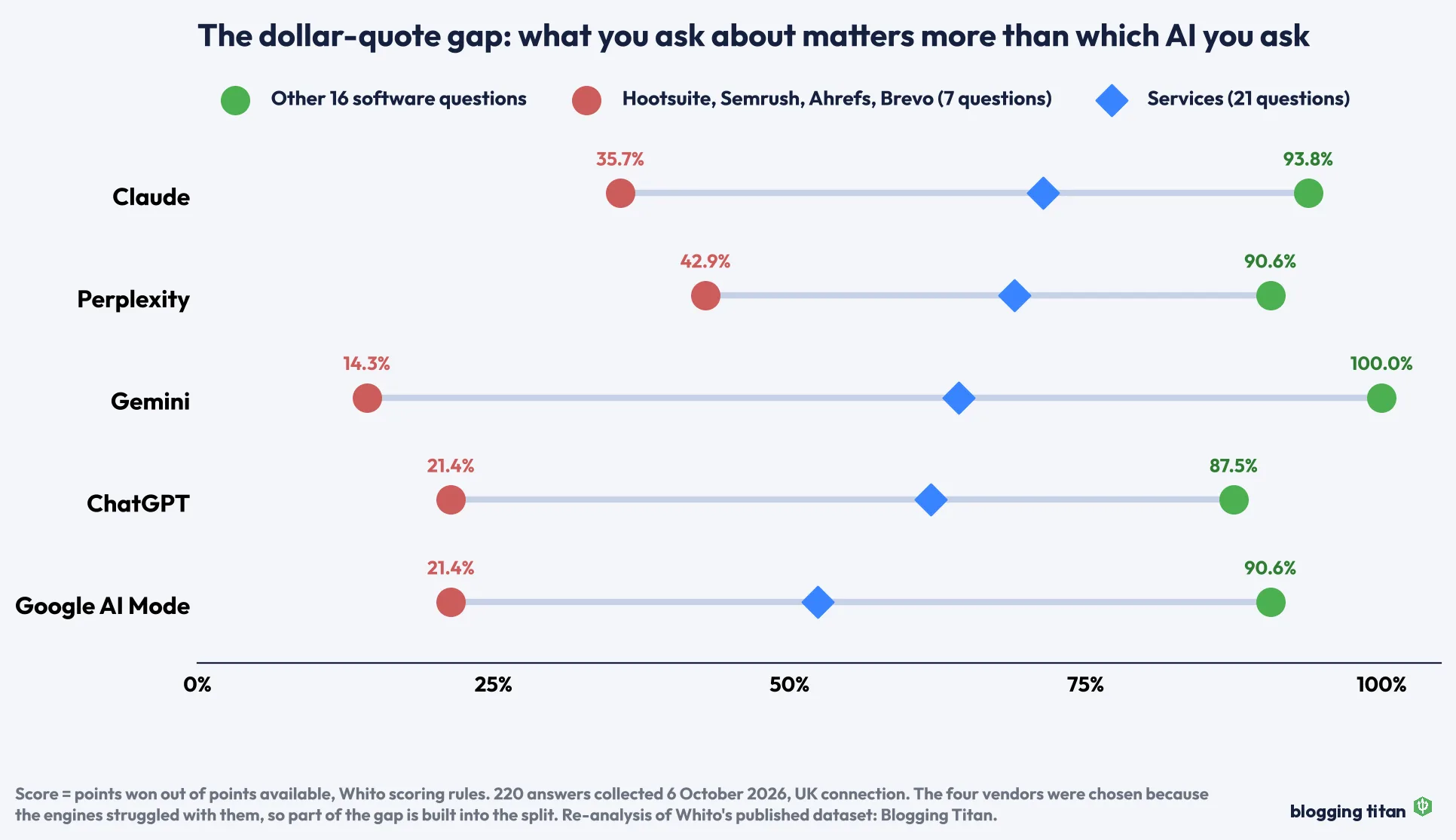
Gemini was the only engine to score 100% on the first group, and it was the weakest on the second. Within every engine, the gap between the two software groups was at least 47 points. Between engines, on the same group, it was never more than 28.6 points.
We call this the dollar-quote gap: in this test, which product a business asked about mattered more than which AI it asked. One caution belongs beside it. The four vendors were picked from Whito’s write-up because the engines struggled with them, so part of the gap is built into the way we drew the line. Whito suggests a likely cause, which it says it has not proved: the vendors may pick the currency from the visitor’s location, so a crawler reading from the US would see dollars while a UK buyer sees pounds. Hootsuite is the starkest case. Its UK plans page showed Standard at £89 and Professional at £169 a user a month, billed annually, and none of the ten Hootsuite answers gave either figure.
Of the 11 misses outside that group, five were old prices and one was a wrong billing basis. The other five were currency errors. Google AI Mode quoted dollars for QuickBooks Simple Start, QuickBooks Plus and FreeAgent. ChatGPT quoted dollars for HubSpot Marketing Hub Starter and converted Pipedrive from dollars.
Ranking engines on 44 questions is fragile
The headline order looks precise, but Claude and Perplexity are one point apart out of 88. Whito itself says to read the top two as level. To put a number on that, we resampled the 44 questions with replacement 10,000 times and recorded which engine came first each time.
| Engine | Finished first | Finished last | Middle 90% of resampled scores |
|---|---|---|---|
| Claude | 49.8% | 0.6% | 63.6% to 84.1% |
| Perplexity | 34.5% | 1.7% | 62.5% to 81.8% |
| Gemini | 13.5% | 2.4% | 58.0% to 79.5% |
| ChatGPT | 1.9% | 30.5% | 53.4% to 75.0% |
| Google AI Mode | 0.3% | 64.8% | 51.1% to 71.6% |
The bottom of the table is steadier than the top. ChatGPT or Google AI Mode came last in about 95% of resamples. Which engine comes first depends heavily on which questions happen to be asked.
One benchmark choice can change the result
The website question shows how much depends on the yardstick. Whito scored it against the published package prices of UK web designers: a median of £520, with the middle half of 28 packages between £399 and £898. Every engine scored zero on it.
Whito’s own UK Marketing Cost Index gives a different planning band for a 5 to 10 page brochure site: £1,500 to £3,000 from a freelancer, and £3,000 to £6,000 from an agency. ChatGPT’s answer suggested budgeting £1,500 to £3,000 for a 5 to 10 page site, the same band. Perplexity also framed its answer around a 5 to 10 page site. We re-scored that one question against each band, using Whito’s own rules, and left the other 43 untouched.
| Engine | Published benchmark used by Whito (£399 to £898) | Freelancer planning band (£1,500 to £3,000) | Agency planning band (£3,000 to £6,000) |
|---|---|---|---|
| Claude | 73.9% | 75.0% | 76.1% |
| Perplexity | 72.7% | 75.0% | 72.7% |
| Gemini | 69.3% | 69.3% | 69.3% |
| ChatGPT | 64.8% | 67.0% | 65.9% |
| Google AI Mode | 61.4% | 63.6% | 63.6% |
Under the freelancer band, Claude and Perplexity tie. The broad order holds, and Whito’s choice is defensible: its stated aim is to measure answers against the prices a buyer can check, and it says so on the page. The point for a business owner is narrower. An AI price can be “wrong” against what sellers publish and “right” against a planning range from the same source, so the useful question is always what scope the figure assumes.
Why a confident answer can still be a bad budget
The engines rarely sounded unsure. The errors came from four places.
- Currency. Thirty-three software answers gave dollars for products a UK buyer sees priced in pounds. Gemini went further and told the reader Brevo bills UK customers in dollars, when Brevo’s UK page showed £6 a month for Starter.
- Age. Xero, QuickBooks and Sage all raised UK prices in 2026. Five answers quoted the old figure, all from Claude or Perplexity, while ChatGPT, Google AI Mode and Gemini were current on all five.
- Billing basis. A monthly price billed annually and a month-to-month price are different numbers. Shopify Basic was accepted at £19 or £25 depending on billing, and ChatGPT’s answer was marked as the wrong basis. Published sources share the gap: our own audit of blogging-tool reviews found that 267 of 369 price claims never stated the billing term.
- Scope. For services, the median answer sat 14% above the measured central price. Four of five engines put a small business website at 3.7 to 6.3 times the published median, which is the same scope problem described above.
Two further complications sit outside the test. VAT: UK business software and service prices are often shown before VAT, and an answer that does not say which it means can be 20% out for a business that cannot reclaim VAT. Billing currency is the other. A tool invoiced in dollars by a supplier outside the UK can add exchange costs. HMRC’s guidance on the place of supply of services says a UK VAT-registered business receiving most business services from an overseas supplier accounts for VAT itself under the reverse charge.
The citation question
Claude cited whito.co.uk in 17 of its 44 answers, 17 of the 21 service questions, so on that half of the test it was partly reading back Whito’s own measurements. Whito publishes Claude’s score without those answers: 75.9% on the other 27. ChatGPT cited Whito three times. Perplexity, Gemini and Google AI Mode did not cite it at all.
Two engines used Whito figures without saying so. Gemini set out Whito’s marketing stack figures (£2,667 a year for a brand-name stack, £1,320 for alternatives, £5,678 for a small team) and credited them to “recent UK market research” with no link. ChatGPT gave Whito’s care plan figures, £49 to £170 a month with a £95 median, without a link on the sentence. Both answers scored well because the figures were right. A reader could not see who measured them, or when.
What this test cannot tell you
- One run, one day. Each question was asked once on 6 October 2026. Ask again and some answers will change, and every engine is updated regularly.
- Published prices are not the whole market. Many agencies publish no price, and their quotes may sit closer to what the engines said.
- Judgement in long answers. Picking the “typical” range from a long answer needs a rule. Whito wrote its rule down and applied it to all five engines, and every choice is in the dataset.
- Sign-in states differ. Gemini and Claude ran in temporary or incognito chats in a signed-in context, the other three signed out. Signed-in results can differ, and the specific model versions matter.
- Self-citation. Claude’s service score partly reflects Whito’s own figures.
- Our resampling assumes the 44 questions stand in for a wider set. They were chosen by Whito, so the intervals describe sensitivity to question choice within this design, not accuracy on every possible question.
- Our split by vendor is drawn from Whito’s own write-up. The four vendors were chosen because engines failed on them, which inflates the gap, and we did not test which vendors geolocate their prices.
A verification checklist before you budget with an AI answer
- Treat the AI figure as a question. Use it to learn what to ask, then confirm the number at source.
- Open the vendor’s UK pricing page yourself, from a UK connection. If an answer quotes dollars for a tool you will buy in the UK, assume it is wrong until the page says otherwise.
- Check the date. Ask the engine when its price was true and where it came from. If it cannot say, look for a dated source.
- Pin down the billing basis. Monthly billed monthly, monthly billed annually, per user or per account.
- Confirm VAT treatment. Note whether the figure includes VAT and whether you can reclaim it.
- Fix the scope before comparing service prices. A website answer for 5 to 10 pages with stock copy is a different job from one with original copy and photography.
- Test the figure against two kinds of benchmark. Published UK seller prices tell you what the cheaper end advertises. A planning range tells you what a fuller scope tends to cost.
- Add the costs an answer leaves out. Setup fees, minimum terms, ad spend, currency fees and add-ons.
- Keep a record. Save the answer, the date and the engine. If you later rely on a figure, you will know where it came from.
How we re-ran the analysis
We downloaded whito-ai-price-accuracy-2026-10-06.csv from Whito’s study page on 23 October 2026: 220 rows, one per answer, with each answer’s figures, the measured price, the score and verdict, and a flag for Whito citations. We recalculated each engine’s overall, service and software scores and the no-Whito score for Claude. All matched the published table.
For the vendor split, we grouped the 23 software questions by product name and scored each group as points won out of points available. For the resampling, we drew 44 questions with replacement from the 44, summed each engine’s points, and repeated this 10,000 times with a fixed random seed, sharing ties for first or last place equally. For the benchmark test, we applied Whito’s published service-scoring rule to the stored midpoint of each engine’s website answer against each alternative band and left every other score unchanged. Anyone with the CSV can reproduce each figure in a few lines of code.
Sources
- Which AI gets UK marketing prices right? The October 2026 accuracy league table, Whito, collected 6 October 2026, with the downloadable CSV
- UK Marketing Cost Index 2026, Whito, data last verified 5 October 2026
- VAT: place of supply of services (VAT Notice 741A), HM Revenue and Customs, section 5
- The Teaser Rate Test, Blogging Titan, July 2026

Written by
Blogging Titan Team
Blogging Titan is an independent team of bloggers documenting what actually grows a blog in the AI search era. We have been building, ranking, and monetizing WordPress sites since 2017, and every guide on this site is based on strategies and tools we have tested ourselves. Want a second pair of eyes on your blog? Request a free blog audit or start with the 2026 playbook.