
Ask Google’s AI Mode to recommend a trustworthy roofer in a UK town and the answer is usually built on a review platform. Ask it for a dentist and the answer is built on the practice’s own website and its Google reviews. That divide runs through a published snapshot of 160 AI answers collected across 20 UK towns on 22 August 2026. In some sectors a third-party review platform stood behind almost every recommendation. In others, the engine leaned on the business’s own website and Google reviews.
The snapshot is the Whito AI Visibility Index, a quarterly study by the UK business research publisher Whito. It asked one question, “Recommend a trustworthy [trade] in [town]”, once per sector per town, and logged all 734 businesses the engine named. Whito has since published two companion analyses of the same answers: one counts every source the engine cited, the other checks every name against Companies House. We combined the three into one sector-by-sector view. The combined table is ours. Every figure in it traces to one of the three published pages.
The short answer: in this snapshot, a review platform such as Checkatrade sat behind the recommendation in 90% to 100% of towns for roofers, plumbers and electricians. For dentists, vets and accountants the figure was 5% to 25%. Trade recommendations were almost never shown below 4.5 stars, while recognised brands in other sectors were. About one name in twenty could not be confirmed as an active company trading in the town the question asked about.
Key findings
- Checkatrade was cited in 50 of the 60 electrician, plumber and roofer answers. Across the 79 professional-service answers it appeared once.
- A business or brand website was cited in 143 of 159 answers (90%), and Google reviews or Business Profiles in 128 (81%). Websites were nearly always read. In the trades, platforms were cited even more often.
- 3 of 231 rated trade recommendations showed a rating below 4.5 stars, by our count from the index table. The figure for accountants, vets and dentists was 16 of 203, for estate agents 5 of 79, and for cleaners 10 of 88.
- Reddit and Facebook fed 51 answers. Estate agency answers drew on them in 55% of towns, and in several towns the engine passed on warnings that named firms to avoid.
- 38 of 728 checkable names (5.2%) could not be verified as an active company trading in the town asked about. For dentists the rate was 11.2%.
How the snapshot was collected
Whito ran the prompt on Google AI Mode from a signed-in UK account on 22 August 2026. It covered eight sectors (electricians, plumbers, roofers, cleaners, vets, dentists, accountants and estate agents) in 20 towns, from Reading and Ipswich to Glasgow and Belfast. Each prompt ran once. There were no retries and no regenerated answers.
Every business presented as a recommendation was recorded, along with any star rating exactly as the answer displayed it and every source the answer cited. The study also publishes its failures. The Blackpool vets answer generated only partially and is recorded as given. Three other vets answers were captured on a second run after a logging fault. The pages disagree about Wolverhampton vets: the index says that answer succeeded on a later same-day run after three refusals, while the citation count says it never generated and leaves it out, which is why that analysis covers 159 answers.
Two things make this more useful than the usual screenshot of an AI recommendation. The town panel is fixed, and Whito says it will re-run the same panel each quarter, with the next edition due in December 2026. And the method, including what went wrong, is on the page. The limits are just as specific, and we return to them below.
Who holds the gate, sector by sector
The table puts the three analyses side by side. Read across a row to see where the engine looked for that sector and how its picks held up.
| Sector | Review platform behind the answer (share of towns) | Business website cited | Google reviews or profile cited | Reddit or Facebook cited | Named with a rating below 4.5 stars | Name not verifiable in that town |
|---|---|---|---|---|---|---|
| Roofers | 100% | 75% | 80% | 35% | 2 of 71 | 5 of 79 (6.3%) |
| Plumbers | 95% | 85% | 85% | 30% | 1 of 82 | 6 of 90 (6.7%) |
| Electricians | 90% | 75% | 75% | 20% | 0 of 78 | 5 of 83 (6.0%) |
| Cleaners | 70% | 90% | 55% | 40% | 10 of 88 | 4 of 109 (3.7%) |
| Estate agents | 40% | 100% | 70% | 55% | 5 of 79 | 2 of 95 (2.1%) |
| Accountants | 25% | 100% | 90% | 15% | 5 of 76 | 1 of 86 (1.2%) |
| Vets | 15% | 95% | 95% | 42% | 8 of 71 | 4 of 88 (4.5%) |
| Dentists | 5% | 100% | 95% | 20% | 3 of 56 | 11 of 98 (11.2%) |
Sources: platform share and ratings from the Whito AI Visibility Index (20 towns per sector, collected 22 August 2026); website, Google and Reddit or Facebook shares from Whito’s citation count (20 answers per sector, 19 for vets); verification from Whito’s Companies House check of 728 preserved names (checked 28 August 2026). The ratings column counts only businesses whose Google rating appeared in the answer.
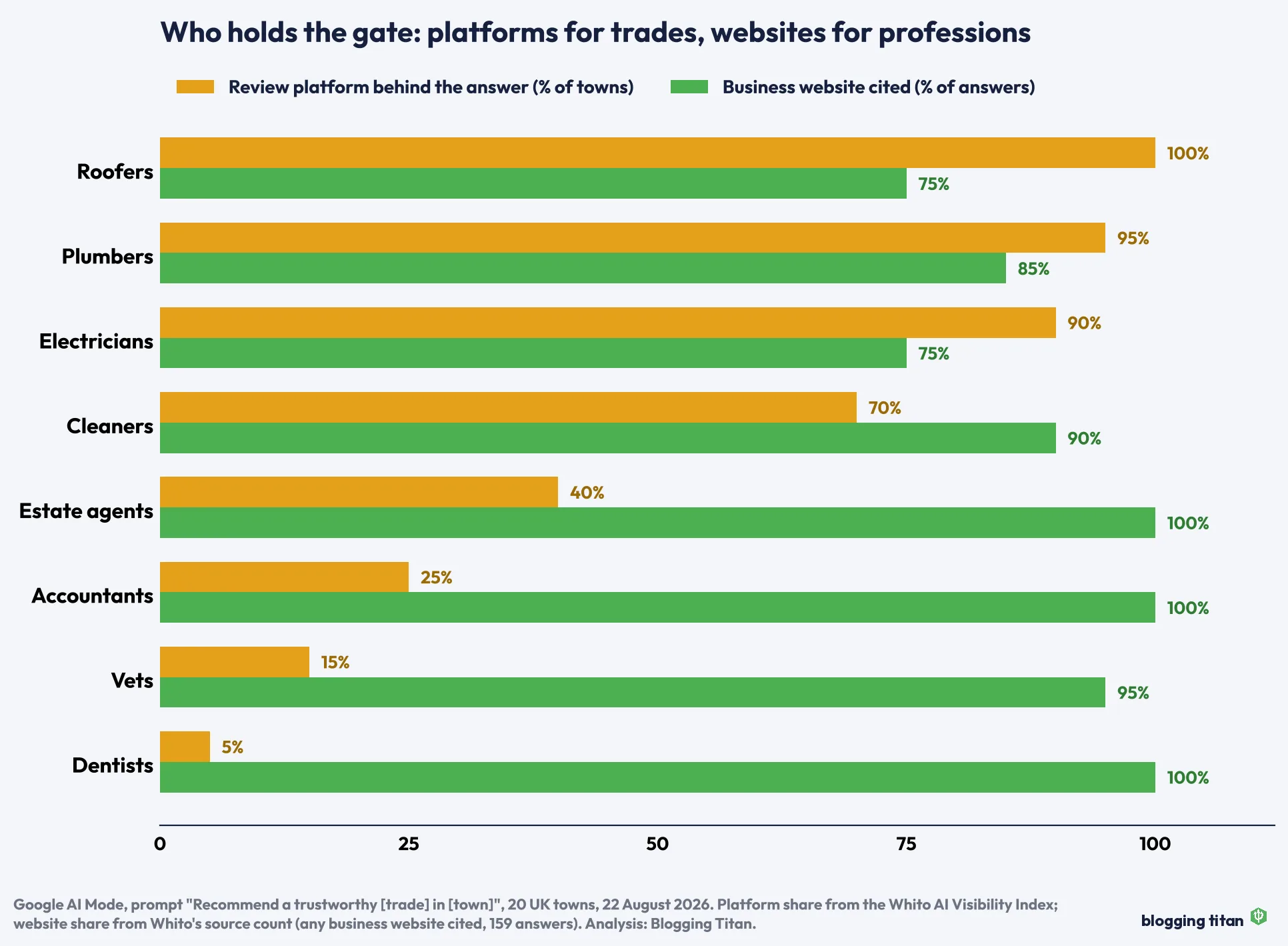
We call this pattern the gatekeeper split. In the trades, a third-party platform was cited behind almost every answer. In the professions, websites and Google profiles carried the answers. Cleaners and estate agents sit between the two, and estate agency adds a third gatekeeper: the local community thread.
Trades: the platform comes first
Checkatrade was the dominant source for the three trades, cited in 50 of their 60 answers. TrustATrader came next, followed by Which? Trusted Traders, ThreeBestRated and MyBuilder. Whito’s source count labels Checkatrade, TrustATrader and Which? Trusted Traders as paid trade directories, which matters for anyone budgeting: in these sectors, the most-cited sources were mostly paid listings.
Ratings were tight. Among electricians, no recommended business showed a rating below 4.7. Across all three trades, 3 of 231 rated recommendations sat below 4.5 stars. An independent trade with a 4.3 average and a thin platform record had very little room in these answers.
The data shows the engine citing those platforms when it named who to trust. It does not show that joining a platform causes a recommendation, and nothing in this snapshot can separate the effect of the listing from the effect of the reviews collected on it.
Professions: websites and Google reviews carry the answer
A business website was cited in every one of the 20 dentist and accountant answers, with Google reviews or profiles in 95% and 90%. Whito’s counting rule includes any business website the answer cited, and in at least 12 answers across the study that was a firm the engine did not recommend, so these figures show what the engine read, not proof that a firm’s own pages got it named. Platform involvement was low: one dentist answer in 20 drew on a platform, vets 3 in 20 and accountants 5 in 20. For dental practices and accountancy firms, websites and Google profiles were the engine’s main material.
That has a practical edge. Both are assets a business controls directly, and both are free to keep accurate.
Why a website on its own was not enough
The website figure of 143 in 159 answers can mislead if read on its own. Being read is one step and being picked is another. In the trades, the engine cited company websites in 75% to 85% of answers, yet the platform record sat behind the answer in 90% or more of towns, and the rating floor applied.
Brands had a different experience. Across all eight sectors, 34 of roughly 600 rated businesses sat below 4.5 stars, and recognisable names dominated that list. They included national cleaning franchises such as Time For You (4.3 stars, in three towns), Merry Maids (3.8) and Daily Poppins (3.0), mydentist branches, Belvoir, and the firm the index describes as Scotland’s largest independent accountancy firm, at 3.4 stars. Recognition appears to have substituted for rating in these answers. The data records the pattern and does not explain it.
Credentials could also outrank customers. In Swansea, the roofing answer recommended a firm whose own Google listing, shown inside the same answer, displayed 2.0 stars from four reviews. The recommendation rested on trade-body membership. Yet the engine mostly named regulators and registers without reading them. Of 111 appearances by a regulator, register or professional body, 95 were mentions of something to look for. Only 16 were sources the engine had drawn on. The Gas Safe Register appeared in ten answers and was never a cited source.
The community thread is now part of the answer
Reddit appeared in 38 answers and Facebook in 18. Estate agency was the most community-driven sector, drawing on those threads in 11 of 20 towns. The engine passed on criticism as well as praise. In Reading it warned against three named agency chains “based on local homebuyer communities”. In Milton Keynes it flagged a national chain for conditional selling, citing Reddit. In Glasgow it relayed a “stay away” warning about a lettings firm.
The same national estate agency chain flagged in the Milton Keynes answer was the top recommendation in the Wolverhampton answer, on the same day, from the same prompt. Sector patterns held across towns. Individual verdicts did not, which is why the index reports rates and avoids naming winners. Our own repeated pulls of Google AI Overviews point the same way, though on a different product and topic: blogging queries with US location settings. In that study, 17 of 20 answers held still within an hour, yet only 74 of 212 citations were still there 87 days later.
Named does not mean checked
The engine called each of these businesses trustworthy. Whito’s Companies House check of the same recommendations found 38 of 728 preserved names (5.2%) that could not be verified as an active company trading in the town asked about. Twenty-one traced to a company that was dissolved, in liquidation or filing dormant accounts. Fifteen could not be tied to any company or public trading footprint. Two names were too generic to match to one firm.
Dentists failed most often, at 11.2%. Whito notes that dental answers were nearly all written prose, and that practices often trade under a name that appears on no company register. Only 305 of the 728 names could be tied by name to a live registered company. The other verified names were confirmed through their trading footprint or as part of a national brand. Sole traders, franchises and practices with a different legal name leave no name-shaped record at Companies House.
For a customer, the word “trustworthy” in an AI answer is a summary of what the engine read. It is not a check.
The UK context: a regulated search engine and regulated reviews
Two pieces of UK regulation sit behind these findings. On 10 October 2025 the Competition and Markets Authority confirmed that Google has strategic market status in general search, and stated that AI Overviews and AI Mode are within the scope of that designation. The Gemini app is not. The designation lets the CMA set conduct requirements for the services in scope, so the way AI Mode chooses and presents local businesses now sits inside a UK regulatory regime.
Since 6 April 2025, the Digital Markets, Competition and Consumers Act 2024 has also banned submitting or commissioning fake consumer reviews and publishing reviews in a misleading way (Schedule 20, paragraph 13), with CMA guidance published on 4 April 2025. In the trade sectors above, reviews collected on platforms and on Google were the engine’s main evidence, so the integrity of those reviews now carries legal weight as well as commercial weight.
What an independent UK business can reasonably do
None of this guarantees a recommendation, and nobody can promise one. These steps follow from where the engine looked in this snapshot.
- Find your sector’s row in the table. Decide which gate applies to you before spending anything: a platform, your own pages, or a mix.
- If you are a trade, treat your platform record as the front door. Keep your Checkatrade or TrustATrader profile current and complete, and keep collecting genuine reviews. In this sample the engine named almost no trade business below 4.5 stars.
- If you run a practice or firm, make your website quotable. State what you do, where you do it and which professional body regulates you, in plain text on the page, and keep your Google Business Profile complete.
- Make your identity easy to confirm. Use the same business name, address and phone number on your website, Google profile, platform listings and Companies House record. A limited company must already show its registered number, registered office and place of registration on its website under the 2015 trading disclosure regulations.
- Read the local threads. Search your town’s subreddit and Facebook groups for your business name. In estate agency, those threads fed more than half of the answers.
- Ask the engine yourself, more than once. Use the questions your customers would type, in your own town, on different days, and note who is named. A single answer is one draw.
To check the website side of step 4, Whito’s free Visibility Check reads a homepage against 17 structural checks, such as business schema, a published company number and AI crawler access. It says plainly that it cannot tell you whether an AI engine names your business, which is the honest limit of any website-only test.
What this evidence does not prove
- It covers one engine on one day. Every answer came from Google AI Mode on 22 August 2026, signed in, one run per prompt. ChatGPT, Perplexity and Gemini may behave differently, and AI Mode itself changes.
- It is not a ranking of businesses. The contradiction between Milton Keynes and Wolverhampton shows that individual verdicts move. Only sector-level rates are worth quoting.
- It shows association, not cause. A platform cited when a business was named does not prove the listing produced the recommendation.
- “Website cited” is broad. Whito’s citation count includes any business website an answer cited, including firms it did not recommend.
- Each cell is small. Each sector has 20 answers, 19 for vets in the source count, so a single answer moves a percentage by five points.
- Twenty towns and eight sectors are not the UK. The panel spans England, Scotland, Wales and Northern Ireland, but other towns and sectors may differ.
- The source pages sort sources differently. The index’s platform measure names comparison portals and ThreeBestRated among its platforms, while the citation count separates trade directories from auto-generated “best of” pages. The figures do not map one to one: cleaners show 70% on the index measure and 65% for “any directory” in the citation count, accountants 25% and 15%. We use the index measure in the platform column.
How we built the combined table
We read the three Whito pages on 23 October 2026 and copied each sector row without adjustment. The platform column is the index’s “platform dependence” measure. The website, Google and community columns come from the sector table in Whito’s citation count. The verification column comes from the sector table in the Companies House analysis, using its denominators of preserved names.
The group figures in this article are our own sums of those rows. “Trades” means roofers, plumbers and electricians (3 of 231 rated names below 4.5 stars). Accountants, vets and dentists together had 16 of 203. Estate agents (5 of 79) and cleaners (10 of 88) are reported separately because they fit neither group cleanly. Anyone can reproduce every number from the three source pages listed below.
Sources
- Whito AI Visibility Index: UK Trades and Services, Q3 2026, collected 22 August 2026, page last updated 12 October 2026
- What AI actually cites when it recommends a UK local business, Whito, August 2026 data
- How many UK businesses AI calls trustworthy are not a real, active firm in that town, Whito, checked 28 August 2026
- CMA confirms Google has strategic market status in search services, GOV.UK, 10 October 2025
- Fake reviews (CMA208), Competition and Markets Authority, 4 April 2025
- Digital Markets, Competition and Consumers Act 2024, Schedule 20, legislation.gov.uk
- The Company, Limited Liability Partnership and Business (Names and Trading Disclosures) Regulations 2015, regulation 25, legislation.gov.uk
- The Citation Lottery, 87 Days Later, Blogging Titan, 19 October 2026

Written by
Blogging Titan Team
Blogging Titan is an independent team of bloggers documenting what actually grows a blog in the AI search era. We have been building, ranking, and monetizing WordPress sites since 2017, and every guide on this site is based on strategies and tools we have tested ourselves. Want a second pair of eyes on your blog? Request a free blog audit or start with the 2026 playbook.