

What Cloudflare Pay Per Use offers a small blog, and why ours cannot see an offer
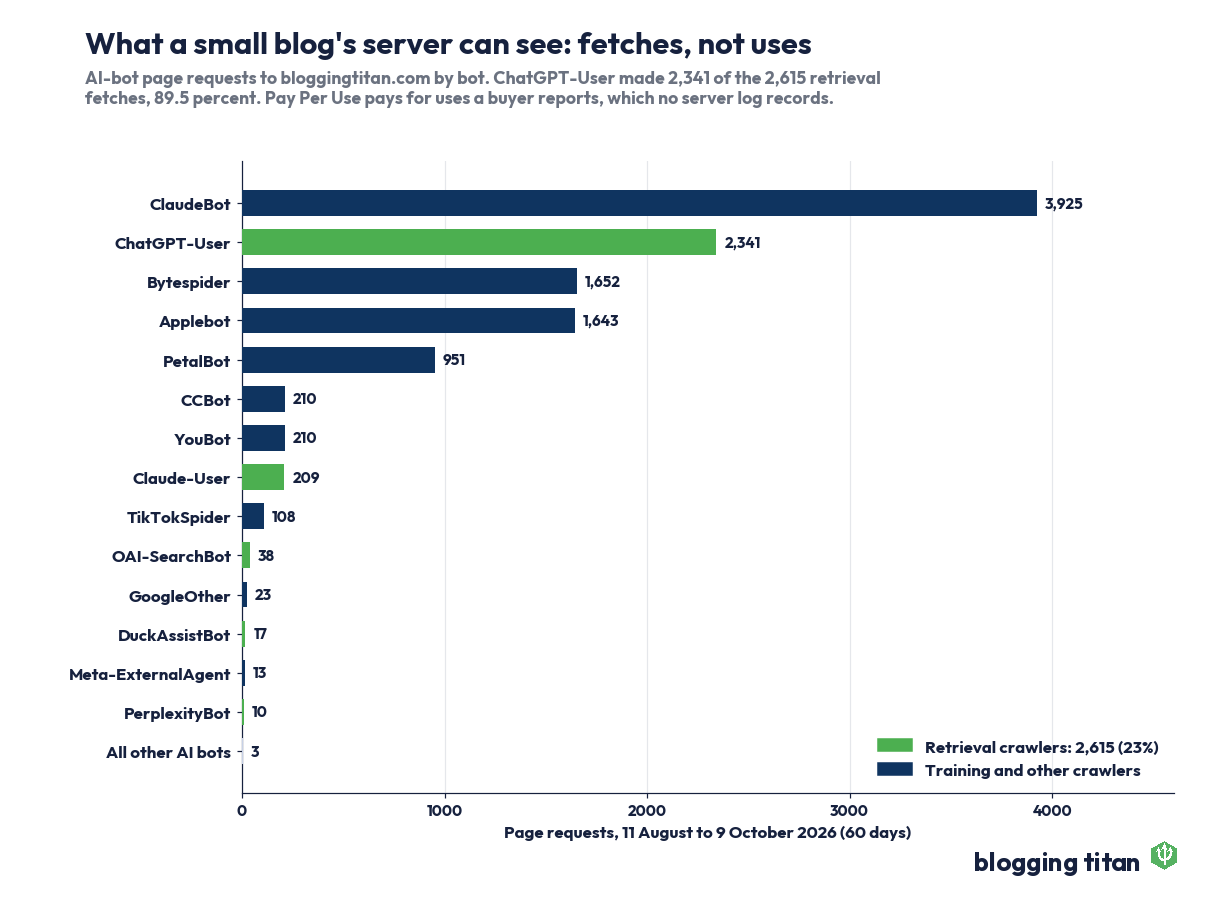
Quick answer: Cloudflare Pay Per Use, in beta since 30 September 2026, lets an AI company offer a price for a specific use of your content, such as returning an excerpt to its users. You can accept an offer in the Cloudflare dashboard and stop participating later, the buyer reports each use, and Cloudflare pays you monthly. Cloudflare has published no rates and named no buyers. A small blog can only see an offer if its site runs through Cloudflare, and ours does not. What we can count is the demand side: in 60 days our server logged 2,615 page fetches from AI retrieval crawlers, 43.6 a day, and 89.5 percent came from ChatGPT-User. We call that the one-buyer blog: for a site like ours, Pay Per Use is worth whatever one company decides to offer.
Original research. 11,353 AI-bot page requests logged on bloggingtitan.com across 60 full days, 11 August to 9 October 2026. Cloudflare’s announcement and documentation read on 10 October 2026.
The numbers, up front
- No published rate. Cloudflare’s 30 September announcement gives no price, no rate card and no buyer name. The AI company sets the price, and the offer is only shown to publishers inside the dashboard.
- 2,615 retrieval fetches in 60 days. ChatGPT-User, Claude-User, OAI-SearchBot, DuckAssistBot and PerplexityBot together made 43.6 page requests a day to this site, every day between 18 and 69. That is 23 percent of all AI-bot page requests we logged.
- One company, nine fetches in ten. ChatGPT-User made 2,341 of the 2,615. Add OAI-SearchBot and OpenAI accounts for 91.0 percent. Claude-User was second with 209.
- The rest is crawling. The other 8,738 requests came from crawlers outside the retrieval group, led by ClaudeBot with 3,925. Pay Per Use does not pay for any fetch as such. It pays for whatever use a buyer reports afterwards, which no server log can see.
- The arithmetic. No buyer has published a rate. At a hypothetical tenth of a cent per use, our roughly 1,310 monthly retrieval fetches would total about $1.31, and only if every fetch counted as a use.
What Pay Per Use is
Cloudflare describes four steps. An AI company sets up a program: it identifies its crawler, defines the use it will pay for, sets a price and connects a payment account. Publishers see the offer in the dashboard under Monetize, then Pay Per Use, with the AI company, the use and the price on one screen. If a publisher accepts, the buyer reports each use through Cloudflare’s API as a line of JSON giving the time, the URL and an event ID. Cloudflare totals the reports, charges the buyer and pays the publisher monthly into a connected payment account.
The two example uses in the announcement are a search service paying when it returns an excerpt from an enrolled page, and a shopping agent paying when an enrolled review shapes a recommendation. Each program’s terms also set what the AI company may do with the content, including any limits on training. Reporting is done by the buyer. In Cloudflare’s words, “Usage is self-reported: the program terms require complete reporting”, and Cloudflare checks that each reported use maps to an enrolled publisher.
It sits beside an older product. Pay Per Crawl, launched in 2025, charges a crawler for access at a price the site owner sets, and Cloudflare’s documentation still lists it as a closed beta. Pay Per Use flips who names the price: the buyer proposes, the publisher accepts or walks away.
What Cloudflare has not published
Three things a small publisher would want to know are missing from the announcement and from the coverage we read on 10 October.
- Any price. Neither the announcement nor Search Engine Journal’s report gives a figure for Pay Per Use. Search Engine Journal notes that neither Cloudflare post reports transaction counts or payouts.
- Any buyer. The announcement names no AI company. Search Engine Journal reports that Cloudflare is working with buyers without naming them.
- Who can join. The announcement says that during the beta Cloudflare is “working directly with each buyer and with the publishers who opt in”. It sets out no plan tier or country rule for Pay Per Use. Search Engine Journal does list rules, including that buyers and sellers be based in the United States and that a zone be more than 30 days old. Those belong to Monetization Gateway, a separate product launched the same day. Whether any of them carry over to Pay Per Use is not stated.
Cloudflare does say where pricing is meant to go. It wants publishers to be able to counter on price and to price content differently by use, and it gives the example of last week’s reporting being worth more than a ten-year-old archive page. Those are plans. Today the buyer names the price.
Why we cannot see an offer
Offers live in the Cloudflare dashboard, so a site has to run through Cloudflare to receive one. Blogging Titan runs on LiteSpeed at Hostinger, and its nameservers are Hostinger’s, so there is no Monetize screen for us to open. That was also why our 30 September crawler study could treat this site as a rough control for Cloudflare’s 15 September change.
Getting an offer screen would mean moving the domain’s DNS to Cloudflare. That changes how every request reaches the site, and it brings a choice with it. Cloudflare’s July 2025 announcement says every new domain is asked on sign-up whether to allow AI crawlers. Pay Per Use only reaches content that the publisher’s controls let a verified buyer fetch. A blog that blocks AI crawlers on the way in has nothing for a buyer to use.
So for a site like ours, the order is fixed. Move to Cloudflare, keep the crawlers allowed, wait for a buyer to send an offer, then find out the price. We have not done the first step, and this post does not pretend to know what the last one would show.
What a use looks like from a small blog’s server
A server log records fetches. A use, in Cloudflare’s scheme, is whatever the buyer defines and reports: an excerpt shown, a review weighed. One fetch might feed many answers or none. So a log can only give the nearest thing it has, the fetches made when someone asks an AI assistant a question.
Our snippet has logged every AI-bot page request to bloggingtitan.com since 10 August, with the page cache bypassed for known AI user agents so cached pages still reach the logger. Across the 60 full days from 11 August to 9 October 2026 it recorded 11,353 page requests. The retrieval group, the crawlers that fetch pages to answer questions or to build an AI search index, made 2,615 of them.
| Retrieval crawler | Page requests, 60 days | Share of the group |
|---|---|---|
| ChatGPT-User (OpenAI) | 2,341 | 89.5% |
| Claude-User (Anthropic) | 209 | 8.0% |
| OAI-SearchBot (OpenAI) | 38 | 1.5% |
| DuckAssistBot (DuckDuckGo) | 17 | 0.7% |
| PerplexityBot (Perplexity) | 10 | 0.4% |
| Total (shares rounded) | 2,615 | 100% |
The volume is steady. The first 30 days brought 1,252 retrieval fetches and the second 30 brought 1,363, and no day in the window had fewer than 18. ChatGPT-User, Claude-User and DuckAssistBot, the three agents here that fetch a page in response to a question, made 2,567 of the 2,615 between them.
The one-buyer blog
Pay Per Use is a market where the buyer names the price. That works best for a publisher when several buyers each want the content, so no single buyer’s offer decides what it is worth. On our log there is barely a second buyer. OpenAI’s two agents made 91.0 percent of the retrieval fetches, Anthropic’s made 8.0 percent, and two other companies, DuckDuckGo and Perplexity, made the remaining 1.0 percent between them.
A blog in that position has little to bargain with. If OpenAI joins Pay Per Use as a buyer, its offer would set most of what the scheme could pay us. If it stays out, the scheme has little volume left to pay on. Cloudflare does not say what declining changes beyond payment; access stays governed by your crawler controls. Blocking the crawler costs you the citations and visits that come from being in the answer, the same trade we argued against for Google’s AI Overviews in the visibility strike.
A large publisher is in a different game. A news site that dozens of assistants need can wait for a better price, because it can credibly block and buyers lose something when it does. A small blog’s block costs it more than it costs the buyer. A small blog’s leverage is the long tail as a whole, which is exactly what Cloudflare is trying to aggregate. Until buyers are named and prices are visible, nobody outside the beta can say whether the aggregation gives a small blog a better price than it would get alone.
What the arithmetic says
Our 43.6 retrieval fetches a day come to about 1,310 a month. No buyer has published a price, so take any figure here as hypothetical. Nothing in Cloudflare’s announcement says every fetch would count as a use. If one did, at a hypothetical tenth of a cent per use our fetches would total about $1.31 a month, and at a hypothetical full cent about $13. These are multiplications on our own traffic, offered so you can scale them to yours. They are not prices, and nothing on this page should be quoted as what Pay Per Use pays.
The useful number for your own site is the first one. Count the page requests from ChatGPT-User, Claude-User and the other retrieval agents in your server logs over a month. That figure is the most a per-use program could ever count on your site, before the buyer’s own definition of a use cuts it down.
What this means for your blog
- If your site already runs through Cloudflare, open Monetize, then Pay Per Use, and look. If an offer is there, read the program terms before the price, especially what they allow on training, because accepting covers more than payment.
- If it does not, moving DNS to Cloudflare for this alone is a bet on a price nobody has seen. The move may be worth making for other reasons. Make it for those.
- Do not block retrieval crawlers to create scarcity. A buyer that makes nine in ten of your AI fetches can live without your pages more easily than you can live without its citations.
- Count your own fetches now. When rates do appear, the publishers who know their monthly retrieval volume will be able to judge an offer in a minute.
How we measured it
The log is a WordPress code snippet on bloggingtitan.com that matches about 35 AI-bot user agents and records each page request by day and bot. LiteSpeed’s page cache is set to skip those user agents, so cached pages still reach PHP and get counted. Googlebot is not excluded from the cache and is not in the log. The window runs from 11 August to 9 October 2026, 60 full days, and the partial days at either end, 10 August and 10 October, are left out.
The retrieval group is the same five crawlers used in our earlier studies, so the figures line up with them: ChatGPT-User, Claude-User, OAI-SearchBot, DuckAssistBot and PerplexityBot. ChatGPT-User, Claude-User and DuckAssistBot fetch pages in response to questions. OAI-SearchBot and PerplexityBot build search indexes and do not fetch per question. They are in the group for consistency and add 48 requests between them. User agents can be spoofed, and we did not verify each request against published IP ranges. One small site cannot stand for the web, and our content mix (guides and studies about blogging and AI search) may draw more AI interest than many niches.
Cloudflare’s blog post, its Pay Per Crawl documentation, its July 2025 press release and Search Engine Journal’s report were each read on 10 October 2026. If Cloudflare publishes rates or names buyers, we will add them here with the date.
Frequently asked questions
Short answers, using the same figures as above.
How much does Cloudflare Pay Per Use pay?
Cloudflare has not published any rate. Each AI company sets its own price for the use it defines, and the offer is shown only to publishers in the Cloudflare dashboard, under Monetize, then Pay Per Use. As of 10 October 2026 the announcement names no buyer and reports no payouts.
Can a small blog join Pay Per Use?
Only if the site runs through Cloudflare, because offers appear in the Cloudflare dashboard. The announcement gives no plan tier or size threshold, and says that during the beta Cloudflare is working directly with buyers and with the publishers who opt in.
What is the difference between Pay Per Use and Pay Per Crawl?
Pay Per Crawl charges a crawler for access at a price the site owner sets, and is still a closed beta. Pay Per Use pays for what happens after access, a defined use such as an excerpt shown to a user, at a price the AI company sets and the publisher accepts or declines.
How many AI fetches does a small blog get?
On bloggingtitan.com, AI retrieval crawlers made 2,615 page requests in the 60 days from 11 August to 9 October 2026, an average of 43.6 a day. ChatGPT-User made 89.5 percent of them. All AI bots together made 11,353 page requests in the same period.
Cite this data
This is original first-party research by Blogging Titan. The figures below are free to cite or republish with attribution under a CC BY 4.0 license. All figures are page requests to bloggingtitan.com, which is not behind Cloudflare.
| Window | 11 Aug to 9 Oct 2026, 60 full days |
| AI-bot page requests | 11,353 |
| Retrieval crawler page requests | 2,615 (23 percent of all) |
| Retrieval crawlers, per day | 43.6 (range 18 to 69) |
| ChatGPT-User share of retrieval | 89.5 percent (2,341) |
| OpenAI share of retrieval | 91.0 percent |
| Claude-User share of retrieval | 8.0 percent (209) |
| Pay Per Use rates published by Cloudflare | None, as of 10 Oct 2026 |
Blogging Titan. (2026). The One-Buyer Blog: What Cloudflare Pay Per Use Offers a Small Blog. Retrieved from https://bloggingtitan.com/blog-seo/cloudflare-pay-per-use-small-blog/
@misc{bloggingtitan_one_buyer_blog_2026,
  title  = {The One-Buyer Blog: What Cloudflare Pay Per Use Offers a Small Blog},
  author = {{Blogging Titan}},
  year   = {2026},
  url    = {https://bloggingtitan.com/blog-seo/cloudflare-pay-per-use-small-blog/},
  note   = {Original first-party dataset, CC BY 4.0}
}
Find out whether AI search can see your site
Our free AI Citation Grader tests whether ChatGPT and Perplexity retrieve and cite your pages.
Not sure what your crawler rules let through? A free blog audit checks them.
- The unmoved fetch: Cloudflare’s 15 Sept change vs our crawler log
- We logged every AI crawler on a small blog for 37 days
- Don’t opt out of AI Overviews: the visibility strike small blogs can’t win
- What is a robots.txt file?

Written by
Blogging Titan Team
Blogging Titan is an independent team of bloggers documenting what actually grows a blog in the AI search era. We have been building, ranking, and monetizing WordPress sites since 2017, and every guide on this site is based on strategies and tools we have tested ourselves. Want a second pair of eyes on your blog? Request a free blog audit or start with the 2026 playbook.