
Quick answer: We took 48 pages that rank on page one of Google for 12 common blogging questions and tried to prove the author was a real person: a full name, a bio saying something checkable, an independent profile off-site, and any published work under that name anywhere else. 33 of 48 passed. 15 of 48 (31%) have no author we could verify exists. The surprise is what the 15 are made of. Only one is a full human name that leads nowhere. Nine name nobody at all, two credit a brand, and three give a first name with no surname attached. The blogging advice industry does not have a fake author problem. It has an absent author problem, which is harder to see and easier to excuse.
Experience, expertise, authoritativeness, trust. Four words that have launched a thousand agency invoices. The entire E-E-A-T framework rests on a premise so obvious nobody bothers to check it: that behind every piece of advice on page one, there is a person you could in principle look up.
We have already tested two other things page-one advice claims about itself. The Stake Test followed every link on 40 “best blogging tool” posts and found 80% had a financial stake in their own answer. The Proof-of-Use Test checked 47 tool reviews for evidence anyone had used the tool, and 38% could not show any.
Both of those studies asked what the page was hiding. This one asks something simpler and stranger: is there anybody home?
What we did
On 20 July 2026 we pulled the US organic top 10 for 12 questions that beginners actually type: how to start a blog, how to make money blogging, how to get traffic, how to write a blog post, blog SEO tips, how often to post, how long a post should be, where to get post ideas, how to promote a blog, how to grow a blog fast, how to build an email list, and whether blogging is still worth it.
We dropped platform UGC, because asking whether a Reddit thread has a verifiable author misses the point of a Reddit thread. That removed Reddit, Quora, YouTube, LinkedIn posts and Medium. We kept everything else, including corporate blogs, media outlets, personal blogs and institutional pages, then took the top four surviving editorial results per query. That gave 48 pages across 42 distinct domains.
Each page was scored against four binary checks. We call it the Ghost Author Test:
- Named. Does the page credit a specific human being with a full name? “Admin”, “Editorial Team”, “Shopify Staff” and a first name on its own all score zero.
- Bio. Is there a bio, on the page or on a linked author page, that says something specific and checkable? A role, an employer, a credential, a thing they built. “Passionate about content” is not a bio.
- Off-site identity. Is there an independent profile elsewhere on the web that clearly matches this person? We opened every profile we counted. Auto-generated aggregator stubs and same-name coincidences do not count.
- Independent bylines. Has this person published anything under that name on any other domain? A book, an article elsewhere, a named talk, a podcast appearance.
Ambiguous evidence was scored as a fail throughout. Six researchers ran eight pages each, and every one of them was told the same thing: a well-evidenced zero is worth more than a generous one.
The result: 31% cannot be traced to a person
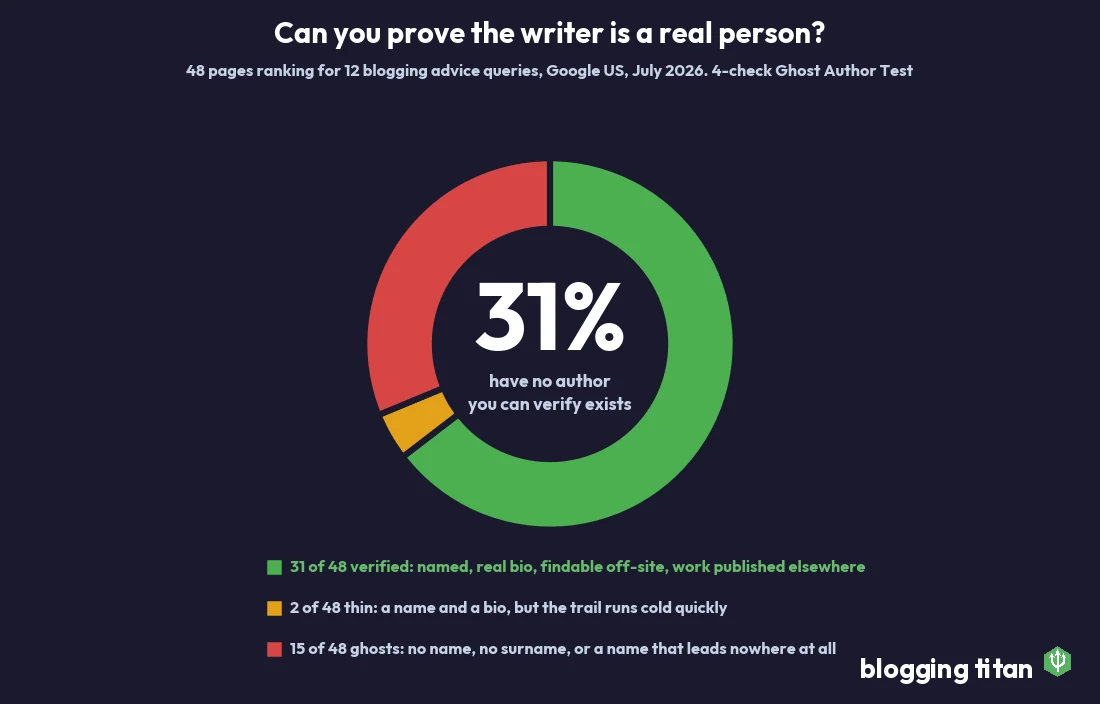
Fifteen pages out of 48 have no author with an independently verifiable identity. Seventeen (35%) never name a human being at all. Twenty-one (44%) have an author with no published work anywhere except the one site you are reading.
Those are the numbers. What makes them interesting is the shape underneath them.
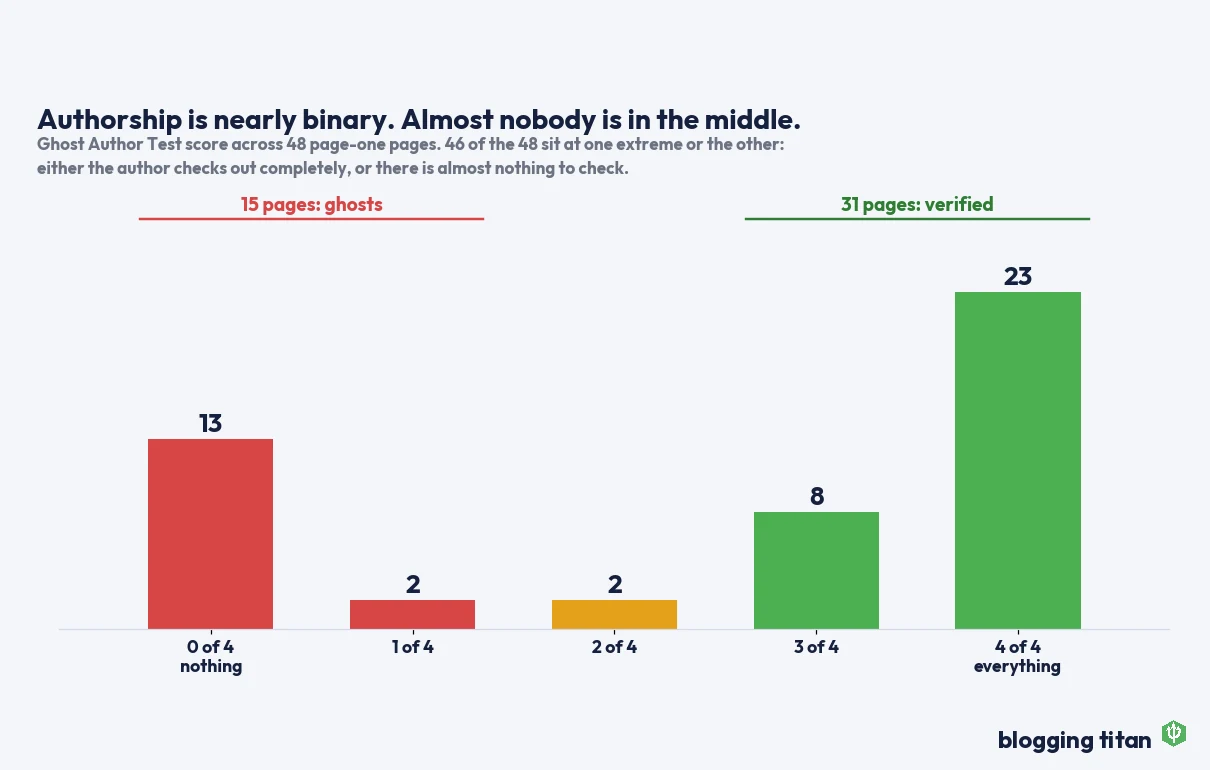
We expected a spread. What we got was a canyon. Twenty-three pages scored four out of four and thirteen scored zero. Group the near-misses with them and 46 of the 48 sit at one end or the other: 15 pages scored zero or one, 31 scored three or four. Exactly two pages in the whole corpus scored a middling two.
This is worth sitting with, because it says something about how the checks relate to each other. Four checks, but really one decision, made once and then expressed four ways. A site either treats authorship as real and does all of it, or treats it as decoration and does none of it. There is no such thing as a site that publishes a full name and a real bio but forgets to have the person exist.
Which means that in practice you rarely need all four checks. One of them does most of the work, and we come back to which one at the end.
The ghosts are not who you would guess
Before running this we assumed the failures would be content-farm personas: invented names, stock headshots, bios generated in bulk. That is the story everyone tells about low-quality SEO content.
It is not what we found. Here is what the 15 unverifiable pages actually are:
- Nine pages name nobody whatsoever. No byline, no author box, no meta author tag, nothing in the structured data. Twilio’s email list guide runs to nine chapters and a 19-minute read time with zero attribution. Mailchimp, Ghost, Lovable and the University of Wisconsin’s writing handbook are the same.
- Two credit a brand instead of a person. “By Shopify Staff.” “Adobe Express.”
- Three give a first name and stop. “Hi, I’m Carly.” “I’m Noel.” “Author: Sean H.”
- One is a full human name that leads nowhere. Exactly one, out of 48.
So the fabricated-persona theory is close to unsupported by this data. Only one page in the corpus presents a complete name that we could not connect to a real person. The overwhelming majority of ghost authorship comes down to omission: pages that give advice without anyone signing it.
That is a lower-grade failure than fraud, and in some ways a more revealing one. Nobody decided to deceive you. Somebody decided it did not matter who wrote it.
The one that leads nowhere
Since there is only one, it deserves its own section.
A page ranking on page one for “how to grow a blog fast” carries a full name, an author profile page, and a byline count in the hundreds on that domain. The bio describes a seasoned content writer with a passion for analytics and SEO.
Search that name and you get three kinds of result. The publisher’s own pages. An auto-generated press-database stub with no content in it. And a third site that has republished the bio and the articles verbatim, which turns out to be a scraper mirroring the publisher wholesale. No LinkedIn. No other byline. No talk, no interview, no quote, no trace.
We are not going to claim this person does not exist, because we cannot prove a negative and it would be unfair to try. Plenty of real writers keep no public profile. But that is the point of the exercise: from the reader’s side of the screen, an unverifiable real person and an invented one are the same object. You have no way to tell them apart, which means the byline is doing no work.
One detail did stand out. A colleague of theirs at the same publisher, writing on a neighbouring query, has a bio with near-identical structure and phrasing. Not copied, but clearly poured into the same mould. Whatever else those bios are, they are not individual people describing themselves.
Not every ghost is a fake, and this matters
Four pages in the corpus are written by people who are demonstrably, easily real, and whose own websites will not tell you their name.
One is a New York Times bestselling couple, twenty years into a well-documented career, whose article and About page both say “we’re John and Sherry” and never once print a surname. One is a History PhD candidate at a well-known university with a substantial following, who signs everything with a first name. One is a business owner profiled by an independent journalism outlet, whose own site says “Written By Tiffani” and leaves it there. One is a widely recognised blogger whose personal domain carries his name in the logo file and nowhere in the visible text of the article.
These are not deceptions. They are people who feel like they are on first-name terms with their readers, which is a lovely instinct and a real liability. A returning reader knows exactly who Sherry is. A first-time visitor arriving from a search result does not, and neither does a language model deciding whose advice to summarise.
Three of those four scored well anyway, because we could verify them off-site. But it took work that no reader will do. If you write under a first name, you are asking every stranger to take the same thing on faith that a content farm asks them to take on faith.
The amateurs are beating the software companies
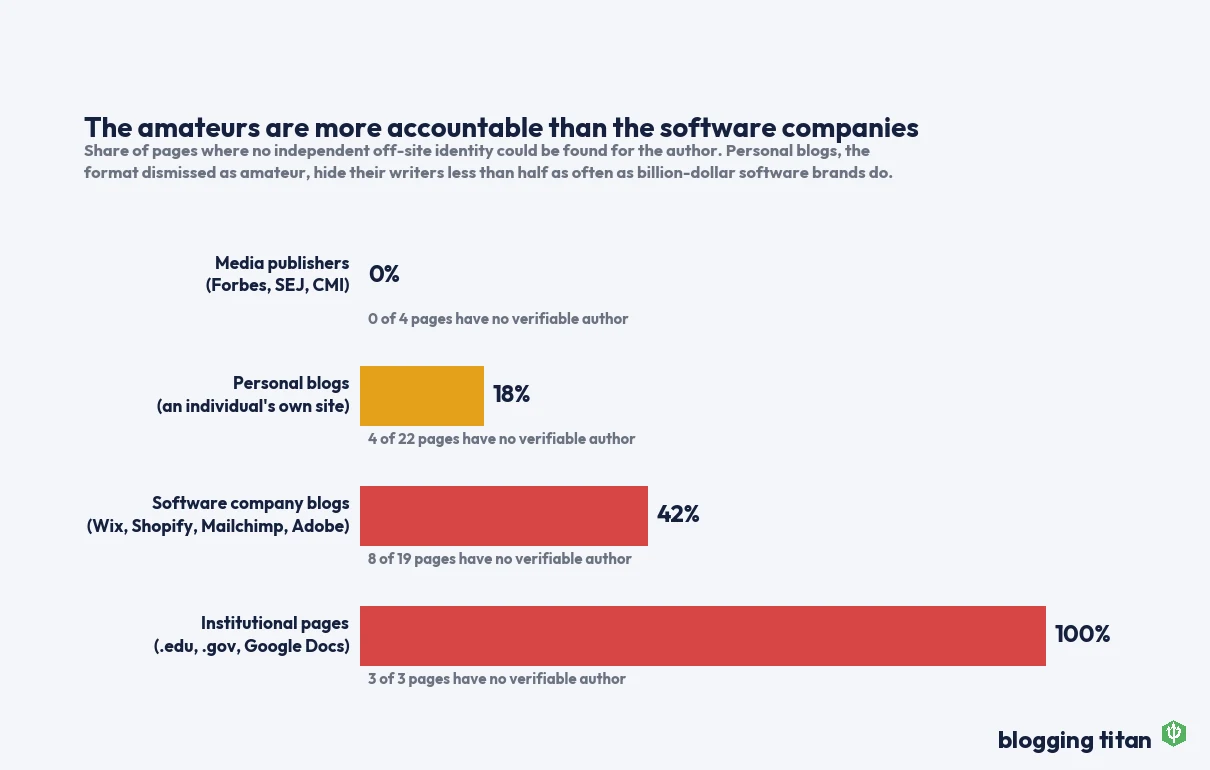
Split the corpus by who owns the site and the pattern is not subtle.
- Media publishers: 0 of 4. Every page from a real publication had a fully verifiable author. Small sample, but a perfect one.
- Personal blogs: 4 of 22 (18%). The format everyone dismisses as amateur.
- Software company blogs: 8 of 19 (42%). Wix, Shopify, Mailchimp, Adobe, Twilio, Ghost, Klaviyo and friends.
- Institutional pages: 3 of 3. Universities, city governments and Google’s own documentation, none of which byline anything.
A person writing about blogging on their own website is more than twice as likely to tell you who they are as a company with a marketing department and a content calendar. The companies are not cutting corners on quality. Several of those unattributed pages are perfectly good. They have simply concluded that the brand is the author, and that the writer is a cost line.
The institutional result deserves a caveat. A university writing centre handbook is authored by the institution on purpose, and that is a legitimate convention. Strip the three institutional pages out and the headline rate is 12 of 45, or 27%. Either way, roughly one in three or one in four.
Google’s own SEO guide has no byline
The top organic result for “blog seo tips”, ahead of every blog and every agency, is Google’s SEO Starter Guide, on Google’s own developer documentation. It is the most-cited SEO document on the internet. It names no author, has no bio, and offers no way to identify a single human being responsible for a word of it.
Calling that hypocrisy would be too strong. Google has never said that pages must carry bylines, and its own guidance explicitly allows that some content is properly attributed to an organisation. But it does clarify the shape of the thing. E-E-A-T was never a byline audit, and no author box bolted onto a template is going to satisfy it.
Which leaves a genuinely awkward question for everyone selling E-E-A-T services: if the single most authoritative SEO page on the web has no author, what exactly is the author box for?
Our answer, after reading 48 of these pages closely, is that the author box is not for Google. It is for the reader, and increasingly for the machines that summarise pages on the reader’s behalf. Google can afford institutional authority. You cannot. A named, traceable person is the cheapest authority signal available to a site that has no other kind.
Three things we did not expect
A page presenting original survey data credited no researcher. One of the corporate pages reports a survey of 433 business owners, complete with specific percentages that other sites will happily cite. No analyst, no methodology contact, no human name anywhere. The data may well be sound. There is simply nobody to ask.
One site’s hidden metadata credits a different person than its visible copy. The article carries an unattributed bio blurb. The About page, the Contact page and the owner’s LinkedIn all use one name. The page’s own author meta tag contains a different surname that appears nowhere else on the site. There are innocent explanations, including a name change. It is still a reminder that the machine-readable byline and the human-readable one are separate fields, and nobody is checking that they agree.
One first-name-only blog has a different name in its copyright notice. The bio says “I’m Noel.” The footer says a different name entirely. Almost certainly a theme that was never fully edited after a handover, which is its own small lesson about how much of the identity on a website is furniture nobody moved.
And one entirely gratuitous find: the writer whose independent byline we used to verify him has an article on another publication about hiring a ghostwriter.
What this means if you write a blog
The bar here is embarrassingly low, and a third of page one is under it.
- Print your surname. Not in the footer, not in the logo alt text, not on a page one click away. On the article, next to the words. This is the single highest-return change available to most personal blogs and it takes ten minutes.
- Put one checkable fact in your bio. Where you worked, what you built, how long you have done this, a number. Anything a stranger could verify. Nobody has ever been persuaded by “passionate about content”.
- Exist somewhere else. One profile, kept current, that a reader can land on and recognise as the same person. LinkedIn is the obvious choice but far from the only one. What matters is that it sits off your own domain, because your own website cannot be the evidence for your own website.
- Publish something under your name off your own domain. A guest post, a podcast, a talk, a comment thread you are proud of. Forty-four percent of the pages we audited had authors with no work anywhere but the site itself, and that is the check most people fail without realising it exists.
- If your author box is a brand, be honest about what it costs you. Corporate blogs can rank fine without human bylines. But they are borrowing the brand’s authority, which works if the brand has some and does nothing at all if it does not.
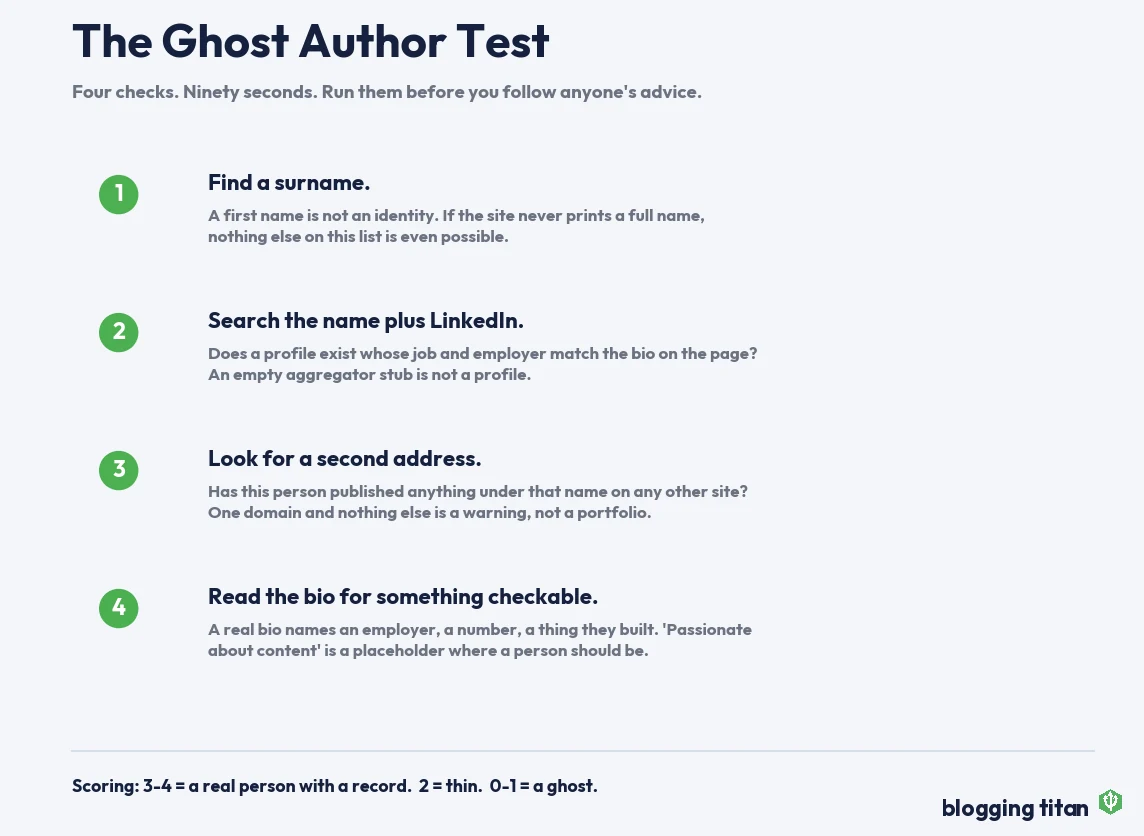
Next time a page tells you how to grow your blog, spend ninety seconds on this before you spend an afternoon on the advice.
- Find a surname. A first name is not an identity. If the site never prints a full name, nothing else on this list is even possible, and you have your answer already.
- Search the name plus LinkedIn. Does a profile exist whose job and employer match the bio on the page? An empty aggregator stub is not a profile.
- Look for a second address. Has this person published anything under that name anywhere else? One domain and nothing else is a warning, not a portfolio.
- Read the bio for something checkable. A real bio names an employer, a number, a thing they built. “Passionate about content” is a placeholder where a person should be.
Check one does most of the work. Fourteen of the 15 unverifiable pages in this corpus failed it, which means the surname alone catches almost every ghost. It is not a perfect proxy: four pages printed a full name and a real bio and still had an author with no work published anywhere else. But if you only have time for one check, make it the first.
A failed test does not mean the advice is wrong. Some of the unattributed corporate pages we read are more accurate than some of the bylined personal ones. It means you are taking the advice on the brand’s word rather than a person’s, and you should price it accordingly.
Limits of this study
Forty-eight pages is enough to describe page one and not enough to describe the web. The results are a snapshot of Google US on one day in July 2026 and rankings move.
Absence of evidence is not evidence of absence. When we say an author could not be verified, we mean exactly that and nothing more. Some of those writers are certainly real people with a healthy dislike of the public internet, and we have tried to say so wherever the evidence pointed that way.
We also dropped a photo-authenticity check partway through the analysis. It was in the original design, but our researchers applied it inconsistently, because confirming that a headshot is genuine rather than stock turns out to be much harder to do rigorously than the other four checks. Reporting it would have been worse than dropping it, so we dropped it. All four remaining checks were applied the same way by everyone.
Finally, this study measures whether an author can be identified, not whether they are any good. Those are different questions. This one is just the one you can answer in ninety seconds.
Cite this data
Key figures
| Pages audited | 48 across 42 domains, 12 queries |
| No verifiable author | 15 of 48 (31%) |
| No named human author at all | 17 of 48 (35%) |
| Author with no work on any other domain | 21 of 48 (44%) |
| Full name that could not be traced | 1 of 48 (2%) |
| Pages scoring 0 or 4 out of 4 | 36 of 48 (75%) |
| Software company blogs unverifiable | 8 of 19 (42%) |
| Personal blogs unverifiable | 4 of 22 (18%) |
Plain citation
Blogging Titan (2026). The Ghost Author Test: author identity verification in page-one blogging advice. Retrieved from https://bloggingtitan.com/blog-seo/ghost-author-test-blogging-advice/
BibTeX
@misc{bloggingtitan2026ghostauthor,
  title  = {The Ghost Author Test: author identity verification in page-one blogging advice},
  author = {{Blogging Titan}},
  year   = {2026},
  month  = {July},
  url    = {https://bloggingtitan.com/blog-seo/ghost-author-test-blogging-advice/},
  note   = {Dataset: 48 pages, Google US organic top 10, 12 queries, collected 20 July 2026}
}
Licensed CC BY 4.0. Please link back to this page when citing.
The mirror-image exercise, pointing the checklist at ourselves instead of the SERP, is the Signs of AI Writing self-audit, re-run in two waves so the before and after are on the record.

Written by
Blogging Titan Team
Blogging Titan is an independent team of bloggers documenting what actually grows a blog in the AI search era. We have been building, ranking, and monetizing WordPress sites since 2017, and every guide on this site is based on strategies and tools we have tested ourselves. Want a second pair of eyes on your blog? Request a free blog audit or start with the 2026 playbook.