
A UK small business trying to price its marketing runs into a simple problem: most of the prices are not published. In a July 2026 check of the top five marketing agencies in ten UK cities, 47 of 50 showed no price anywhere on their websites. Where prices do appear, they are usually an entry figure for a narrow scope. The terms that change the real cost, such as setup fees, minimum terms and notice periods, often sit somewhere else.
This article sets out what UK marketing buyers can see before they speak to anyone. It draws on a series of dated pricing studies from the UK business research publisher Whito and organises them into one framework for judging any price you are shown. It also explains why the same service can carry three or four different “costs” depending on who measured it, and how to compare two quotes on equal terms.
The short answer: for most marketing services, a buyer can see a published price for a minority of providers, and a complete price with its terms for very few. In Whito’s 29 September 2026 read of 39 UK agencies that do publish a monthly price, 5 stated their setup position on the pricing page and also passed Whito’s test for saying how a client leaves. Software is the exception, with vendors routinely printing a UK price. The practical fix is to stop comparing headline numbers and start comparing priced scopes.
Key findings
- 47 of 50 UK marketing agencies checked in July 2026 published no price anywhere, and several of them asked for the buyer’s budget on their enquiry form.
- 19 of 39 agency pricing pages did not state both the minimum term and how to leave, and only one of the 39 published a setup fee.
- 5 of 39 price-publishing agencies met the terms test at the top of our ladder, stating their setup position and passing the leave-date test on the pricing page. At two of those five, the agency’s own terms document gave a stricter answer.
- 17 of 35 UGC and creator platforms published no price, and 3 let a business work out the full cost of a first order from the page.
- A “small business website” has at least two honest published benchmarks that differ by a factor of about three to six, because they measure different things.
Four prices that get called “the cost”
Most arguments about whether marketing is expensive collapse because the people involved are quoting different kinds of number. Keep these four apart:
| Kind of price | What it is | Where you find it | What it misses |
|---|---|---|---|
| Advertised price | The figure a provider puts on its own website, often “from” or an entry tier | Pricing pages, rate cards | Scope, setup, term, VAT treatment, the tier most buyers end up on |
| Quoted price | The figure in a proposal for your brief | Proposals, emails, calls | Comparability, because each quote describes a different scope |
| Price paid | What actually leaves your account over the life of the contract | Invoices, bank statements | Rarely published by anyone |
| Typical market price | A planning range built from many sources | Cost guides, indexes, surveys | Your specific scope, and whoever chose the sources |
A published-price study measures the first kind. It cannot tell you the second or third, and it should not be read as the fourth without saying so.
The price-in-writing ladder
To compare markets with different habits, we placed four published samples onto one scale. We call it the price-in-writing ladder. Each rung adds something a buyer needs to compare like with like.
- Rung 0, no price. “Request a proposal”, “book a discovery call”, or a form asking for your budget.
- Rung 1, a statement that is not a price. “No call-out charge”, “a low monthly fee”, or a platform fee with the main cost left out.
- Rung 2, a starting point. A “from” figure, an average or a campaign minimum.
- Rung 3, a complete price for a defined scope. Priced tiers that say what each one includes.
- Rung 4, a complete price with the terms that change it. Rung 3, plus the setup position, the minimum term and how to leave, all on the page that sells the service.
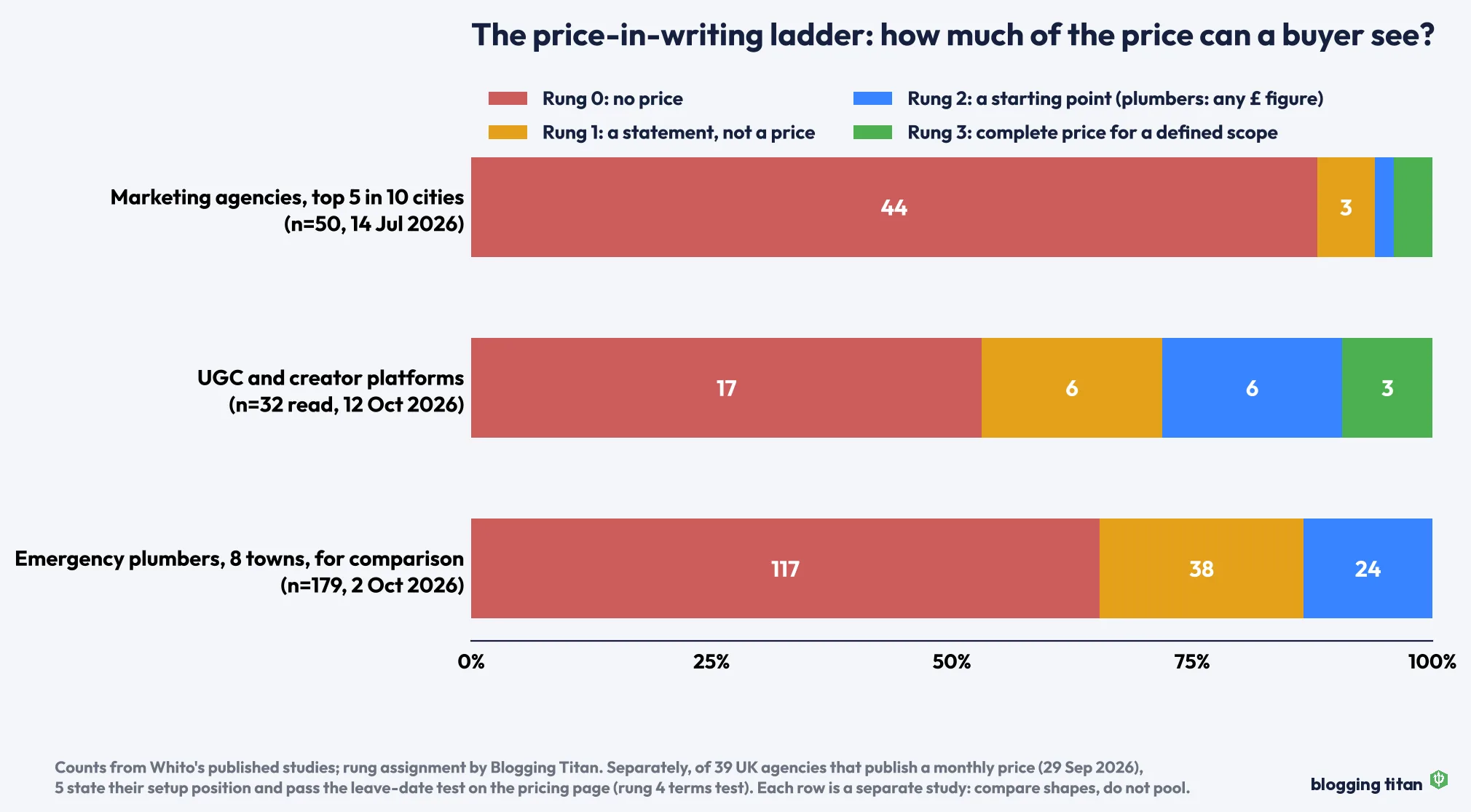
Here is where the published samples land. Each row is a separate study with its own date, method and sample, so read the rows side by side and resist adding them together.
| Sample (date read) | Providers | Rung 0 | Rung 1 | Rung 2 | Rung 3 or above |
|---|---|---|---|---|---|
| Top five marketing agencies in 10 UK cities (14 July 2026) | 50 | 44 | 3 | 1 | 2 |
| UGC and creator platforms sold to UK businesses (12 October 2026) | 35, of which 3 could not be read | 17 | 6 | 6 | 3 |
| UK agencies that publish a monthly price (29 September 2026) | 39 | 0 (chosen because they publish) | n/a | n/a | 5 meet the rung 4 terms test |
| Emergency plumbers in eight UK towns, for comparison (2 October 2026) | 179 | 117 | 38 | 24 across rungs 2 and 3 | counted with rung 2 |
Rung assignments for the agency and UGC rows follow the categories each study used. The 39-agency study did not grade rungs 1 to 3, because every agency in it was chosen for publishing a monthly figure. The plumbing row is outside marketing and is included because it shows the same habit in a trade that sells to the public. Its 24 figures are a mix of call-out fees and hourly rates, so we have not split them between rungs 2 and 3. The rung 4 count of 5 is our reading of the 39-agency register: the agencies that state a setup position and also pass Whito’s “leave-date test” on the pricing page. That study recorded entry prices only, so whether each of the five prices a complete scope was not assessed.
Software sits at the other end. In Whito’s October 2026 test of AI price answers, every one of the 23 software plans asked about had a UK price on the vendor’s own pricing page. Whito chose those plans, so they are not a random sample. Software is sold from the published page. Agency work is mostly priced in the sales conversation.
What the agencies that publish actually show
The three agencies in the 50-firm sample that published figures gave a buyer something to anchor on. Republic Marketing in Birmingham listed three tiers starting at £999 a month plus VAT. Pxa Marketing in Cardiff itemised two example retainers at £1,500 and £2,500 a month. Our Agency in Leeds and Wakefield gave “from” figures in an FAQ, including SEO from around £1,200 a month. Whito notes that even Pxa’s itemised £2,500 package added up to £1,600 as published.
The agencies that published nothing still communicated something. Several asked the buyer to choose a monthly budget band on the enquiry form, one with options from “under £750” to “over £100,000”. Whito’s study of agency price transparency puts the consequence plainly: a buyer who discloses a budget first receives a proposal shaped to that budget.
Hours were also scarce. Among 13 UK agencies Whito found publishing monthly figures in August 2026, 2 said how many hours the money bought.
The terms that sit away from the price
A monthly figure is the number agencies compete on, so it is the number they publish. In Whito’s reading of 39 agency pricing pages against their own terms, 12 of the 39 held a minimum term somewhere. Five of those 12 kept it off the pricing page, and at two of them the pricing page said the opposite, such as “Contract length: None”. The longest was 12 months with automatic 12-month renewal unless 60 days’ notice was given, found only in one agency’s terms and conditions.
Twenty-two of the 39 had no usable service terms readable on the public site on the day. Exactly one published a setup fee (£125 plus VAT), six stated there was none, and 32 said nothing either way. Whito is careful on the point: “not stated” means the terms were not on the public pages, not that a hidden charge exists.
Why one website can cost £520 or £3,000
Ask what a small business website costs and you can get two honest answers from the same publisher.
| Benchmark | Figure | What it measures | Collected |
|---|---|---|---|
| Published package prices | Median £520; middle half of 28 packages £399 to £898 | Prices UK web designers print on their own sites | Whito price file, June 2026 |
| Freelancer brochure site, 5 to 10 pages | £1,500 to £3,000 | A planning range from rate cards, surveys, marketplaces and quotes | Whito UK Marketing Cost Index, data last verified 5 October 2026 |
| Agency brochure site, 5 to 10 pages | £3,000 to £6,000 | The same planning method, agency providers | Whito UK Marketing Cost Index |
Neither figure is wrong. The first describes what sellers who publish a package advertise. The second describes a blended planning range, and Whito’s own reading is that the sellers who publish are cheaper than the agency market, which mostly does not. A buyer holding a £599 quote can read it as suspiciously cheap against one benchmark and typical against the other. The question that resolves it is about scope: how many pages, whose copy, whose photos, how much custom design, and who owns the site afterwards.
Planning ranges also hide add-ons. The cost index notes that copywriting is almost never included in web design quotes, and budgets £50 to £150 a page for it separately. It also notes that PPC management fees are separate from the ad spend they manage.
Why the cheaper quote may cost more
Three adjustments change the order of two quotes more often than the headline figure does.
VAT. UK business-to-business prices are often shown before VAT. The ASA’s guidance on the CAP Code says VAT-exclusive prices are likely to be acceptable when an ad’s audience consists entirely of businesses, provided it is clear the price excludes VAT. A freelancer below the £90,000 VAT registration threshold need not register for VAT, and many do not charge it. So £1,000 from an unregistered freelancer and £1,000 plus VAT from an agency are £200 apart for a buyer who cannot reclaim VAT, and level for a VAT-registered buyer who can.
Time bought. Whito’s comparison of 17 marketing purchases found the rare UK agencies that publish a day rate charging £895 to £1,125 a day, against an average freelance marketer day rate of £418. At those rates, £1,000 a month buys roughly one agency day or about two and a half freelance days. The cheaper retainer may buy fewer hours, or more.
Exit cost. A £600 monthly retainer with a 12-month minimum commits £7,200 before VAT. A £900 rolling monthly retainer with 30 days’ notice commits £1,800 if you give notice at the end of the first month. The second is dearer per month and cheaper to get wrong.
A buyer’s checklist for comparing two quotes
- Write your scope before asking for prices. List deliverables in countable units: pages, posts, hours, campaigns, reports.
- Leave the budget field blank. Ask for standard rates for the written scope.
- Ask every supplier to fill in the same table. Monthly fee before VAT, VAT treatment, setup fee, minimum term, notice period, hours included, and what happens to accounts and files when you leave.
- Run the leave-date test on each one. From the pricing page or proposal, write down the earliest date you could stop paying. If you cannot, ask by email.
- Read the terms document, then compare it to the proposal. At 3 of the 20 agencies that passed the leave-date test on their pricing page, the terms document said something different, and at 2 it was stricter.
- Separate fees from spend. For paid ads, confirm which part of a figure goes to the platform and which to the manager, and that the ad account is in your name.
- Price the whole contract. Multiply the monthly fee by the minimum term, add setup and VAT if you cannot reclaim it, and compare those totals.
- Check against two benchmarks. Compare a quote with published prices and with a planning range, and ask which one your scope resembles.
What published-price research cannot tell you
- Who publishes is not random. Providers that print a price may be cheaper, more standardised or newer than those that do not. Every published-price sample leans towards them.
- It records the page, not the contract. A term missing from a website may be in the signed agreement, and a published price may be negotiated.
- Each study is one day’s read. Prices and pages change. The dates in the ladder table are the dates that matter.
- The samples are not representative of every UK provider. The 50 agencies came from one search in ten cities. The 39 were selected because they publish a price.
- The ladder table mixes studies. Each row has its own method and sample, so the rows can be compared in shape but not pooled.
- Consumer price rules mostly do not apply here. The CMA’s unfair commercial practices guidance, including its section on price transparency, covers business-to-consumer dealings. The Digital Markets, Competition and Consumers Act 2024 defines a consumer as an individual acting for purposes wholly or mainly outside their business, so a firm buying marketing for its business is generally outside that protection, and the written contract is what a buyer can rely on.
How we built the ladder
We read each Whito study on 23 October 2026 and placed its published categories onto the five rungs without changing any study’s totals. For the 50 agencies: “None” became rung 0, except the three agencies Whito quotes making value claims with no figure (“for a low monthly fee”, “a set monthly fee”, “delivering more, for less”), which we placed on rung 1. “Partial” became rung 2 and “Full” rung 3. For the 35 UGC platforms: “No price published” became rung 0, “platform fee only” rung 1, “starting price, average or campaign minimum” rung 2, and “full cost of a first order on the page” rung 3. For the 39 agencies, we counted the rows in Whito’s published register whose setup column was stated (a fee, “none”, “free” or “included”) and whose leave-date test result was “Pass”. For plumbers we used the study’s own split: no price, “no call-out charge” with no figure, and a figure in pounds. The UK Marketing Cost Index, the website benchmarks and the day rates were copied from the pages listed below.
For the cost planning ranges behind the benchmarks above, see the published UK marketing cost data, which states its own method and update date.
Sources
- UK Marketing Cost Index 2026, Whito, data last verified 5 October 2026
- How much does a UK marketing agency cost? We checked 50 agency websites, Whito, data collected 14 July 2026
- The fees UK agencies don’t quote: 39 pricing pages read against their own terms, Whito, read 29 September 2026
- What UGC platforms charge: 35 pricing pages read, Whito, read 12 October 2026
- Emergency plumber call-out prices: what 179 UK firms actually publish, Whito, read 2 October 2026
- Which AI gets UK marketing prices right? October 2026 accuracy league table, Whito, collected 6 October 2026 (website package median and software price pages)
- UK marketing prices compared 2026: 17 purchases side by side, Whito, re-read 9 September 2026
- Compulsory costs and charges: VAT, Advertising Standards Authority, CAP Code rule 3.18
- When to register for VAT, GOV.UK
- Digital Markets, Competition and Consumers Act 2024, section 225 (definition of consumer), legislation.gov.uk
- Unfair commercial practices (CMA207), Competition and Markets Authority, updated 18 November 2025

Written by
Blogging Titan Team
Blogging Titan is an independent team of bloggers documenting what actually grows a blog in the AI search era. We have been building, ranking, and monetizing WordPress sites since 2017, and every guide on this site is based on strategies and tools we have tested ourselves. Want a second pair of eyes on your blog? Request a free blog audit or start with the 2026 playbook.