

How Buffer’s Transparent Blog Built a $22 Million Business
What happens when a startup decides to publish its salaries, revenue figures, and equity formula for the entire world to see? For most companies, that sounds like a terrible idea. For Buffer, it became the single most effective growth strategy they ever deployed.
Buffer, the social media scheduling tool, grew from a dorm room side project to over $21 million in annual recurring revenue, and their blog was the engine that made it happen. Their engine was something far more counterintuitive: radical, almost uncomfortable transparency.
Company Snapshot
- Company: Buffer
- Founded: 2010 by Joel Gascoigne and Leo Widrich
- Industry: Social Media Management (SaaS)
- Blog Launched: 2011 (Open Blog launched 2013)
- Peak Users: 4+ million
- Revenue: $21.9 million ARR (bootstrapped)
- Paying Customers: about 77,000
- Key Result: Blog was the primary customer acquisition channel for the first 4 years of the business
The Challenge: Zero Budget, Zero Connections, Zero Brand
When Joel Gascoigne built the first version of Buffer in his UK college dorm room in 2010, he had nothing that typically drives a startup’s early growth. No venture capital. No industry connections. No existing audience. No press coverage. And certainly no budget for advertising.
The product itself, a tool to schedule social media posts, was simple and useful, but it existed in a market that was already getting crowded. Hootsuite had a head start. Sprout Social was well-funded. Dozens of smaller competitors were launching every month.
Gascoigne and co-founder Leo Widrich needed a way to stand out that didn’t require money. They needed something that would compound over time, building a lasting advantage rather than producing a temporary spike of attention.
Their answer was content. But not just any content, content so different in approach that it would become inseparable from the Buffer brand itself.
The Strategy: Guest Blogging, Then Radical Transparency
Phase 1: The Guest Posting Blitz (2010-2012)
Before Buffer had its own significant blog audience, Widrich went on what can only be described as a guest blogging blitz. In less than a year, he wrote approximately 150 articles for other established blogs in the tech and marketing space.
This wasn’t random content scattered across the internet. Each guest post was carefully targeted at publications whose readers matched Buffer’s ideal customer, social media managers, digital marketers, and small business owners. Each post included a byline that linked back to Buffer.
The results were remarkable. That guest blogging campaign alone helped Buffer acquire around 100,000 users. It also built the SEO foundation, hundreds of backlinks from authoritative sites, that would later help Buffer’s own blog rank well in search results.
Phase 2: The Buffer Blog (2011-2013)
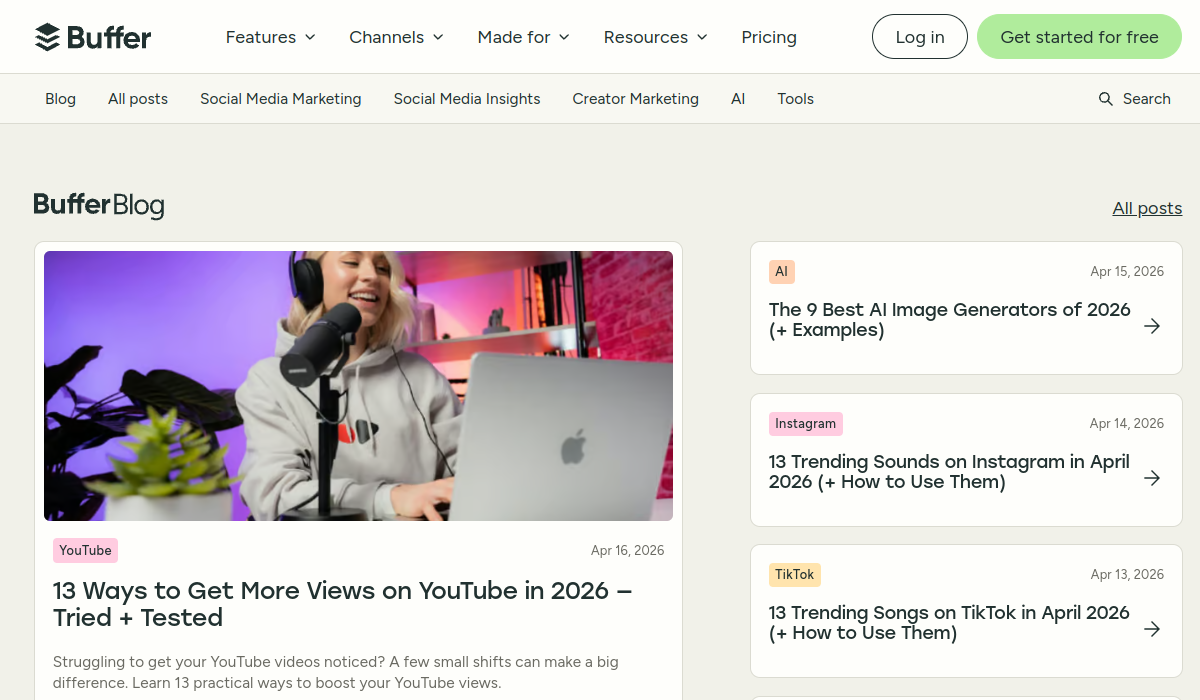
With an initial audience established through guest posting, Buffer launched their own blog focused on social media tips, productivity hacks, and marketing strategies. The content was high-quality, research-driven, and intensely practical.
They developed a content formula that consistently performed well. Posts like “The Ideal Length of Everything Online” became widely shared references, the kind of articles that people bookmarked and returned to repeatedly. Buffer’s blog posts quickly quadrupled their social reach, going from an average of 250 shares per post to more than 1,000 shares per post.
But the real breakthrough came when Buffer decided to do something nobody else in the SaaS industry was willing to do.
Phase 3: The Open Blog, Radical Transparency (2013-Present)
In 2013, Buffer launched their “Open” blog with a post that sent shockwaves through the startup world: they published every employee’s salary, from the CEO to the most junior team member, along with the exact formula used to calculate each salary.
The reaction was explosive. The salary transparency post was shared hundreds of thousands of times. Major publications covered it. And suddenly, Buffer went from a scheduling tool to one of the most talked-about companies in tech.
But Buffer didn’t stop at salaries. Over the following years, they published:
- Their complete revenue dashboard, updated in real-time for anyone to view
- Their equity formula and cap table details
- Diversity and inclusion statistics
- The details of their decision to return VC funding and go bootstrapped
- Their remote work policies and vacation tracking
- Internal decision-making processes and even failures
This wasn’t transparency as a PR stunt. Buffer built transparency into the company’s operating system and used their blog as the primary channel to share it all.
The Results: Content-Driven Growth to $21.9M ARR
User Growth
Buffer grew from zero to over 1 million users by 2014, just four years after launch. The blog was the primary acquisition channel throughout this period. By the time Buffer crossed 4 million total users, the content flywheel was well-established, organic search, social sharing, and word-of-mouth driven by their transparent blog posts were generating a steady stream of new signups.
Revenue Without Traditional Sales
What makes Buffer’s story particularly remarkable is what they did without: traditional enterprise sales. Buffer reached $21.9 million in ARR (and later $20M+ in ARR with about 77,000 paying customers) largely through self-serve conversions, users who discovered Buffer through content, signed up for a free plan, and eventually upgraded to paid.
There were no cold calls. No trade show booths. No expensive advertising campaigns. The blog attracted the right people, the product converted them, and the transparent brand built the trust that retained them.
The Compounding Effect of Trust
Buffer’s transparency strategy produced a benefit that’s difficult to quantify but impossible to ignore: trust. In a SaaS market where customers are increasingly wary of hidden pricing, questionable data practices, and corporate doublespeak, Buffer’s radical openness became a genuine competitive moat.
Customers who felt they could trust Buffer with their social media presence, because they could see exactly how the company operated, became vocal advocates. They recommended Buffer in blog posts, social media discussions, and industry forums, creating an organic referral engine that no amount of advertising could replicate.
The Unexpected Turn: Returning VC Money
One of the most remarkable chapters in Buffer’s story is their decision around 2018 to buy back shares from investors and return to a bootstrapped model. They documented this entire process on their blog, including the financial details and the reasoning behind it.
This move was risky, and blogging about it was even riskier. But it reinforced everything Buffer’s brand stood for. The transparency wasn’t performative; it extended to the company’s most significant strategic decisions. The blog post about returning VC money became one of their most-read articles and cemented Buffer’s reputation as a company that practices what it preaches.
Lessons for Your Business
1. You don’t need your own audience to start. Buffer’s guest posting strategy proves that you can build significant traction by creating content for other people’s audiences. Write for publications your customers already read, provide genuine value, and direct interested readers back to your product.
2. Transparency is a competitive advantage most companies won’t use. Buffer’s willingness to share uncomfortable information, salaries, revenue, failures, created a level of trust that no marketing campaign could achieve. You don’t need to publish your salary spreadsheet, but find areas where you can be more open than your competitors.
3. Consistency compounds. Buffer published over 2,500 blog posts over their journey. There was no single viral moment that made the company, it was the cumulative effect of showing up with valuable content week after week, year after year.
4. Content should serve the reader, not the algorithm. Buffer’s most successful content was genuinely useful, surprisingly honest, and deeply human. The traffic followed because readers shared it, bookmarked it, and came back for more.
5. Use your blog to differentiate, not just to market. Buffer’s blog defined what the company stood for, going well beyond a traffic driver. The transparency grew beyond a marketing tactic and became the brand itself. When your content reflects your values, it attracts customers who share those values.
80+ AI Blogging Statistics for 2026
See how AI is changing blogging with the latest data and trends.

Written by
Blogging Titan Team
Blogging Titan is an independent team of bloggers documenting what actually grows a blog in the AI search era. We have been building, ranking, and monetizing WordPress sites since 2017, and every guide on this site is based on strategies and tools we have tested ourselves. Want a second pair of eyes on your blog? Request a free blog audit or start with the 2026 playbook.