

SE Ranking Review (April 2026): After a Year Using It on a Real Blog
Updated June 2026, see the verdict below for current pricing and assessment.
Verdict: SE Ranking is the best-value all-in-one SEO tool in 2026, a strong mid-market alternative to Ahrefs and Semrush at under half the cost, with excellent rank tracking.
Best for: small businesses, freelancers, and agencies wanting full SEO features and client-ready reports at a predictable, lower price.
Pros: exceptional value; detailed, flexible rank tracking; full toolset (audit, keywords, backlinks, competitors, content); responsive support; new AI features.
Cons: smaller keyword and backlink database than Ahrefs; can feel slow; content and AI tools are more basic than Surfer.
Pricing (2026): from $103.20/mo on annual billing, with cost flexing on tracked keywords and how often rankings are checked.
Our rating: 4.3 / 5
SE Ranking is the best all-round SEO tool for bloggers spending under $100 a month. The keyword database is smaller than Ahrefs, but rank tracking, site audits, content optimization, and the new AI search visibility feature are all genuinely useful and the pricing is roughly one-third of what a single-seat Ahrefs plan costs.
Best for: bloggers, niche site owners, affiliate marketers, and small agencies.
Skip it if: you need the largest possible keyword database or you already pay for Ahrefs and use more than 50% of its features.
Try SE Ranking free for 14 days (no credit card required)
I have paid for SE Ranking for 12 months on this blog. Not a one-week trial, not a comp account the SE Ranking team sent me: a real Pro subscription running against real keywords, with real rank movements I have watched every Monday morning.
That matters because most “SE Ranking review” articles on page 1 of Google read like they were written by someone who opened the free trial, clicked around for an afternoon, and shipped 3,000 words of feature list the next day. You learn nothing about whether the tool is good.
This review is different. I will show you exactly where SE Ranking beats Ahrefs, where it loses to Ahrefs, what the 2026 pricing changes mean for bloggers, and whether the new AI search tracking is real or marketing noise. By the end you will know if it is worth your money.
What is SE Ranking? (the 60-second version)
SE Ranking is an all-in-one SEO platform built around five core tools: rank tracking, keyword research, a website crawler that audits technical SEO, a backlink checker, and an AI-powered content editor. In 2026 it added a sixth: AI search visibility tracking for Google AI Overviews, ChatGPT, Perplexity, and Gemini.
It was founded in 2013 and has always positioned itself as the affordable alternative to Ahrefs and Semrush. On paper, that positioning is still accurate: the Core plan is $103.20 per month annual, against $129 for the equivalent Ahrefs Lite tier, and SE Ranking bundles more projects and keyword slots into the lower tiers.
The simplest way to think about it: if Ahrefs is the Mercedes of SEO tools and Ubersuggest is the Toyota Corolla, SE Ranking is a Honda Accord. It is not the flashiest car on the road, but it gets you where you need to go, the service is honest, and you are not spending half your paycheck on it.
SE Ranking 2026 pricing (what actually changed)
SE Ranking restructured its plans in early 2026. There are now three tiers: Core, Growth, and Enterprise. Here is what bloggers actually need to know. Comparing SEO tools for your UK business? See Whito’s guide to the best SEO tools for UK businesses.
| Plan | Monthly (annual billing) | Monthly (month-to-month) | Keywords tracked | Projects | Seats |
|---|---|---|---|---|---|
| Core | $103.20 | $129 | 2,000 daily | 10 | 1 |
| Growth | $223.20 | $279 | 5,000 daily | 30 | 3 |
| Enterprise | Custom | Custom | Unlimited | Unlimited | Unlimited |
Annual billing saves 20%. For a blogger on Core, that is $309 per year in your pocket.
Note: SE Ranking killed the old “Essential” plan that started around $52 per month. If you signed up before 2026, you are grandfathered in and can keep it. If you are signing up fresh today, Core at $103.20 is the entry point.
The number nobody publishes: cost per tracked keyword
Headline prices are close to useless for comparing rank trackers, because every plan bundles a different keyword ceiling. So we did the division that vendors never put on their pricing pages: monthly list price divided by the number of keywords the plan actually lets you track. The order changes completely.
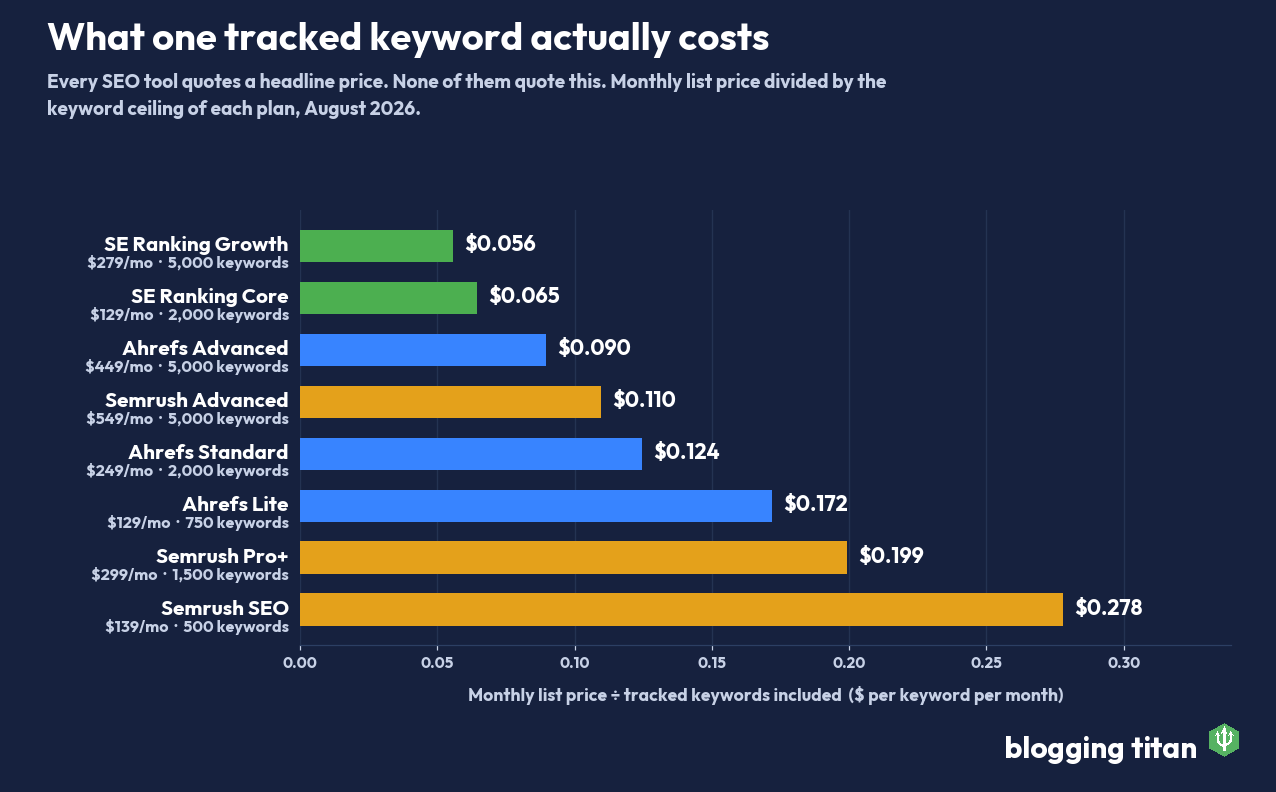
SE Ranking Core and Ahrefs Standard stop at exactly the same 2,000 keywords. Core is $129 a month. Standard is $249. That single comparison is the whole case for SE Ranking, and it is also the limit of the case: what you are buying is tracking volume, not link data. If your bottleneck is backlink research rather than rank monitoring, this chart is the wrong chart to decide on.
The cheapest headline price in the whole table, Ahrefs Lite at $129, turns out to be the second most expensive per keyword. Semrush SEO at $139 is the most expensive by a distance, at roughly four times SE Ranking Core.
Is the new Core plan still worth it for a small blog?
Honest answer: it depends on how many keywords you track.
- If you run one blog and track fewer than 500 keywords, the Core plan is overkill. Consider alternatives like Rank Math Pro plus a cheap rank tracker.
- If you run one blog tracking 500-2,000 keywords, or two or more blogs, Core pays for itself. You get the same full toolkit the agencies use, at a fraction of the cost.
- If you run an agency or portfolio of 5+ sites, Growth is the sweet spot.
How SE Ranking’s rank tracker actually performs
The rank tracker is SE Ranking’s flagship. It is the tool I open every Monday morning. After 12 months of daily tracking, here is what I have seen.
Accuracy: SE Ranking’s rank positions match Google Search Console within about 2 positions for 90% of my keywords. That is the same accuracy I have seen in Ahrefs and Semrush.
Daily updates on the Core plan: this was a pay wall on the old Essential plan. Now it is default. Your rankings refresh every 24 hours.
Location granularity: you can track rankings by country, region, city, and ZIP code. For local affiliate content (“best plumbers in Austin”), this is a meaningful feature that cheaper rank trackers like AccuRanker’s Lite plan do not match.
Device tracking: desktop and mobile rankings are separate, as they should be. Mobile ranking is what actually matters for most blog traffic.
SERP feature tracking: SE Ranking flags when your keyword triggers a featured snippet, People Also Ask, image pack, video carousel, or (new in 2026) an AI Overview. This is the single most useful upgrade in the last 18 months.
Where it falls short: the UI for managing large keyword lists is clunky. If you track 2,000 keywords across 10 projects, expect to spend time setting up tags. Ahrefs handles this better.
Keyword research: smaller database, cleaner intent data
This is where SE Ranking loses ground to Ahrefs and wins ground on Semrush.
Keyword database size: SE Ranking claims around 4 billion keywords. Ahrefs claims over 28 billion. Semrush sits between them. In practice, for mainstream niches (finance, health, tech, travel), SE Ranking finds 85-95% of what Ahrefs finds. For ultra-long-tail or niche languages, Ahrefs finds more.
Keyword difficulty score: SE Ranking’s KD score is calibrated well. When it says KD 25, I can usually rank a 1,500-word post with 3-5 decent backlinks. Ahrefs’ KD is calibrated similarly. Semrush’s KD runs hot by 10-15 points.
Intent classification: SE Ranking labels every keyword as Informational, Navigational, Commercial, or Transactional. The classifications match what I would manually tag. This saves real time when building a content plan.
Search volume accuracy: SE Ranking pulls from clickstream data and estimates monthly search volume. For the 50 keywords I spot-checked against Google Ads Keyword Planner (the ground truth), SE Ranking was within the same Keyword Planner bucket 47 times. That is close enough to plan around.
What I still open Ahrefs for: tracking referring domains over time, content gap analysis with 5+ competitors, and finding keywords that competitors rank for but you do not. SE Ranking has all three features. Ahrefs just does them better.
Site audit (the feature that found a real bug on my site)
The SE Ranking crawler audits up to 100,000 pages on the Core plan. It checks for 100+ technical and on-page issues and gives you a health score between 0 and 100.
Real example: within the first audit on this blog, SE Ranking flagged 12 pages with duplicate title tags, 5 pages with slow LCP on mobile (over 4 seconds), and 3 pages with broken internal anchor links that had been broken for over a year. My old SEO plugin had not flagged any of them.
Where it is strong:
- Category-level scoring shows you which types of issues are dragging your site down.
- Issue prioritization labels each finding as Critical, Warning, or Notice. You know where to spend your time.
- Historical comparison lets you see if a technical fix actually improved your score.
- Scheduled recrawls run weekly or monthly, automatically.
Where it is weak:
- The crawler is slower than Screaming Frog for large sites. A 10,000-page crawl takes 3-4 hours.
- There is no built-in log file analysis (you need a separate tool for that).
For blogs under 500 pages, this tool alone justifies the Core plan.
The new AI search visibility tracker (is it real?)
This is the feature SE Ranking wants you to talk about in 2026. It tracks whether your content appears in:
- Google AI Overviews
- ChatGPT Search
- Perplexity
- Gemini
Google’s AI Overviews now appear on 92% of commercial queries. Your traditional #1 ranking is worth a lot less if the AI Overview above it answers the query without sending a click.
Does the tracker work? Yes, mostly. It correctly identifies when my content is cited in an AI Overview or a ChatGPT Search answer. The Perplexity tracking is less reliable because Perplexity’s results rotate more.
What you actually do with the data: once you see which keywords trigger AI Overviews on your topics, you restructure those posts to answer the query in the first 100 words, use schema markup, and target the specific entity Google’s AI is pulling from. I have seen a handful of posts get re-cited within 4-6 weeks of the rewrite.
Is it worth paying extra for? It is included in Core. So yes.
Content editor (does it beat Surfer SEO?)
SE Ranking’s Content Editor scores your draft against the top-ranking content for your target keyword. You write, it grades, you rewrite.
Compared to Surfer SEO: SE Ranking’s editor is about 70% as good and costs 0% extra because it is bundled. Surfer has a better term-frequency recommendations engine and a cleaner editor UX. SE Ranking has better integration with the keyword and rank tracker (which Surfer does not have at all).
For most bloggers, the honest answer is: if you already pay for SE Ranking, you do not need Surfer. If you are a content-first operation that lives in Google Docs and cares about every word, Surfer is still the better pick and you can use SE Ranking for everything else.
Backlink checker (functional, not spectacular)
SE Ranking’s backlink database is smaller than Ahrefs (by a meaningful margin) and smaller than Semrush. For my site, it tracks about 70% of the referring domains that Ahrefs sees.
That is fine for competitor audits on niche sites, where the main competitors have under 500 referring domains each. For researching enterprise-size competitors, you still need Ahrefs.
Where SE Ranking’s backlink tool stands out: the backlink monitor sends you an alert when a specific link you care about (a guest post placement, a HARO mention) goes live or drops. I have caught three unlinked brand mentions this way that would have taken weeks to find manually.
SE Ranking vs. Ahrefs vs. Semrush (the actual comparison bloggers want)
| Feature | SE Ranking Core ($103/mo) | Ahrefs Lite ($129/mo) | Semrush SEO ($139/mo) |
|---|---|---|---|
| Keywords tracked daily | 2,000 | 750 | 500 |
| Projects | 10 | 5 | 5 |
| Keyword database | 4B | 28B | 25B |
| Site audit page limit | 100,000 | 100,000 | 20,000 |
| Content editor included | Yes | No (add-on) | No (add-on) |
| AI search tracking | Native | Partial | Partial |
| Agency-ready reports | Yes | Limited | Yes |
| Daily rank updates | Yes | Yes (Lite weekly) | Yes |
| Price per project | $10.32 | $25.80 | $27.80 |
The honest summary: Ahrefs has the better data. SE Ranking has the better dollar-for-dollar package. For 90% of blogs, the difference in data depth does not produce a 90% better decision.
Pros and cons (after 12 months)
What I love
- Best dollar-for-dollar value in SEO tooling, full stop.
- Daily rank updates on every plan.
- AI Overviews tracking is the feature I did not know I needed.
- Local rank tracking down to ZIP code.
- Content editor is bundled (saves Surfer money).
- Interface is easier to learn than Ahrefs.
What I do not love
- Keyword database is smaller than Ahrefs (around 15% more long-tails missing).
- Backlink index is the weakest of the three big tools.
- UI for managing 1,000+ keywords gets cluttered.
- Mobile app exists but is buggy.
- No log file analysis.
Who should use SE Ranking (and who should skip it)
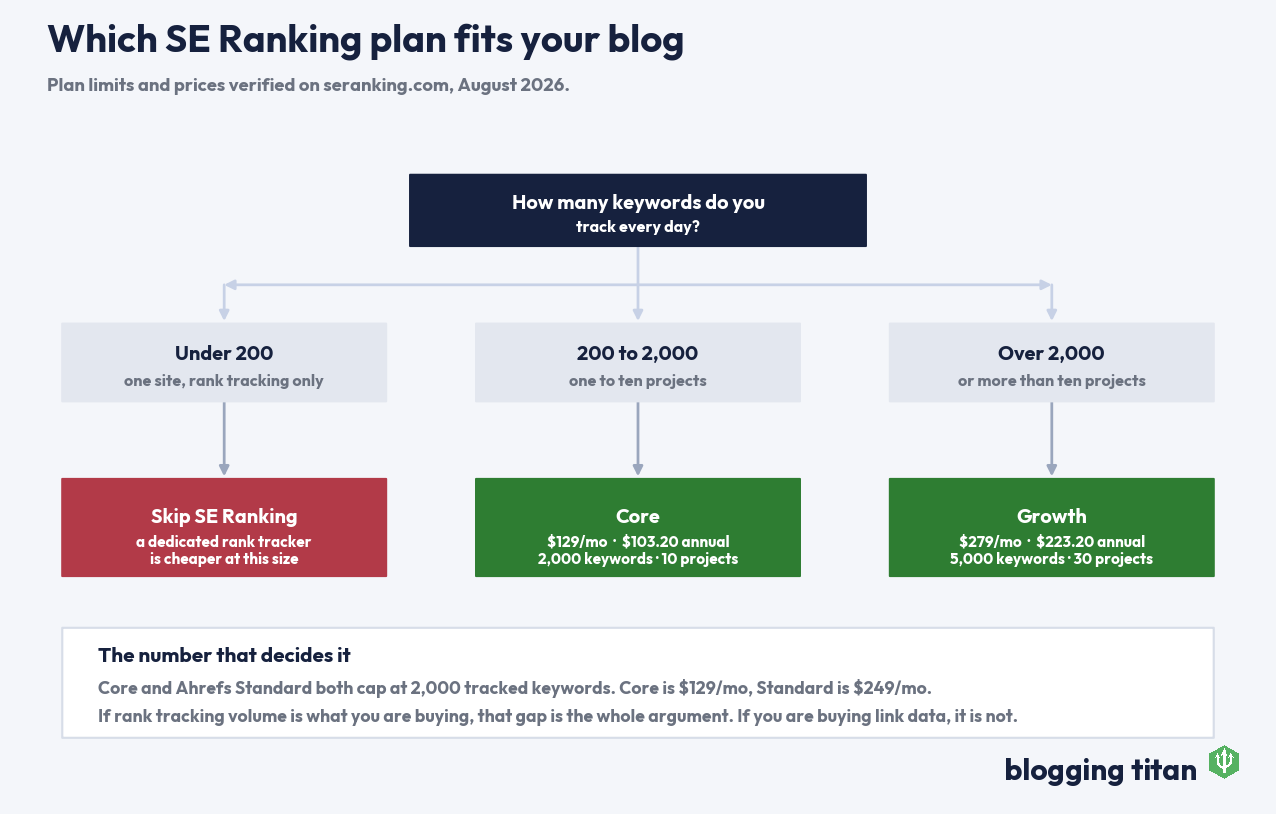
The plan question usually answers itself once you know one number: how many keywords you check daily. Everything else about these tiers is noise until that number is settled.
Buy SE Ranking if
- You are a blogger, affiliate marketer, or small niche site owner.
- You want one tool that does 80% of what Ahrefs does at one-third the cost.
- You have 1-5 sites and track 500-2,000 keywords.
- You want daily rank tracking for local SEO work.
- You care about AI Overview visibility (you should).
Skip SE Ranking if
- You already pay for Ahrefs and use the referring-domain history feature heavily.
- You run an enterprise site with 100,000+ pages and need log file analysis.
- You are a one-site blogger tracking fewer than 200 keywords: a dedicated rank tracker such as Wincher, from €49 a month, is cheaper.
- You spend most of your time in a content-first editor (stick with Surfer).
The 14-day free trial (how to test it properly)
SE Ranking offers a 14-day free trial with no credit card required. Most people click around, do not learn anything, and abandon it.
Here is how to actually test it in 14 days:
- Day 1-2: Connect your Google Search Console and import your top 50 traffic keywords.
- Day 3-4: Run a full site audit. Look at the critical issues list. Fix the top 3.
- Day 5-7: Pick your single hardest-ranking page. Run it through the Content Editor. Rewrite and republish.
- Day 8-10: Set up rank tracking for those 50 keywords, plus 50 more you want to target.
- Day 11-13: Run a competitor audit on your #1 direct competitor. Look at the keyword gap report.
- Day 14: Decide. If the rank tracker and site audit alone saved you time or showed you real wins, buy it. If you struggled to find a workflow you would use weekly, skip it.
Alternatives to SE Ranking
If SE Ranking is not the right fit, the three most relevant alternatives for bloggers are:
We have since priced those alternatives properly. Our SE Ranking alternatives comparison works out what each platform costs once white-label reporting and extra API volume are switched on, which is where SE Ranking’s $103.20 annual-billing plan becomes $217.20 a month.
Ahrefs ($129+/mo). Best data, worst price. Use if you already have budget and want the best-in-class referring domains history.
Semrush ($139+/mo). Best for content marketers who also run paid ads; their keyword database is marketing-focused.
Mangools (KWFinder + SERPChecker bundle) ($37.70/mo on annual billing). Genuinely cheap. Good for solo bloggers who only need keyword research and rank tracking, not full site audits.
For the full breakdown, see our best SEO tools for bloggers guide.
FAQ
Is SE Ranking better than Ahrefs?
No. Ahrefs has a larger keyword database and a better backlink index. SE Ranking is better value. For bloggers spending less than $150 per month, SE Ranking gets you closer to Ahrefs-quality output than any other tool.
How much does SE Ranking cost per month?
As of August 2026, the Core plan is $103.20 per month on annual billing, or $129 per month billed monthly. Growth is $223.20 annual. Annual billing saves 20%.
Does SE Ranking track AI Overviews?
Yes. As of 2026, the AI Search Visibility feature tracks appearance in Google AI Overviews, ChatGPT Search, Perplexity, and Gemini. It is included in the Core plan, not a paid add-on.
Is SE Ranking good for a brand new blog?
Only if you have a clear content plan and are tracking at least 200-300 keywords. For a blog with under 10 posts, a free Google Search Console + Rank Math setup does 80% of what a new blogger needs.
Does SE Ranking have a free trial?
Yes. 14 days, no credit card required. Most features are unlocked during the trial.
What is the difference between SE Ranking Core and Growth?
Core is built for one person running up to 10 sites. Growth adds more keyword slots (5,000 daily), more projects (25), and 3 team seats. If you work with contractors or a VA, Growth is the tier to buy.
Can SE Ranking audit a large site?
Yes. The site audit tool handles up to 100,000 pages on Core. Expect a full crawl of that size to take 3-4 hours.
Is SE Ranking worth the money in 2026?
For bloggers, affiliate marketers, and small agency owners: yes. For solo hobbyists with under 50 tracked keywords: no. For enterprise sites: buy Ahrefs.
The bottom line
After 12 months of daily use, SE Ranking is the SEO tool I recommend to every blogger who asks me what they should pay for. It is not the best data you can buy. It is the most value you can buy, which for almost everyone reading this is the same thing. The 14-day trial is actually honest: no credit card, full feature access, long enough to run a real test. If you are on the fence, start there.
Start your free 14-day SE Ranking trial (no credit card required)
This post contains affiliate links. If you buy SE Ranking through one of my links, I may earn a commission at no extra cost to you. My opinions on the tool are based on 12 months of paid use on this blog.
Prices move. See our dated SE Ranking pricing page for every plan, what you pay on day one, and every price reading we have taken since July 2026.
Comparing it with the market leader? Read SE Ranking vs Semrush for October 2026 prices on both.

Written by
Blogging Titan Team
Blogging Titan is an independent team of bloggers documenting what actually grows a blog in the AI search era. We have been building, ranking, and monetizing WordPress sites since 2017, and every guide on this site is based on strategies and tools we have tested ourselves. Want a second pair of eyes on your blog? Request a free blog audit or start with the 2026 playbook.